



Antique Glass Mantel Ornaments
Antique glass mantel ornaments bring Victorian and Regency colour and cut crystal directly to the fireplace, offering a brilliant decorative focal point.
Antique Glass Mantel Ornaments
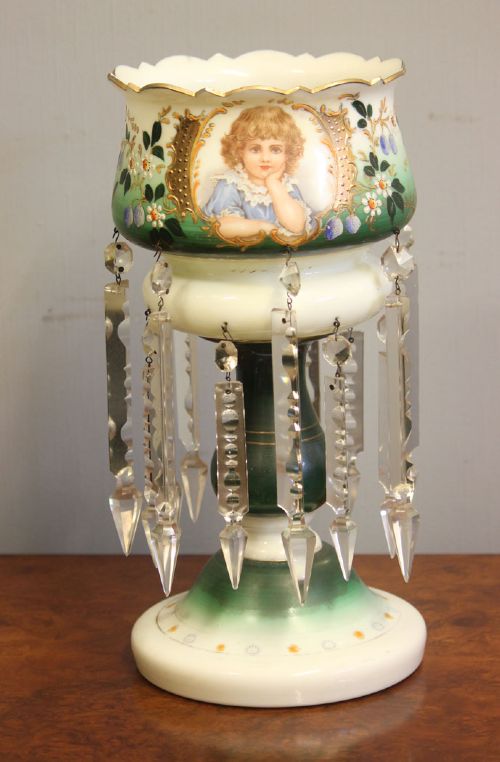
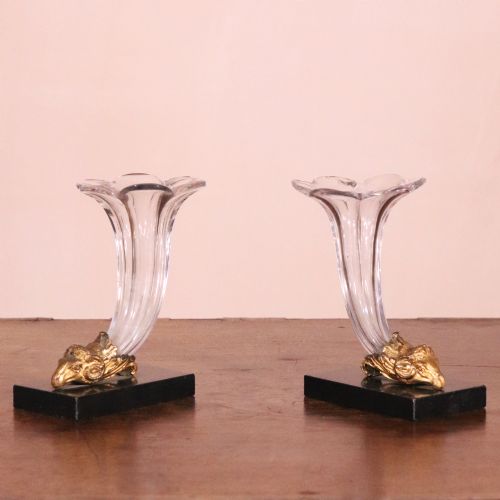
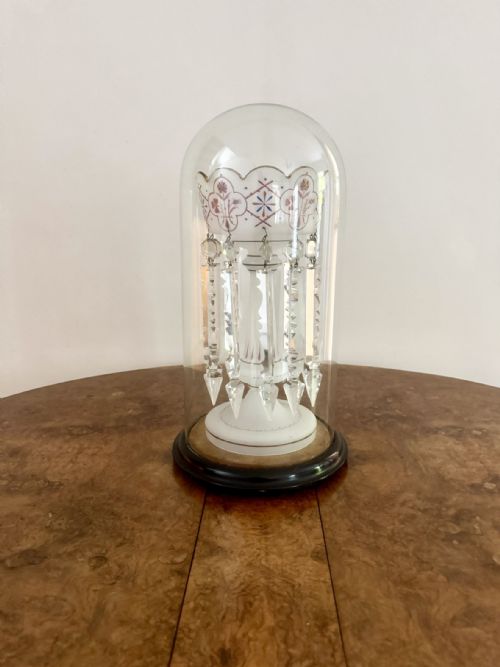
Antique glass mantel ornaments encompass table lustres, cornucopias, decorative vases, and figures sheltered under glass domes, mostly originating from the Victorian era and the nineteenth century. These objects were designed specifically to sit upon the mantelpiece, catching the flickering light of nineteenth-century rooms.
The version most commonly met on this page is the pair of mantel lustres, usually fashioned from green, ruby, or cranberry glass hung with cut glass prisms. Alongside these stand mercury glass collections, gilt bronze cornucopias, and Staffordshire figures paired with original glass domes.
Originating predominantly from Victorian workshops, these decorative objects reflect the period's fondness for saturated colours and reflective surfaces. They bridge the gap between functional glassware and ornamental sculpture, remaining remarkably intact in pairs.
What varies in quality
Quality rests significantly upon the depth and richness of the coloured glass, alongside the precision of the hand-cutting on the body and hanging prisms. Top-tier examples display heavier metal mounts, often in gilt bronze, and retain their complete matching sets of original cut glass drops.
The refinement of the enamelling and gilding dictates the upper range, where hand-painted floral motifs remain crisp and unrubbed. Lesser examples show simpler moulded forms with thinner glass walls and mismatched or replacement prisms.
Survival of ancillary elements, particularly original glass domes and fitted wooden bases, elevates the status of figures and decorative objects considerably. The crispness of the casting on bronze components and the clarity of the crystal further separate standard production from exceptional pieces.
Nineteenth-century mantel lustres doubled as primitive light-multipliers, bouncing the dull flicker of whale-oil lamps across the entire parlour.
The Antique Glass Mantel Ornaments Glossary
- Lustre
- A type of decorative vase or candlestick fitted with a ring of hanging glass prisms that catch the light. They were immensely popular during the Victorian period for mantelpiece display.
- Mercury glass
- Silvered glass produced by blowing a double-walled object and introducing a liquid silver solution between the layers before sealing the hole. This creates a highly reflective, mirror-like finish.
- Cornucopia
- A horn-shaped vessel symbolising abundance, adapted during the Regency and Victorian periods into ornamental vases made from glass and gilt bronze. They are frequently found as matched pairs.
- Cranberry glass
- Transparent pinkish-red glassware created by adding gold chloride to the molten glass batch. It appears widely in nineteenth-century mantel ornaments.
- Cut glass
- Glassware decorated by grinding and polishing facets into the surface using a wheel. This technique enhances the refractive qualities of the crystal on mantel lustres.
Antique Glass Mantel Ornaments: Frequently Asked Questions
How were glass lustres used?
Lustres served primarily as decorative garnitures for the fireplace mantel, often flanked by clocks or paired with matching vases.
While they could hold candles, their main purpose was ornamental, using cut glass drops to refract light and add rich colour to the room.
How do I date Victorian glass?
Dating relies on identifying specific stylistic traits, manufacturing techniques, and colour preferences recorded across the nineteenth century, such as cranberry and ruby glass production.
Examination of pontil marks on the base and the cut of the hanging prisms also helps determine whether a piece belongs to the Victorian period or later.
How should I clean antique glass ornaments?
Cleaning requires gentle dusting with a soft brush and lukewarm water without harsh detergents to protect delicate gilding or enamel work.
Prisms should be washed individually and dried thoroughly before being reattached to avoid stressing the fragile glass hanging loops.