



Victorian Crystal Drop Vases
Victorian crystal drop vases bring remarkable sparkle and colour to a mantelpiece, offering the classic charm of nineteenth-century glasswork.
Victorian Crystal Drop Vases
Victorian crystal drop vases, commonly found as mantel or table lustres, are decorative glass vessels hung with cut glass prisms. They date from the nineteenth century, with pieces recorded from the eighteen-sixties through to nineteen hundred.
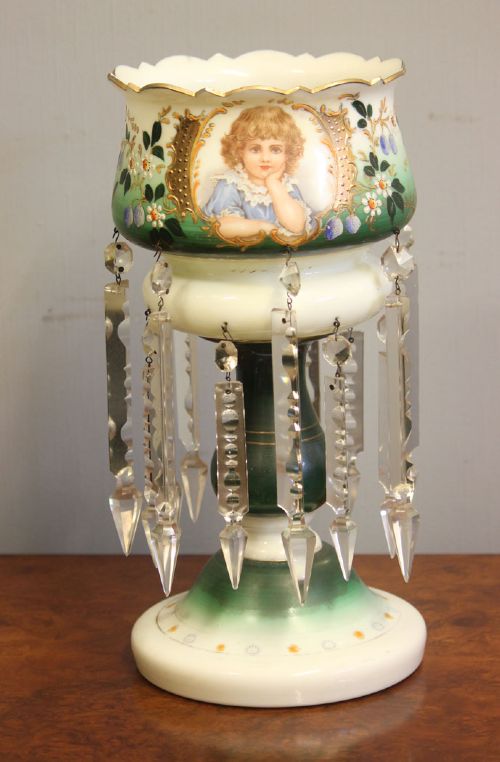
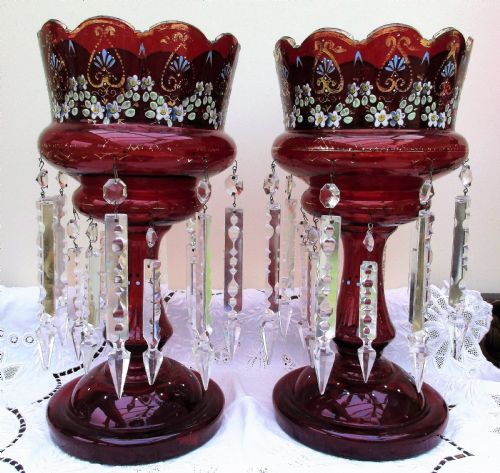
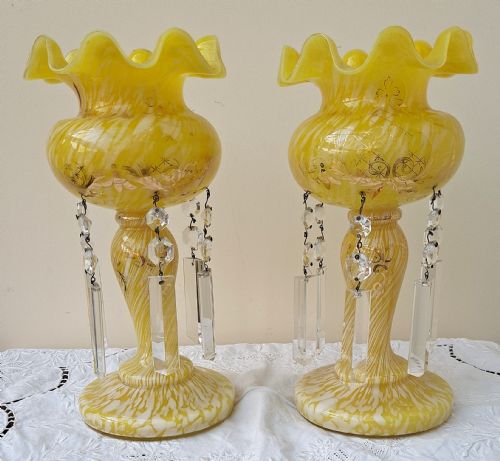
The objects appearing on this page take the form of mantel lustres, table lustres, and glass lustres, often presented as matched pairs. Buyers most frequently encounter ruby glass, cranberry glass, and green or yellow glass varieties.
These pieces function primarily as decorative garniture sets designed to catch and refract light from lamps and fires. Their defining characteristic is the array of crystal drops suspended from the rim.
How they were made
The manufacturing process relies heavily on coloured glass and crystal, utilising rich hues such as ruby, cranberry, green, and yellow. Makers formed the main body through glassblowing and shaping before applying hand-cut facets and intricate detailing.
Many examples incorporate additional decorative elements such as enamel work, gold leaf, and gilt highlights painted onto the body. Crystal drops were separately cut, polished, and suspended from the rim using metal or wire fixings.
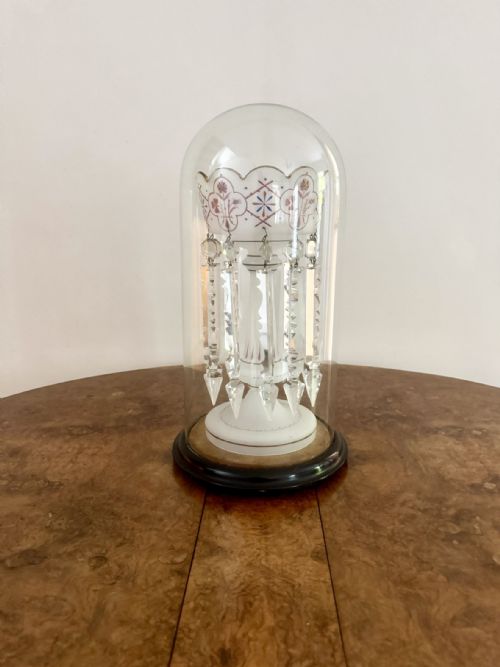
Some nineteenth-century glass lustres even come accompanied by a glass dome to keep the dust off the glittering drops.
What varies in quality
Quality in these items is determined by the depth and clarity of the coloured glass and the precision of the hand-cut facets on the crystal drops. Heavier, more substantial glass bodies and intricate enamel or gilt decoration distinguish superior examples.
The presence of a full, matching set of original crystal drops substantially elevates a piece. Minor discrepancies in the hanging prisms or wear to surface gilding shift items toward the simpler end of the range.
The Victorian Crystal Drop Vases Glossary
- Lustre
- A decorative glass vase fitted with hanging crystal prisms designed to reflect light. They were popular centrepieces on nineteenth-century mantelpieces.
- Mantel lustre
- A specific form of lustre designed to stand upon a fireplace mantel. These often appear in matched pairs.
- Ruby glass
- A deep red glass created by adding gold chloride to the molten mixture during production. It forms the basis of many nineteenth-century table lustres.
- Cranberry glass
- A transparent pinkish-red glass achieved through the use of copper or gold. It appears frequently in Victorian decorative tablewares.
- Crystal drop
- A cut glass pendant suspended from the rim of a lustre. These prisms catch and scatter ambient light.
Victorian Crystal Drop Vases: Frequently Asked Questions
What are victorian crystal drop vases?
These pieces are decorative nineteenth-century glass vessels, known period-wise as lustres, featuring hanging crystal prisms around the rim.
They were primarily produced in vibrant colours like ruby, cranberry, green, and yellow, often enhanced with enamel and gilt work.
How were they used?
Makers designed them as decorative garniture for mantelpieces and tables where candlelight or firelight would strike the hanging glass drops.
They served as status symbols in Victorian parlours, catching and refracting light to brighten dark rooms.
How do I date a lustre?
Dating relies on stylistic clues, glass colours, and manufacturing traits associated with the nineteenth century, spanning the eighteen-sixties to nineteen hundred.
Specific periods are often indicated by the richness of the ruby or cranberry flash glass and the complexity of the gilt ornamentation.
Are they sold in pairs?
Many examples on this page are listed as matched pairs designed to sit symmetrically on either side of a clock or ornament.
Single pieces also appear, offering an option for smaller spaces or mixed displays.