


Antique French Taper Holders
Antique French taper holders bring classical elegance to a room, offering small-scale illumination shaped by centuries of continental design.
Antique French Taper Holders
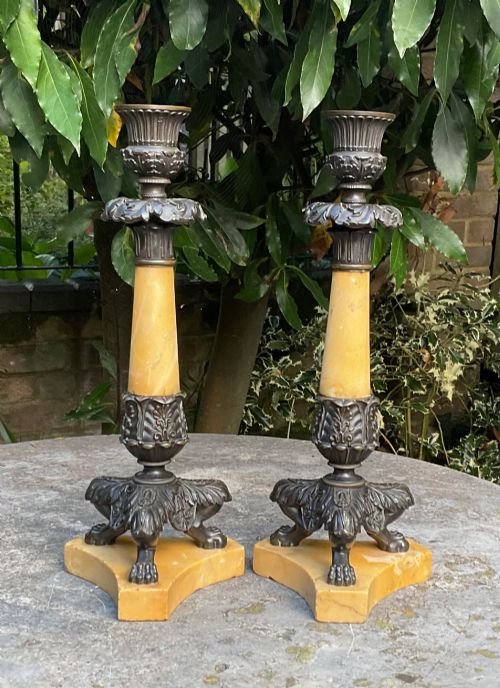
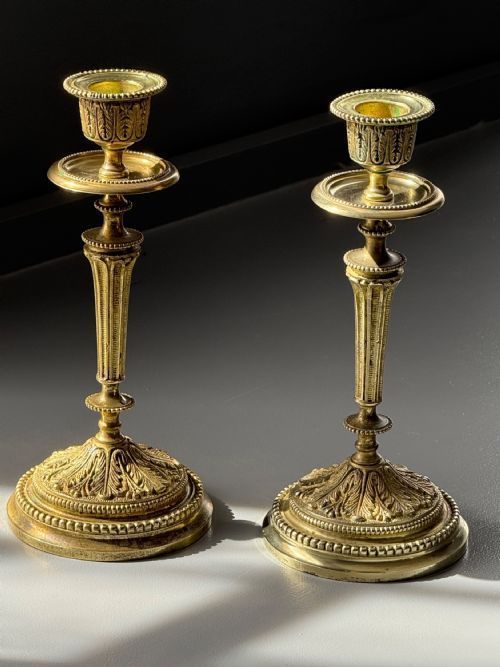
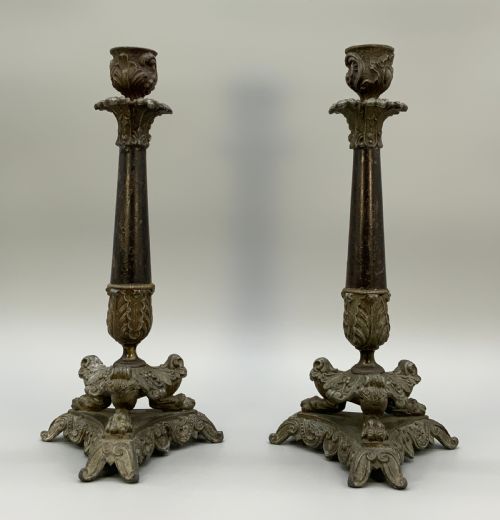
These antique French taper holders encompass small candlesticks designed for slender tapers, appearing across the nineteenth century and earlier eras in various continental styles. Most examples met here take the form of paired candlesticks created in the French Empire, Louis XVI, or Neoclassical manner.
Makers shaped these pieces in bronze, cast brass, gilt bronze, and ormolu, occasionally incorporating marble bases or glass lustre drops. The selection spans robust Regency pieces and refined French Louis XV designs, reflecting diverse domestic lighting needs of their periods.
Materials and construction
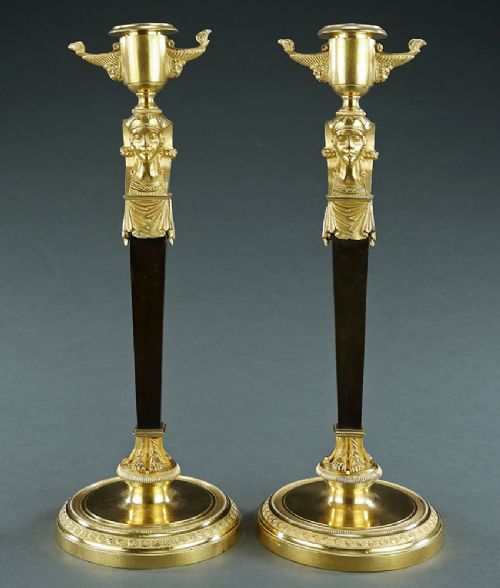
Foundry workers cast these pieces using bronze, brass, and cast metal, often applying fire gilding to create rich ormolu surfaces alongside patinated bronze details. Artisans combined these metals with turned marble bases and occasionally added glass lustre drops for heightened visual effect.
Moulds captured intricate Neoclassical and Empire motifs, from caryatid shafts to classical foliage. Hand-chiselling and finishing refined the cast elements before assembly into the final candlesticks.
Listings feature bronze, gilt bronze, ormolu, and cast brass pieces spanning the eighteenth century through the late nineteenth century.
Judging quality and execution
Superior examples display crispness in the metal chasing, where ornamentation remains sharp and well-defined rather than smoothed over by secondary casting. The depth and durability of the gilding or patination dictate the visual longevity of the piece.
The integration of varied media, such as fitted marble plinths or finely turned wooden shafts, indicates the ambition of the original workshop. Heavier castings with secure mechanical joints demonstrate superior structural integrity.
Ferdinand Barbedienne·Galle
The Antique French Taper Holders Glossary
- Ormolu
- Gilded bronze produced by applying a mercury and gold amalgam to a bronze base and heating it. This technique yielded a rich, enduring golden finish characteristic of fine French decorative arts.
- Patinated bronze
- Bronze treated with chemical solutions to darken or colour the surface. This process enhanced contrast against gilt highlights.
- Caryatid
- A sculpted female figure serving as an architectural support or candlestick shaft. It appears frequently in Empire and Grand Tour metalwork.
- Louis XVI style
- A French design period marked by straight lines, classical symmetry, and delicate ornamentation. It preceded the heavier Empire aesthetic.
Antique French Taper Holders: Frequently Asked Questions
How do I date antique French candlesticks?
Dating relies on stylistic markers, casting techniques, and material combinations associated with specific periods like Regency, Empire, or Charles X. Neoclassical motifs often point towards the late eighteenth or early nineteenth century.
Secondary clues include the quality of the ormolu, the presence of specific foundry signatures, and the construction methods used to join the base and socket.
Where were these pieces used?
Historically, these small holders served in drawing rooms, bedrooms, and studies to provide localized light for writing or moving through domestic interiors. Their modest scale made them easily portable.
Over time, they transitioned from utilitarian objects to decorative mantelpiece ornaments, prized for their sculptural qualities and rich metallic finishes.
How do I care for gilt bronze?
Gilt bronze and ormolu require gentle dusting with a soft, dry cloth to prevent the accumulation of abrasive particles. Avoid commercial cleaning solutions and chemical polishes that can strip the delicate gold surface.
Maintaining a stable indoor environment away from direct moisture protects the underlying metal and preserves the historic patination of the piece.