
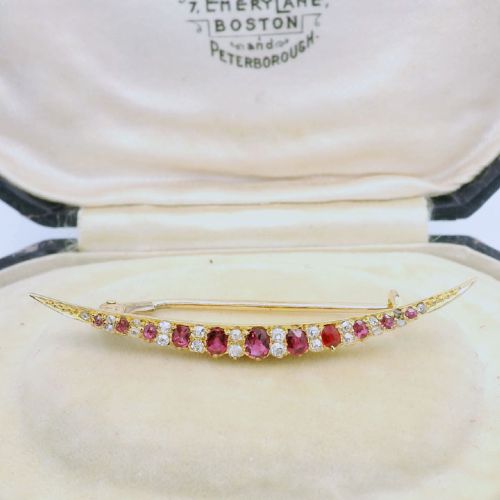
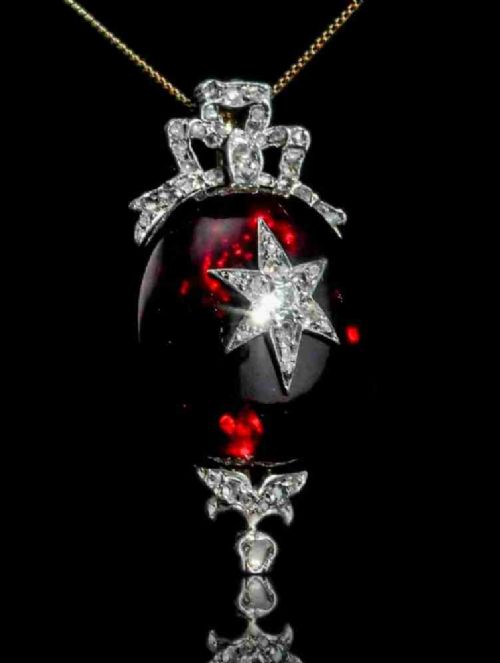


Antique Celestial Brooch
An antique celestial brooch captures the night sky in precious metal and old-cut stones, offering a timeless piece of Victorian and Edwardian craftsmanship.
Antique Celestial Brooch
An antique celestial brooch takes the form of stars, crescents, and sunbursts, capturing the Victorian and Edwardian fascination with the night sky. These pieces frequently double as pendants or convert into tiaras, showing the versatility demanded by past wearers.
You are most likely to meet crescent moons and starbursts on this page, often clustered with diamonds, rubies, sapphires, or pearls. Gold and silver-topped-gold settings dominate the selections, spanning the nineteenth and early twentieth centuries.
How they were made
Goldsmiths set old-cut diamonds and coloured gems into silver-topped gold, a technique that kept metal visibility low and made white stones catch the candlelight. Yellow gold in nine-carat, fifteen-carat, and eighteen-carat purities provided the structural warmth for crescents and star bodies.
Craftsmen utilised seed pearls and turquoise alongside rubies and sapphires to delineate lunar phases and stellar rays. Convertible fittings were soldered meticulously onto the backs to allow simultaneous wear as a brooch or pendant.
Listings feature periods from the late Victorian era through the Edwardian period, alongside materials spanning silver, platinum, pearls, and multiple gold purities.
What varies in quality
The fineness of the stone-setting and the weight of the gold define the upper tier of these jewels. Hand-cut old European diamonds with lively faceting elevate a piece far above simple paste and base metal alternatives.
Artistry shows in the naturalistic arrangement of star rays and the secure grain-setting of tiny pearls. Heavier carat gold and platinum integration indicate a commission of higher social standing.
The Antique Celestial Brooch Glossary
- Old European Cut
- A diamond cut popular during the nineteenth century characterised by a small table, high crown, and large culet. This facet arrangement gathers ambient light with a characteristic soft warmth.
- Silver-Topped Gold
- A manufacturing method where a thin layer of silver is soldered to a gold backing. This allowed jewellers to set diamonds against a white metal surface while retaining the strength of gold underneath.
- Convertible Brooch
- A piece of jewellery engineered with detachable Bails or screw-fittings. It transitions between a hair ornament, a pendant, and a breast brooch.
- Seed Pearl
- A tiny, naturally occurring pearl often drilled and threaded onto silk or wire. Victorian makers clustered them tightly to depict the soft luminescence of the moon.
- Paste
- Hand-cut lead glass used as a substitute for gemstones. Skilled artisans faceted and foiled these stones to mimic the brilliance of diamonds.
Antique Celestial Brooch: Frequently Asked Questions
How do I wear a convertible celestial brooch?
Many of these pieces feature hidden loops or screw mechanisms on the reverse that allow the pin assembly to detach. You can thread a chain through the fitting to wear the star or crescent as a pendant.
Heavier examples designed originally as tiaras often secure to frames with threaded posts. When pinning them to fabric, ensure your garment is sturdy enough to support the weight of gold and old-cut stones.
What periods do these brooches come from?
The pieces span the Victorian, Edwardian, and early twentieth-century eras, generally dating from roughly 1870 to 1920. Victorian examples frequently combine silver and gold to showcase old-cut diamonds in starburst patterns.
Edwardian and later iterations lean towards lighter nine-carat yellow gold frames set with sapphires, rubies, and pearls. Design motifs shifted subtly from naturalistic astronomical observations toward stylised Art Deco geometry.
Are the diamonds real in these brooches?
The diamond pieces utilise genuine mined stones shaped by hand before modern grading standards existed. These old-cut diamonds possess distinctive chunky facets tailored to sparkle under gaslight and candlelight.
Cheaper contemporary alternatives existed in the period, such as glass paste set into base metals. Checking the mountings usually reveals the hallmark of gold or the distinct grey patina of antique silver.
How should I care for my antique brooch?
Keep your brooch away from ultrasonic cleaners and harsh chemical dips because antique seed pearls and foiled gems are easily damaged by moisture. Wipe the metal gently with a soft dry cloth after wearing to remove skin oils.
Store the piece in a lined box away from other jewellery to prevent the sharp star rays from scratching neighbouring items. Period catches are delicate, so fasten and unfasten the pin with care.