
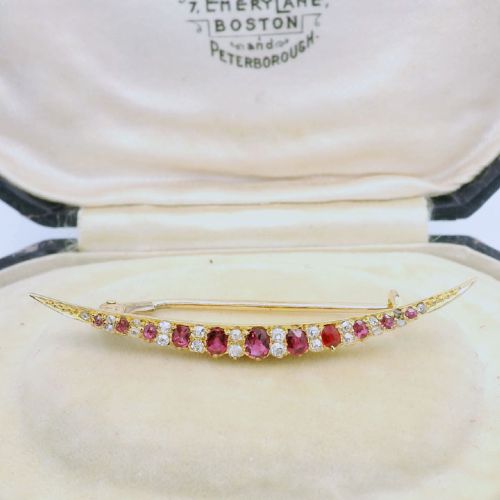


Crescent Moon Pin
These crescent moon pin pieces combine celestial form with precious stones, offering a wearable piece of history.
Crescent Moon Pin
A crescent moon pin takes the shape of a lunar curve, often adorned with gemstones and pearls. When searching for a crescent moon pin, buyers encounter brooches, stick pins, and bar brooches spanning the Victorian, Edwardian, and Art Deco periods.
The pieces on this page originate from roughly 1880 through to the 1920s, showcasing designs heavily rooted in late nineteenth and early twentieth-century jewellery traditions. Common variations include simple gem-set crescents as well as examples paired with birds or stars.
Materials and Techniques
Maker construction relies heavily on yellow gold alloys, including nine-carat, fifteen-carat, and eighteen-carat standards, alongside silver and platinum settings. Gems are flush or prong-set along the curved body to emphasise the lunar outline.
Surface ornamentation integrates natural pearls, seed pearls, diamonds, rubies, sapphires, turquoise, and paste stones. Metalwork often combines different gold colours or pairs gold mounts with silver frontages to enhance the sparkle of set diamonds.
Some crescent moons come accompanied by tiny carved swallows or forget-me-not flowers.
Factors of Quality
Quality rests upon the selection and matching of the gemstones, particularly the clarity and colour of rubies, sapphires, and diamonds. Superior items feature stones of substantial carat weight and well-matched pearls that sit uniformly along the curve.
The finesse of the underlying metalwork and the security of the pin mechanism also dictate overall standard. Finer specimens display delicate claw work or tight grain settings that securely hold each gem without obscuring the graceful crescent silhouette.
The Crescent Moon Pin Glossary
- Crescent brooch
- A curved piece of jewellery shaped like a moon and fitted with a pin fastening on the reverse. These items were widely worn on lapels and collars.
- Stick pin
- A long pin topped with an ornamental head, such as a crescent moon, designed to secure neckties or lapel folds. The shaft is typically straight and slender.
- Seed pearl
- A very small, naturally formed pearl often used in clusters or bordering central stones in antique jewellery. They provide a delicate, luminous texture to the piece.
- Bar brooch
- A brooch featuring a thin metal bar as its primary structure, sometimes mounted with a crescent moon motif. This form was popular throughout the Victorian era.
- Paste
- Hand-cut lead glass used to imitate gemstones in historical jewellery. Quality paste stones display considerable brilliance and are secured in closed or open-backed metal settings.
Crescent Moon Pin: Frequently Asked Questions
How do I wear a crescent moon pin?
These pieces function well secured to coat lapels, scarves, or heavier knitwear using the integrated pin fastening.
Heavier brooches require sturdy fabrics to prevent the pin from sagging while worn.
What periods do these pins come from?
The available selection primarily spans the Victorian, Edwardian, and early twentieth-century Art Deco eras.
Stylistic cues such as metal choices and stone cuts help distinguish between these overlapping periods.
Are the gemstones natural?
Many listings feature natural rubies, sapphires, diamonds, and pearls typical of nineteenth and early twentieth-century production.
Some pieces alternatively utilise paste stones as decorative substitutes for precious gems.
What gold purities are used?
The pieces utilise various gold standards, including nine-carat, fifteen-carat, eighteen-carat, and occasionally lower yellow gold alloys.
Silver and platinum are also utilised independently or combined with gold in the settings.