
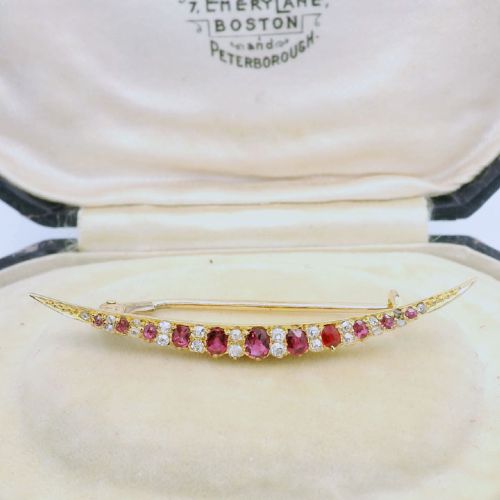


Gold Crescent Brooch
A gold crescent brooch brings together the romantic symbolism of the lunar curve and the fine gemstone work of the Victorian and Edwardian eras.
Gold Crescent Brooch
A gold crescent brooch takes the form of a stylised moon, often embellished with stones such as diamonds, rubies, sapphires, turquoises or pearls. These pieces span periods from the late nineteenth century through the Edwardian era into the early twentieth century.
The versions met most frequently on this page combine yellow gold of various carat weights with clusters of pearls or bright gemstones arranged along the curved body. Some incorporate additional motifs like swallows, stars or floral bars attached to the central moon.
Originating as popular tokens of romance and growth during the Victorian period, these jewels evolved into more delicate, gem-laden designs by the Edwardian years and the Art Deco period.
Materials and construction
Maker's workshops utilised different purities of gold, ranging from nine carat and fifteen carat up to eighteen carat yellow gold, alongside silver and platinum settings often used on the face of Edwardian pieces to enhance the whiteness of diamonds.
Gemstones including rubies, sapphires and diamonds were hand-set into the metal body, accompanied by seed pearls wired or pegged into the gold framework to trace the curved lunar shape.
The site's listings feature gold crescent brooches spanning the Victorian, Edwardian and Art Deco periods, set with diamonds, sapphires and pearls.
Distinctions in quality
The standard of a piece rests upon the weight and depth of the gold work and the selection of the stones, where matched, well-proportioned gems elevate an item above simpler factory productions.
Attention to detail in the setting technique, such as secure grain or bezel work holding the diamonds and rubies, marks out the superior examples from this period.
The Gold Crescent Brooch Glossary
- Crescent
- A jewellery motif shaped like a waxing or waning moon. It symbolised growth and female empowerment in the nineteenth century.
- Old cut
- A diamond cutting style prevalent in the Victorian and Edwardian periods featuring a small table, high crown and deep pavilion. These stones display a soft, warm candlelight sparkle.
- Seed pearl
- A very small natural or saltwater pearl, often pierced and threaded onto wire. They create delicate, shimmering lines of texture on antique jewellery.
- Bar brooch
- A pin constructed around a central horizontal metal bar. Crescent motifs were frequently mounted directly onto or suspended from these bars.
Gold Crescent Brooch: Frequently Asked Questions
How do I wear a antique gold crescent brooch?
These brooches pin securely to lapels, silk scarves, heavy knits or the gathering of a blouse. Their versatile size allows them to sit comfortably on everyday garments as well as formal wear.
Ensure the pin mechanism engages correctly with its safety catch before wearing to protect the integrity of the antique mount.
Are these brooches solid gold?
The listings feature pieces constructed from solid gold alloys, typically marked at nine, fifteen or eighteen carats. Hallmarks and metal tests indicate the specific purity used by the maker.
Unlike plated items, solid gold jewellery retains its metal composition throughout and develops a rich patina over decades of handling.
How can I tell a Victorian crescent from an Edwardian one?
Victorian examples often employ higher carat yellow gold, sometimes paired with silver settings on the face to hold rose cut diamonds. Pearls and turquoise feature heavily alongside heavier mounting work.
Edwardian pieces frequently transition towards lighter eighteen carat gold, platinum and white metal toppings with brighter old cut diamonds and natural rubies or sapphires in airier designs.
Did these pieces always function as brooches?
While predominantly designed as dress pins, some variations include hidden loops or conversions allowing them to double as pendants on chains. Stick pins also share the same lunar iconography.
Original fittings generally include a pin stem extending past the safety catch, characteristic of late nineteenth and early twentieth century fastening systems.