
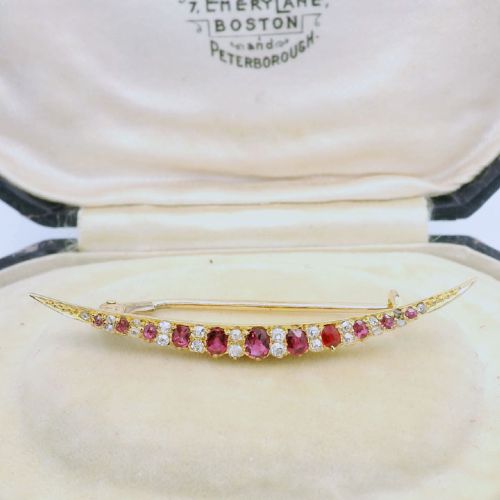


Crescent Moon Brooch
These crescent moon brooch designs combine celestial symbolism with brilliant gemstones, offering an enduring piece of antique jewellery.
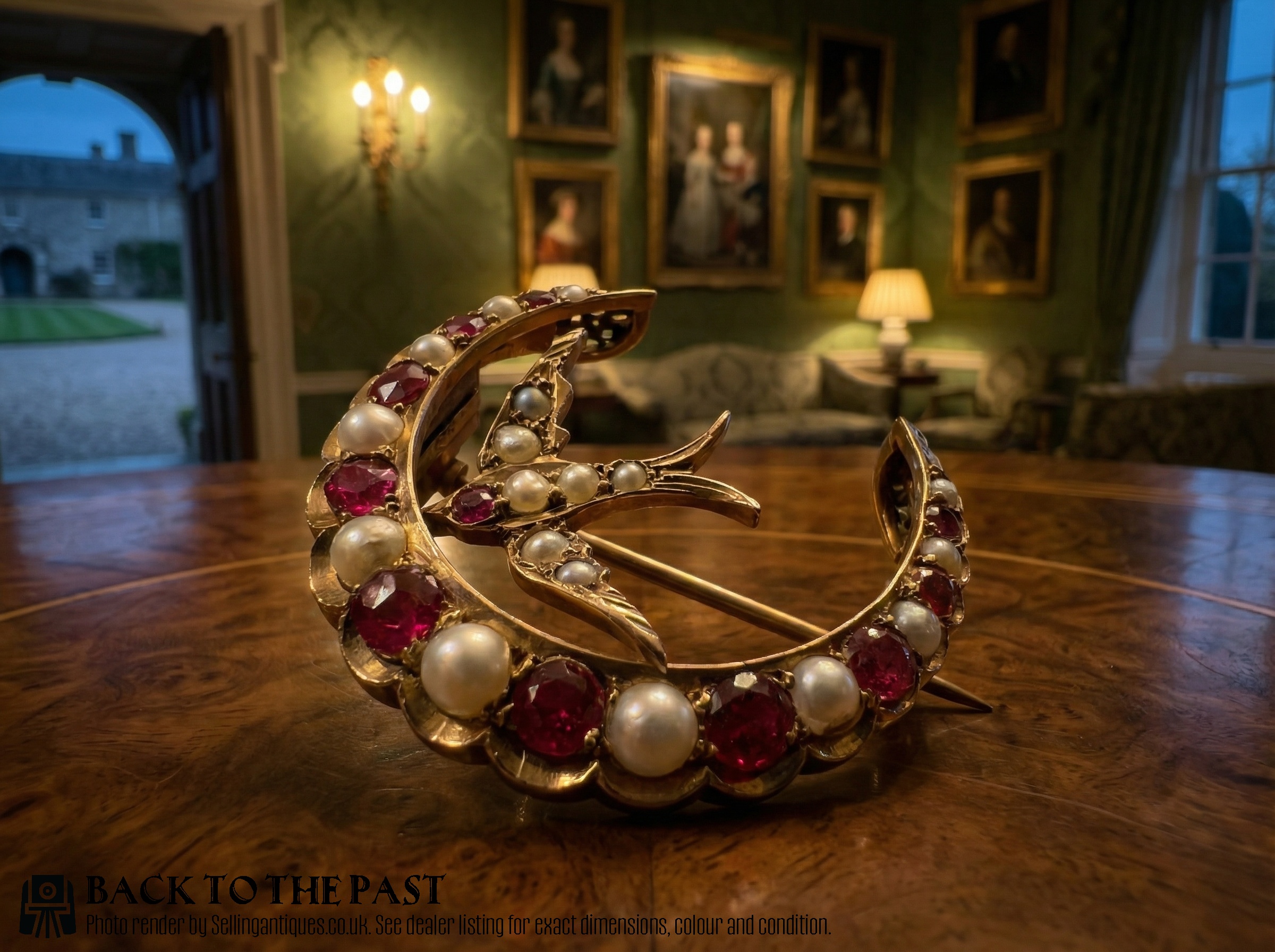
Crescent Moon Brooch
A crescent moon brooch represents a distinct genre of antique jewellery, shaped as the lunar curve and frequently populated with clusters of gems. When exploring a crescent moon brooch selection, the most common examples emerge from the Victorian and Edwardian eras, spanning from the late nineteenth century into the early twentieth century. These pieces encompass various configurations, including standalone curved bars and compositions incorporating stars or swallows.
The materials recorded across these items demonstrate a preference for warm metals paired with precious stones. Yellow gold in nine carat, fifteen carat, and eighteen carat specifications appears regularly alongside silver and platinum. Gemstone combinations unite diamonds with rubies, sapphires, pearls, turquoise, paste, moonstone, and jet.
The physical formats vary from simple pinned brooches to convertible pieces functioning also as pendants. Certain items pair the crescent motif directly with star motifs, while others feature birds such as swallows perched along the curve. The historical timeline represented in these listings stretches from the Victorian period through Edwardian designs up to the Art Deco era.
Materials and Construction
Craftsmen built these jewels using varied gold purities alongside silver and platinum, often employing two-colour metalwork to enhance the visual contrast of the settings. Stones were secured using traditional claw and collet settings, with pavé arrangements bringing multiple small diamonds or pearls close together along the curved body.
Pearls and turquoise beads were typically threaded or pegged onto foundational metal frames, while faceted rubies, sapphires, and diamonds received hand-cut facets suited to the dimensions of each individual crescent.
Crescent Moon Brooch Retail Price Guide 2026
Typical asking prices for crescent moon brooch among the pieces listed under this phrase on Sellingantiques today, from the lower quarter to the upper quarter. They describe what is for sale here now, not the wider market.
Several crescent moons share their metal space with tiny golden swallows in mid-flight.
Distinguishing Quality
The standard of workmanship depends on the precision of the stone setting and the integration of the metal elements. Superior pieces display even spacing in pavé work and secure, tidy claw settings that hold each gemstone firmly without surplus adhesive or clumsy solder marks.
The selection of materials also dictates the character of the piece, where natural rubies, sapphires, and graded diamonds elevate the work above items utilising paste or simpler components. The structural integrity of the pin mechanism and the crispness of the curved casting further separate standard examples from finer workshops.
The Crescent Moon Brooch Glossary
- Crescent brooch
- A piece of fastening jewellery shaped in the form of a waxing or waning moon. These items were widely worn during the late Victorian and Edwardian periods.
- Pavé
- A setting technique where small gemstones are set closely together with minimal visible metal, creating a continuous surface of stones. This method is frequently used on the curved body of moon jewels.
- Paste
- Hand-cut glass used as a substitute for gemstones in historic jewellery. It appears in several period pieces to achieve colourful or brilliant effects.
- Bar brooch
- A slender horizontal pin that may feature a central ornament such as a moon or star. These form a common structural format in the archive.
- Collet
- A small collar or band of metal that holds a gemstone in place by its girdle. This traditional setting style is common in antique gold work.
Crescent Moon Brooch: Frequently Asked Questions
What periods do these brooches come from?
The pieces span the Victorian and Edwardian eras, with examples extending into the early decades of the twentieth century. Specific dates indicated in the records include the 1880s, 1890s, 1900, 1910, and 1920.
These timeframes encompass both late nineteenth-century styles and early twentieth-century designs, reflecting shifting preferences in precious metals and gemstone arrangements.
What metals were used to make them?
Makers utilised various gold purities, including nine carat, fifteen carat, and eighteen carat yellow and rose gold. Silver and platinum also appear, sometimes combined with gold in double-sided or layered mountings.
The choice of metal often correlates with the period of manufacture, with lower and higher gold purities appearing alongside silver settings characteristic of Edwardian techniques.
What gemstones are found on these pieces?
Diamonds, rubies, sapphires, and pearls appear frequently across the selection. Other materials include turquoise, moonstone, jet, and glass paste.
These stones are often mixed within a single crescent, pairing diamonds with coloured gems or pearls to create contrasting visual textures along the curve.
Did these brooches feature other motifs?
Yes, many designs incorporate additional elements alongside the lunar shape. Stars and swallows are recorded joining the crescent moon on various items.
These companion symbols reflect popular decorative themes of the late nineteenth and early twentieth centuries, adding narrative detail to the jewellery.
Can these brooches be worn as pendants?
Certain items are constructed with dual functionality, allowing them to function as both brooches and pendants. The physical evidence includes pieces specifically designated as pendants or convertible items.
This versatility reflects period manufacturing practices where fasteners and loops were integrated to accommodate different forms of dress.