
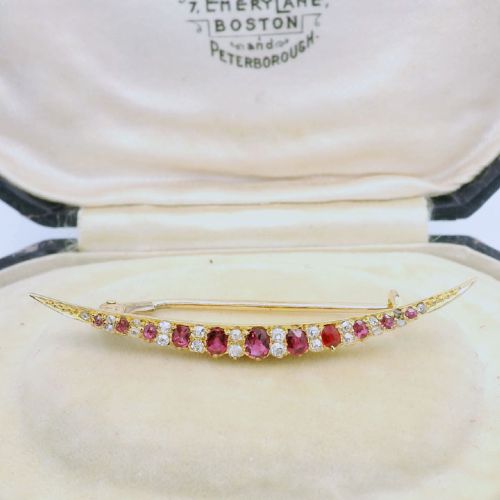


Celestial Gold Pin
A celestial gold pin captures the night sky in miniature, offering the enduring romance of diamonds and pearls set into crescent moons and starbursts.
Celestial Gold Pin
A celestial gold pin unites the astronomical motifs of the Victorian, Edwardian, and Art Deco periods into wearable jewels. When a buyer searches for a celestial gold pin, they encounter intricate brooches and pendants shaped as crescent moons and starbursts.
The pieces on this page span from the nineteenth century into the nineteen-twenties, incorporating both high-karat fifteen-carat and nine-carat yellow gold alongside silver settings. Most examples combine rich gold bases with sparkling clusters of diamonds, rubies, sapphires, turquoises, and pearls.
How they were made
Craftsmen built these pieces using traditional yellow gold, often cast or forged in nine-carat, fifteen-carat, and eighteen-carat purities. Silver was frequently employed on the face of starburst brooches to hold old European cut diamonds securely against the dark metal.
Gems were selected by hand to follow the curved sweep of a crescent moon or radiate outward from a central starburst. Pearls and turquoise beads were carefully drilled and mounted on pins, while rubies and sapphires added vibrant colour punctuation to the diamond clusters.
Victorian stargazers wore these glittering moons to prove they were truly over the moon.
What varies in quality
Quality rests upon the balance between the goldwork and the brilliance of the chosen gemstones. Pieces featuring substantial old European cut diamonds alongside rich rubies or sapphires demonstrate a higher tier of workmanship.
The refinement of the mounting also dictates the calibre of the jewel, particularly in how seamlessly the pearls and turquoise are integrated into the crescent and star designs. Finer examples maintain delicate proportions while securely anchoring every stone in place.
The Celestial Gold Pin Glossary
- Crescent brooch
- A pin fashioned into the shape of a waxing or waning moon. These forms were immensely popular during the Victorian and Edwardian eras.
- Starburst pendant brooch
- A jewel designed with rays spreading outward from a central focal point, often versatile enough to be worn on a chain or pinned to a garment.
- Old European cut
- A vintage diamond cutting style characterised by a small table, a heavy crown, and a round girdle, typical of nineteenth-century jewellery.
- Fifteen-carat gold
- A specific gold alloy standard commonly used in British jewellery before the twentieth century, containing fifteen parts pure gold out of twenty-four.
Celestial Gold Pin: Frequently Asked Questions
How do I wear a brooch?
Brooches attach securely to heavy fabrics like wool coats, scarves, and structured lapels using a pin and catch mechanism on the reverse. Placing them on collars or shoulder seams keeps the piece prominent.
Convertible pieces often feature hidden loops that allow them to transition seamlessly from a pin to a pendant worn on a gold chain.
How do I date my brooch?
Dating relies on examining the materials, gemstone cuts, and overall style visible in the construction. Victorian and Edwardian pieces often utilise distinct gold purities and specific stone arrangements like old European cuts.
Consulting hallmarks and the specific framing of the pin mechanism provides further clues to the exact decade of manufacture.
Are these pieces fragile?
Antique jewellery requires gentle handling due to age and delicate setting techniques. Pearls and turquoise demand particular care to avoid moisture and chemical contact.
Storing each pin in a dedicated box prevents friction against other items and preserves the integrity of the gold and silver mountings.
What is a crescent brooch?
A crescent brooch mimics the shape of the moon, frequently embellished with graduating diamonds, pearls, or coloured gemstones. This motif symbolised female empowerment and romance in the nineteenth century.
They appear frequently in Victorian and Edwardian collections, often paired with contrasting starburst designs.