
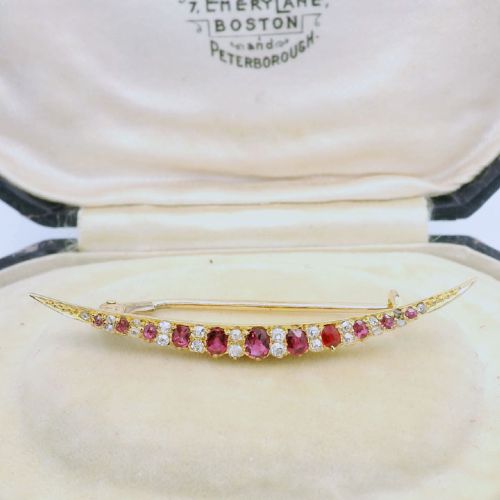


Gold Crescent Moon Pin
These gold crescent moon pin pieces combine celestial form with precious stones, offering a wearable piece of history.
Gold Crescent Moon Pin
A gold crescent moon pin takes the form of a celestial crescent, often rendered as a brooch or pin to fasten garments. These ornaments appear across periods from the Victorian era into the twentieth century, bridging late nineteenth-century styles with Edwardian and Art Deco designs.
The version most commonly met on this page combines a yellow gold crescent frame with gems such as diamonds, rubies, sapphires, turquoises, and pearls. Makers utilised various gold purities, including 8ct, 9ct, 15ct, 18ct, and 18K, shaping them into bar brooches, stick pins, and standard crescent brooches.
Many examples incorporate secondary motifs alongside the moon, such as swallows, stars, or forget-me-not flowers. Such variations reflect the sentimental and symbolic jewellery traditions popular during the Victorian and Edwardian periods.
How they were made
Goldsmiths constructed the crescent bodies using different grades of yellow and rose gold, sometimes combining metals such as platinum and silver with gold to mount stones effectively. These metals were cast, beaten, and soldered to form the curved crescent shape.
Gemstones including rubies, sapphires, diamonds, and turquoises were hand-set into the gold frames alongside pearls and seed pearls. The stones were selected to graduate in size along the curve of the moon or to alternate with pearls for contrast.
Swallows and forget-me-nots frequently join the moon, proving that even celestial bodies need feathered and floral company.
What varies in quality
Quality differences appear in the selection and weight of the gemstones, where larger carat rubies, sapphires, and diamonds elevate a piece. The regularity of stone gradation along the crescent curve also marks the standard of craftsmanship.
The choice of gold purity contributes to distinction, with higher carat thresholds like 15ct and 18ct yellow gold sitting alongside 9ct and 8ct versions. Fine detailing, such as integrated secondary motifs like swallows or star points, further separates standard examples from more elaborate works.
The Gold Crescent Moon Pin Glossary
- Crescent brooch
- A curved ornament shaped like a waxing or waning moon, designed to be pinned to clothing. This form served as a popular canvas for gem-set jewellery during the Victorian and Edwardian eras.
- Seed pearl
- A very small natural or cultured pearl, often drilled and threaded onto wire or glued into settings. These tiny pearls frequently outline the curves of crescent moon pins.
- Stick pin
- A long pin with an ornamental head used to secure cravats, scarves, or lapels. Several pieces in this category take the form of stick pins featuring crescent moons.
- Bar brooch
- A narrow horizontal metal bar that functions as a brooch, sometimes decorated centrally with a crescent moon motif. This layout allows the pin mechanism to span the full width of the bar.
Gold Crescent Moon Pin: Frequently Asked Questions
What is a gold crescent moon pin?
A gold crescent moon pin is a vintage or antique garment fastener shaped like a moon and set with precious materials.
These pieces typically date from the Victorian, Edwardian, or Art Deco periods.
How were crescent moon pins worn?
Original owners pinned these ornaments to lapels, collars, blouses, or hats as decorative accessories.
Stick pin variants were specifically utilised to secure ties, scarves, or fabric folds.
What materials are used in these pins?
The frames consist of yellow or rose gold in various purities, occasionally paired with platinum and silver.
Gemstones such as diamonds, rubies, sapphires, and turquoises are frequently combined with pearls or seed pearls.
How do I tell Victorian from Edwardian pieces?
Victorian examples often feature heavier gold work and darker stones, sometimes incorporating symbolic elements like forget-me-nots.
Edwardian pieces tend to utilise lighter platinum and diamond combinations reflecting a more delicate aesthetic.