
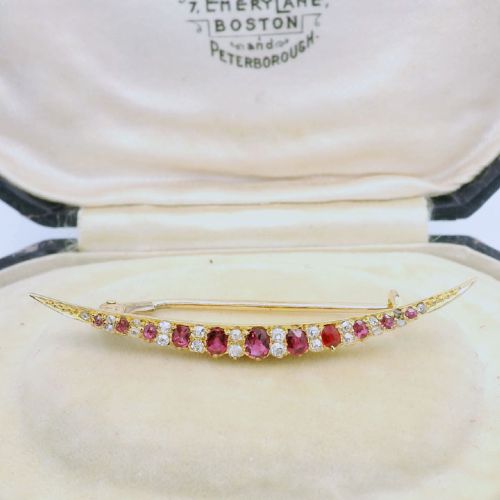


Victorian Moon Brooch
A victorian moon brooch is a crescent-shaped jewel combining celestial symbolism with gemstones, prized for its delicate silhouette.
Victorian Moon Brooch
A victorian moon brooch typically takes the form of a celestial crescent, often paired with stars or rendered simply as a curved horn set with gems. These pieces emerge from the Victorian and Edwardian periods, capturing a nineteenth-century fascination with the night sky.
The most common version met on this page is the crescent brooch fashioned from yellow gold and set with pearls, rubies, diamonds, or sapphires. Variations also include moonstones, turquoise, and paste stones, sometimes mounted as bar pins or convertible pendants.
Makers of the era utilised specific motifs like swallows or scorpions alongside the moon, blending sentimental symbolism with fine metalwork. Collectors encounter both modest nine-carat gold examples and substantial pieces featuring high-carat gold and significant rubies or diamonds.
How They Were Made
Jewellers constructed these brooches using nine-carat and fifteen-carat yellow gold, alongside silver and platinum settings for specific stones. Metals were cast, drawn into wire, or hammered to form the slender crescent frames.
Gemstones such as rubies, sapphires, and diamonds were flush-set, claw-set, or bead-set along the curve, interspersed with seed pearls or larger cabochons. Construction often involved delicate pin stems and secure c-clasps soldered to the reverse.
One particularly imaginative maker combined a crescent moon with a scorpion, proving that even celestial jewellery could occasionally crawl.
What Varies in Quality
Quality in a victorian moon brooch rests upon the choice of materials and the precision of the stone setting. Pieces utilising higher carat gold and natural, well-matched rubies, sapphires, or diamonds occupy the upper tier of craftsmanship.
Proportion and stone density distinguish finer examples from simpler work, particularly where graduation of gem size follows the curve of the crescent. The integration of secondary motifs like stars or birds further demonstrates the artisan's skill.
The Victorian Moon Brooch Glossary
- Crescent
- A shape representing the waxing or waning moon, formed by a curved arc tapering at both ends. This silhouette dominates the geometry of these celestial jewels.
- Seed pearl
- A very small, naturally formed pearl, often drung and set closely together in rows or clusters. They provide a soft, luminous texture against the gold ground.
- Cabochon
- A gemstone shaped and polished with a smooth, convex dome rather than faceted edges. Moonstones and certain sapphires appear in this cut.
- Paste
- Hand-cut and polished lead glass used to imitate gemstones in historical jewellery. High-grade paste creates convincing brilliance without using mined stones.
- Bar brooch
- A pin constructed around a central linear metal shaft, upon which decorative elements like a crescent moon are mounted. This format ensures the ornament sits flat against fabric.
Victorian Moon Brooch: Frequently Asked Questions
How were moon brooches worn?
Victorians pinned these ornaments to the collars of blouses, lapels of jackets, or secured them at the neckline of heavy dresses.
They also served to fasten scarves and cravats, functioning as both decorative adornments and practical accessories.
What metals are typically found?
Listings feature nine-carat and fifteen-carat yellow gold, alongside silver and occasional platinum accents.
Lower-carat gold and silver tend to appear in pieces combined with paste stones or moonstones, while higher-carat gold supports diamonds and rubies.
Are these pieces versatile for modern wear?
Many examples adapt readily to contemporary wardrobes, functioning as jacket lapel pins or hat ornaments.
Some designs feature integrated loops, allowing the brooch to convert into a pendant worn on a chain.
How do I distinguish Victorian from Edwardian pieces?
Victorian examples often showcase warmer yellow gold and heavier, romantic mountings associated with nineteenth-century sentimentality.
Edwardian pieces frequently incorporate platinum and lighter settings, reflecting a turn-of-the-century shift towards whiter metals and delicate diamond work.