
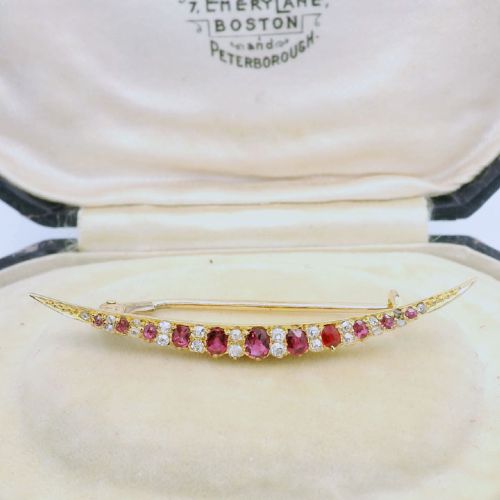


Gold Moon Pin
A gold moon pin captures the nocturnal sky in precious metal and gemstones, offering delicate Victorian and Edwardian symbolism for the lapel.
Gold Moon Pin
A gold moon pin takes the form of a celestial crescent, frequently embellished with pearls, diamonds, rubies, or sapphires. These jewels emerge primarily from the Victorian and Edwardian eras, spanning from the late nineteenth century into the 1920s.
Most examples function as brooches or stick pins, utilising yellow gold, rose gold, or higher caratages such as fifteen carat and eighteen carat. The crescent shape itself often incorporates natural motifs like swallows, forget-me-nots, or trailing star designs alongside the lunar form.
How they were made
Goldsmiths utilised yellow and rose gold in nine, fifteen, and eighteen carat weights to form the crescent foundations, occasionally combining platinum or silver settings for the diamond work. Gemstones including rubies, sapphires, turquoises, and moonstones were meticulously flush-set, claw-set, or bead-set into the precious metal.
Pearls and seed pearls were frequently hand-threaded or pegged onto gold frames to trace the lunar curve. Fabrication relied upon traditional bench techniques, joining hollow or solid gold crescent bars with secure pin stems and C-clasps or safety catches.
Certain crescent pins feature tiny diamond-eyed scorpions crawling along the gold bar, combining lunar romance with Victorian entomological fascination.
What varies in quality
The standard of a gold moon pin rests upon the purity of the gold and the pedigree of the set gemstones. Higher carat alloys and untreated sapphires or fine Thai rubies elevate an example far above standard commercial production.
Execution and secondary ornamentation define the finer pieces, where delicate motifs like birds or floral work integrate seamlessly with the crescent. The precision of stone matching, particularly with graduated seed pearls or uniform diamonds, separates ordinary production from superior workshop output.
The Gold Moon Pin Glossary
- Crescent brooch
- An ornamental pin shaped in the form of a waxing or waning moon. This profile dominated late Victorian and Edwardian celestial jewellery.
- Seed pearl
- A very small, naturally occurring or early cultured pearl, frequently drilled and used in clusters or rows. These tiny spheres trace the curved outline of lunar designs.
- Stick pin
- A long pin topped with an ornamental head, designed to secure cravats, scarves, or lapels. The decorative terminal often mirrors the crescent moon motif.
- Carat
- A unit of mass for gemstones or a measure of gold purity out of twenty-four parts. Higher carat numbers indicate a greater proportion of pure gold in the alloy.
Gold Moon Pin: Frequently Asked Questions
How do I wear a gold moon pin?
These pins attach securely to lapels, scarves, velvet collars, or heavy knitwear using traditional pin stems and catches. Placing them near the shoulder or fastening a cravat allows the crescent curve to catch the light effectively.
Ensure the fabric is sufficiently robust to support the weight of the gold and gemstones, particularly with larger sapphire or ruby pieces. Using a protective backing on the pin stem prevents snagging delicate textiles.
How do I date a gold moon pin?
Dating relies upon material composition, gemstone cuts, and fastening styles characteristic of the Victorian and Edwardian eras. Hallmarks stamped on the reverse provide definitive clues regarding the metal purity and assay office.
Earlier nineteenth-century pieces often display closed-back settings and lower-profile pin fittings, whereas Edwardian examples frequently integrate platinumtopped gold and finer diamond pavé work.
What is the difference between Victorian and Edwardian pieces?
Victorian gold moon pins tend to feature warmer yellow or rose gold tones, often incorporating colourful gemstones like turquoise, garnets, and pink tourmalines alongside pearls. The overall aesthetic leans toward romantic symbolism and heavier metalwork.
Edwardian designs shift toward lighter visual weights, frequently utilising platinum or white gold settings on yellow gold bases to maximise diamond brilliance. The styling reflects a lighter, more ethereal approach to the celestial motif.
Are these pins made of solid gold?
Most period examples are constructed from solid gold alloys, typically marked at nine, fifteen, or eighteen carats. The metal runs entirely through the structural bar and crescent frame.
Assay marks and purity stamps located on the reverse confirm the metal standard utilised by the original workshop.