
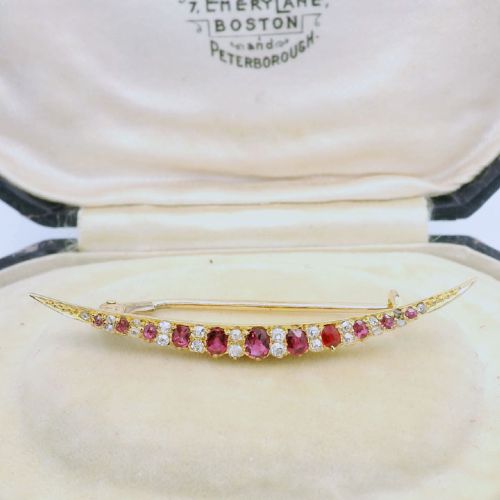


Victorian Crescent Pin
A victorian crescent pin offers the starry sparkle of late nineteenth-century jewellery, designed to catch the candlelight on a lapel or bodice.
Victorian Crescent Pin
A victorian crescent pin takes the shape of the moon, capturing the late nineteenth-century obsession with celestial motifs. Buyers searching for a victorian crescent pin will find pieces ranging from small, delicate seed pearl adornments to substantial gem-set brooches.
Most examples found here date from the Victorian and Edwardian eras, spanning the late nineteenth and early twentieth centuries. These pieces typically take the form of brooches, occasionally incorporating bar pins or convertible hair pin fittings.
The crescent form lent itself to varied interpretations, sometimes pairing the lunar shape with floral elements, swallows, or graduated stones. These ornaments were worn pinned to day dresses, evening gowns, or jackets.
How they were made
Makers set precious stones into yellow gold of varying purities, alongside silver, using rubies, diamonds, sapphires, turquoises, and pearls. The metals commonly include nine-carat and fifteen-carat yellow gold, with occasional eighteen-carat examples.
Gems were carefully graduated along the curved body of the crescent to create a sense of volume and balanced light. Seed pearls and natural pearls were wired or pegged into position, while diamonds and rubies received traditional claw or flush settings.
Listings feature 15ct gold, 9ct gold, and silver alongside rubies, diamonds, sapphires, pearls, and turquoise across Victorian and Edwardian periods.
What varies in quality
Quality rests upon the choice and matching of the stones, particularly the saturation of the rubies and the cleanliness of the diamonds. Superior pieces display stones selected specifically for their harmonious graduation along the curve.
The delicacy of the metalwork and the security of the settings distinguish finer examples from standard production. Master jewellers ensured the reverse was finished with as much care as the front.
The Victorian Crescent Pin Glossary
- Crescent brooch
- An ornamental pin shaped in the curve of a moon. This design enjoyed immense popularity throughout the late Victorian and Edwardian periods.
- Seed pearl
- A very small, naturally formed pearl, often unpeeled and delicate. These were frequently used in clusters or arranged along the curves of crescent jewellery.
- Bar brooch
- A pin constructed around a straight central bar of metal. Some crescent designs are mounted directly onto these bars for stability.
- Conversion
- A piece of jewellery altered from one function to another, such as a brooch adapted from a hair pin. Such items retain their original decorative heads while gaining a new fastening.
Victorian Crescent Pin: Frequently Asked Questions
How do I wear a crescent pin?
These pieces pin securely to the lapel of a jacket, the front of a blouse, or the fabric of a scarf. Their curved shape sits naturally against the fabric.
Ensure the safety catch or pin mechanism is secure before fastening it to heavier wools or delicate silks.
Were these pins worn every day?
In their original period, crescent pins served as versatile accessories for both daytime walks and evening gatherings. They transitioned easily from structured daywear to softer evening fabrics.
Their popularity spanned several decades, meaning women collected multiple variations for different outfits.
How do I tell Victorian from Edwardian pieces?
Victorian pieces often display heavier gold work and warmer yellow gold tones, sometimes incorporating rich clusters of rubies and diamonds. Edwardian examples tend towards lighter settings, frequently using platinum alongside gold.
Examining the pin mechanism and the style of stone setting helps narrow down the decade of manufacture.