






Antique Canterbury Whatnot
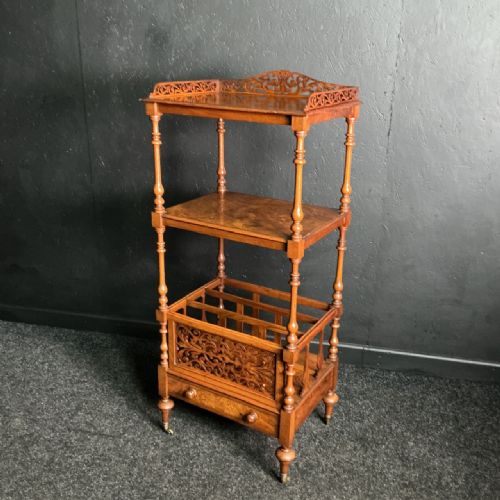
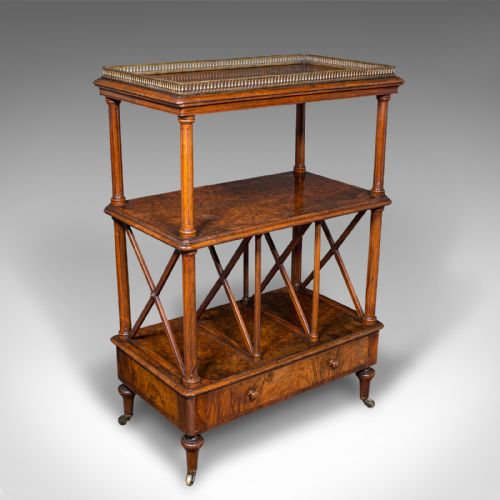
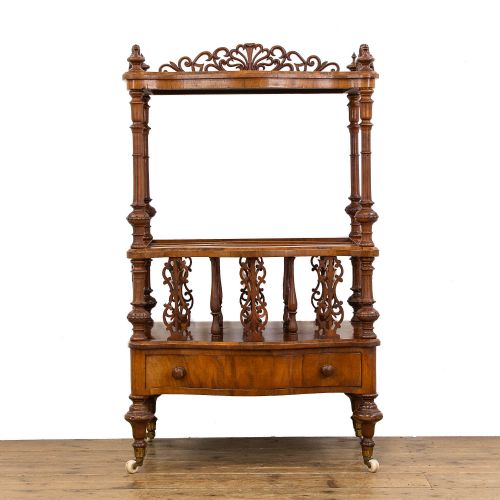
An antique canterbury whatnot combines a tiered display stand with a partitioned rack, offering practical storage for sheet music and periodicals alongside surface space.
Antique Canterbury Whatnot
When you search for an antique canterbury whatnot, you encounter multi-functional furniture designed to hold reading material while displaying ornaments on open shelves. These hybrids merge the vertical tiers of the traditional whatnot with the partitioned lower compartments of the musical canterbury.
The pieces appearing here date predominantly from the nineteenth century, spanning the Regency, George IV, and Victorian eras into the early twentieth century. Walnut, burr walnut, and rosewood dominate the surviving forms, frequently complemented by mahogany and yew.
Standard configurations include freestanding pieces fitted with lower divisions for newspapers or music folios, topped by graduated shelves supported on slender columns. Variants incorporate work tops, small drawers, or serpentine forms designed to sit neatly in a Victorian parlour.
Distinctions in quality
Quality rests in the selection of the timber veneer and the precision of the inlay work. Superior examples display carefully matched burr walnut figures across the shelves and drawer fronts, maintaining grain continuity.
Structural refinement also separates standard production from finer pieces. Better examples utilise robust turning on the supporting columns, tidy joints in the partition slats, and quality brass or ceramic hardware that remains original to the piece.
Victorian households relied on these racks to keep sheet music tidy, proving that domestic clutter management existed long before the modern magazine rack.
The Antique Canterbury Whatnot Glossary
- Canterbury
- A low stand featuring vertical partitions, originally designed for holding music folios, newspapers, or periodicals. Later iterations integrated this rack beneath the shelves of a display stand.
- Whatnot
- An open shelving unit with multiple tiers supported by slender pillars, used for displaying ornaments and decorative objects. The form evolved during the nineteenth century to include specialised storage compartments.
- Burr walnut
- A prized timber veneer obtained from the deformed growth or burl of a walnut tree, yielding intricate, swirling grain patterns. It appeared frequently on high-status Victorian furniture.
- Etagere
- A piece of furniture consisting of a set of open shelves for knick-knacks, synonymous with the term whatnot. The style originated in France before becoming popular in British parlours.
- Serpentine
- A curved outline resembling a snake's movement, seen along the front edges of shelves or tabletops. This contour added visual fluidity to nineteenth-century cabinetwork.
Antique Canterbury Whatnot: Frequently Asked Questions
What is a canterbury whatnot used for?
These pieces served multiple domestic purposes in nineteenth-century drawing rooms and parlours. The lower slatted sections held sheet music, newspapers, and periodicals, while the upper tiers displayed decorative objects.
Today, they function well in modern interiors for holding magazines beside a sofa or displaying small collections while occupying minimal floor space.
How do I date a canterbury whatnot?
Dating relies on timber choice, decorative style, and construction methods. Regency and George IV examples tend to utilise solid mahogany with restrained classical lines.
Victorian pieces frequently display figured burr walnut or rosewood veneers, intricate ebony inlay, and turned supports reflecting the changing tastes of the mid-nineteenth century.
Are these pieces freestanding?
Most surviving examples are designed to stand away from walls rather than attach to them. Their finished backs and balanced proportions allow them to occupy central positions in a room.
Castors fitted to the base allowed easy repositioning across carpets during cleaning or when rearranging the parlour for musical recitals.
What woods are most common?
Walnut and rosewood dominate the Victorian examples recorded here, often highlighted with burr figure and contrasting ebony inlay. Mahogany appears frequently across both Regency and Victorian pieces.
Early twentieth-century variations occasionally combine brass elements with mahogany for lamp standards and allied forms.