
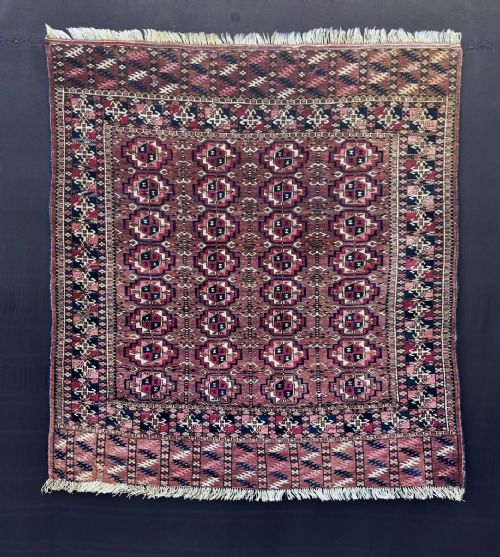


Antique Bukhara Carpet
An antique bukhara carpet brings the geometric richness of Central Asian weaving into a room.
Antique Bukhara Carpet
When you search for an antique bukhara carpet, you are looking at tribal and village floor coverings originating from Central Asia, particularly associated with Turkmen tribes and the historic Emirate of Bukhara. These textiles typically take the form of rugs, small carpets, and long runners produced across the nineteenth and early twentieth centuries.
The pieces you are most likely to meet on this page include wedding rugs, dowry rugs, and main carpets displaying repeating geometric motifs. Their origins span tribal groups such as the Tekke, Ersari, Saryk, and Yomut, reflecting distinct regional weaving traditions within the broader Turkmen style.
Makers ranged from nomadic and village weavers working within specific tribal lineages to settled artisans producing traditional formats. Each piece serves as a physical record of Central Asian textile history, utilised for domestic flooring, tent furnishings, and ceremonial purposes.
How they were made
These carpets rely heavily on wool, hand-spun wool, and cotton for their pile and structural foundations. Weavers frequently incorporated goat hair and horsehair into the foundation to increase durability and structural stability.
Natural dyes provide the characteristic colour palette seen across these textiles, interacting with the animal fibres over decades of use. The construction methods combine hand-knotting techniques with durable warps and wefts handed down through generations of tribal weavers.
Some carpets incorporated goat hair into the foundation simply because the family goat refused to be ignored on shearing day.
What varies in quality
The standard of an antique bukhara carpet depends heavily on the fineness of the knotting and the precision of the repeating gul motifs. Finer structures allow for sharper definition within the geometric patterns and a more supple handle.
The integrity of the wool pile and the foundation materials dictates longevity. Examples retaining strong, uniform hand-spun pile and stable horsehair or goat hair foundations demonstrate superior preservation compared to those with significant wear or structural repair.
The Antique Bukhara Carpet Glossary
- Gul
- A primary octagonal or polygonal medallion motif repeated across Turkmen carpets. This design element serves as the defining visual signature for specific tribes and regions.
- Main carpet
- A large-format floor covering intended for principal domestic spaces rather than smaller tent or dowry uses. These pieces often measure significantly larger than standard rugs.
- Dowry rug
- A textile created specifically for a bride's trousseau, often incorporating auspicious symbols and traditional motifs. These rugs frequently exhibit particular care in their execution.
- Foundation
- The underlying grid of warp and weft threads that supports the knotted pile. In this tradition, foundations frequently incorporate goat hair or horsehair alongside wool and cotton.
Antique Bukhara Carpet: Frequently Asked Questions
How do I identify different tribal styles?
Tribal styles are distinguished primarily by the shape and arrangement of the repeating gul motifs across the field. Different groups such as the Tekke, Ersari, and Yomut employed specific medallion geometries and border arrangements.
Examining the secondary colours and structural materials also helps assign a piece to a particular Central Asian weaving tradition or region.
Where were these carpets originally made?
These textiles originated in Central Asia, spanning regions associated with the historic Emirate of Bukhara and surrounding Turkmen tribal territories. Nomadic and village communities produced them for daily domestic life and ceremonial use.
Over time, many of these pieces entered trade routes, eventually reaching Western markets where they became known broadly under the Bukhara designation.
How should I care for an antique rug?
Care for these textiles involves gentle vacuuming without a beating brush bar to protect the hand-spun wool pile and delicate foundations. Keeping the carpet out of direct sunlight prevents the natural dyes from fading prematurely.
Professional cleaning tailored to antique tribal woolens ensures the animal fibres and natural colorants remain stable over decades of display.
What is a turreted gul?
A turreted gul is a specific variation of the traditional octagonal medallion featuring small projecting points or 'turrets' along its perimeter. This detail often points toward specific tribal origins such as the Saryk.
Recognising these subtle variations allows collectors to distinguish between closely related Central Asian weaving groups.