
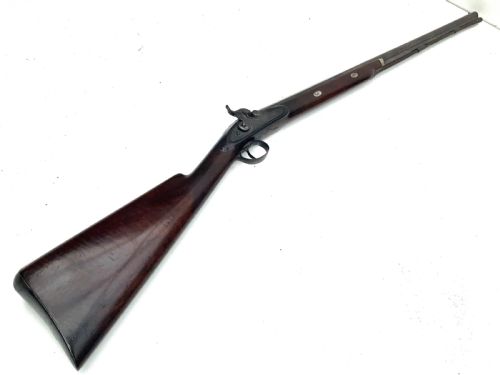


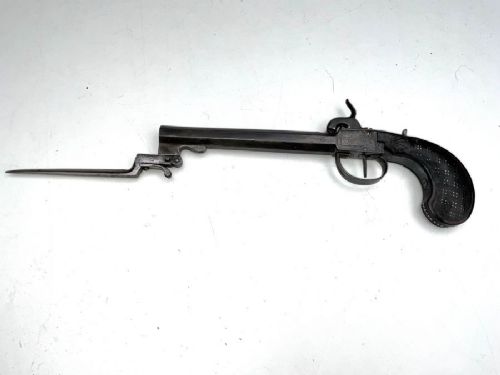


Antique Black Powder Gun
An antique black powder gun carries the mechanical ingenuity and operational history of centuries past, offering collectors a direct link to early military and civilian firearm development.

Antique Black Powder Gun
When you search for an antique black powder gun, you encounter arms spanning from the 18th century through to the Victorian era. The selection ranges from service muskets and blunderbusses to officers' percussion pistols, flintlock holster pistols, and boxed revolvers.
The pieces originating from military arsenals, private makers, and foreign empires display distinct forms developed for warfare, personal defence, and sporting use. Flintlock and percussion ignition systems dominate the selection, often accompanied by contemporary powder flasks and accessories.
How they were made
Makers constructed the barrels and locks primarily from steel and iron, frequently incorporating brass for trigger guards, butt caps, and furniture. Copper also appears in associated equipment such as powder flasks.
Stocks rely upon dense hardwoods like walnut, oak, and mahogany, shaped to house the mechanical components securely while providing a balanced grip for the user.
A powder flask dated 1838 bears the name Edward Coke, linking a utilitarian container directly to an individual's personal equipment.
What varies in quality
The distinction between tiers of manufacture rests upon the precision of the lock mechanism, the crispness of maker signatures or military inspection stamps, and the integrity of the timber stock. Master gunmakers applied refined finishing to metal parts and precise checkering to wood.
Service weapons produced in quantity for government contracts prioritise utilitarian durability, whereas bespoke civilian and officers' arms exhibit superior metallurgy, decorative engraving, and balanced proportions.
John Manton & Son·Sargant & Son·Brasher·Barber of Newark·Wilson
The Antique Black Powder Gun Glossary
- Flintlock
- An ignition mechanism utilising a piece of flint held in a cock to strike a steel frizzen, creating sparks to ignite the priming powder. This system predates the percussion cap.
- Percussion
- A later ignition method where a hammer strikes a small explosive cap placed on a nipple, transferring flame to the main charge within the barrel. This technology superseded the flintlock in the 19th century.
- Blunderbuss
- A muzzle-loading firearm with a flared barrel designed to scatter shot at close range. It saw service in coaching and maritime defence.
- Fowler
- A long-barrelled smoothbore firearm designed specifically for hunting birds and small game. These pieces often feature lighter builds than military muskets.
Antique Black Powder Gun: Frequently Asked Questions
How do I identify the period of a black powder gun?
Dating relies upon examining the lock mechanism, barrel proof marks, and overall configuration. Flintlock systems generally indicate 18th-century or Napoleonic manufacture, whereas percussion caps and revolving cylinders point toward the mid-19th century and the Victorian era.
Maker signatures, crown stamps, and military acceptance marks stamped onto the metal or wood further narrow down the exact decade of production.
What is the difference between a flintlock and a percussion pistol?
A flintlock pistol uses a piece of flint striking a steel plate to generate sparks for ignition. A percussion pistol employs an external hammer that falls upon a small priming cap.
Percussion arms arrived later in the 19th century, offering faster ignition times and greater reliability in damp weather compared to the older flintlock design.
How were these firearms used historically?
These pieces served across military campaigns, naval engagements, and civilian protection. Service muskets and revolvers equipped infantry and cavalry units, while shorter pocket pistols and blunderbusses protected individuals during travel.
Sporting rifles and fowlers were utilised by landowners and officers for hunting game during periods of peace.
What woods were used for the stocks?
Gunmakers predominantly selected walnut for its strength, shock absorption, and distinctive grain patterns. Oak and mahogany also appear across various models, particularly in military service weapons and specific regional manufactures.
Stock timber was seasoned and shaped to withstand the stresses of firing and environmental exposure.