
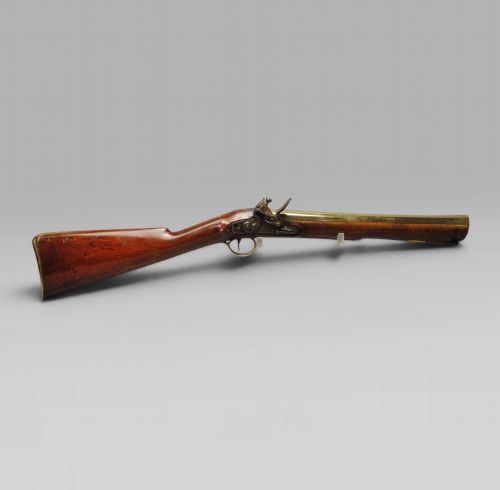
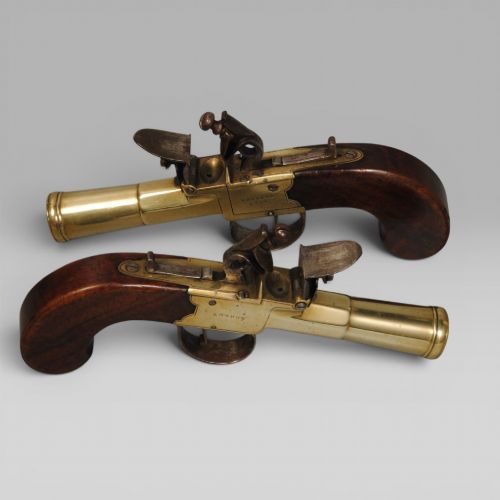


Brass Barrel Flintlock
These brass barrel flintlock pieces are tactile survivals of eighteenth and nineteenth century military and civilian defence, prized for their bright cast metal and mechanical ingenuity.
Brass Barrel Flintlock
A brass barrel flintlock search brings up historic firearms and militaria spanning the eighteenth and nineteenth centuries, including the Georgian and Napoleonic eras. The items range from compact pocket and overcoat pistols to heavy dragoon service arms and wide-mouthed blunderbusses.
Most examples encountered on this page originate from British, French, and Ottoman workshops. These pieces appear in forms designed for naval, cavalry, and private personal protection, reflecting the diverse tactical requirements of their original owners.
How They Were Made
Makers cast the characteristic barrels from brass, pairing them with stocks fashioned from dense walnut or other regional woods. Steel components formed the internal lock mechanisms, while iron and occasionally silver provided mounts and structural reinforcement.
Craftsmen utilised traditional foundry and smithing techniques, casting brass components before hand-finishing the metal and fitting the wooden stocks. Locks were hand-forged and adjusted to ensure the flint struck the frizzen correctly, creating the spark needed to ignite the powder charge.
Listings feature walnut stocks, brass barrels, and steel lock components across eighteenth and nineteenth-century forms.
What Varies in Quality
Quality rests in the crispness of maker signatures, the depth of proof marks, and the proportion of the brass casting. Finer pieces display sharp engraving on the lock plates and furniture alongside well-figured, unblemished wood stocks.
Henry Nock·Thomas Henshaw·La Motte·J. Robinson·John Rimes·Ketland and Co·I.E. Weston
The Brass Barrel Flintlock Glossary
- Flintlock
- Ignition mechanism that uses a piece of flint held in a cock to strike a steel frizzen, generating sparks into a priming pan. This system dominated firearm design from the seventeenth through the early nineteenth century.
- Blunderbuss
- Muzzle-loading firearm with a flared barrel designed to scatter shot at close range. These were widely utilised by coach guards and naval personnel.
- Turn-off
- Barrel design that unscrews from the breech to allow direct loading of powder and ball. This configuration appears frequently on pocket and coat pistols.
- Bore
- The interior diameter of the barrel. In historic arms, this is often measured by the number of lead balls of a matching diameter that weigh a pound.
Brass Barrel Flintlock: Frequently Asked Questions
How do brass and iron barrels differ?
Brass resists corrosion from salt air and powder residue better than iron, making it popular for naval and maritime use. Iron barrels appear more frequently in standard military regulation arms.
Over time, brass develops a warm, stable patina while maintaining its structural integrity against the elements.
Were these used in the military?
Many examples served regular military and naval forces, marked by government ownership stamps like the Broad Arrow or Crown over GR. Others were private purchases by officers or civilians for personal defence.
Service weapons tend to show sturdier, standardised construction without the decorative engraving found on civilian pieces.
How do I care for a brass barrel?
Keep the metal clean and dry, allowing the natural historic patina to remain undisturbed by harsh chemical polishes. Store the piece in a stable environment away from high humidity to protect the wooden stock.
Light application of microcrystalline wax can help protect both the brass and the walnut from atmospheric moisture.