



Georgian Brass Firearm
A georgian brass firearm brings tactile history to your collection through solid metalwork and timber stocks.
Georgian Brass Firearm
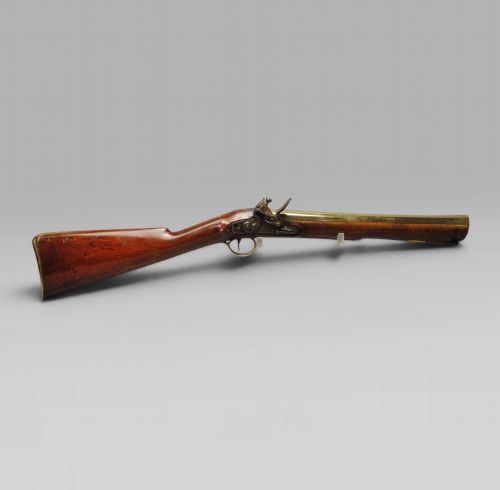
A georgian brass firearm encompasses military and civilian pieces originating from the eighteenth and nineteenth centuries, spanning eras like the Georgian and Regency periods. Buyers seeking a georgian brass firearm typically encounter blunderbusses, pocket pistols, dragoon pistols, and full-length muskets.
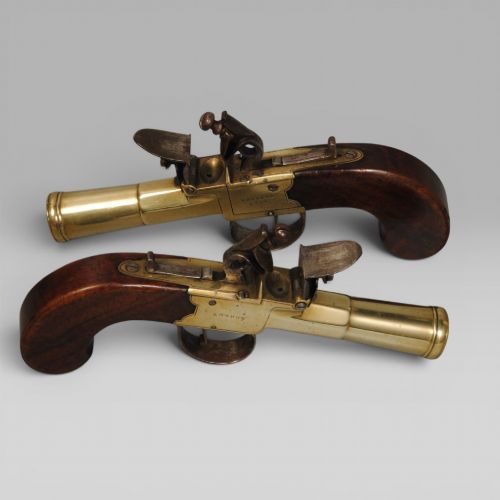
The selections on this page range from compact box-lock pocket pistols to heavy blunderbusses and service muskets. Makers and arsenals such as London firms and the Tower Armoury produced these arms for self-defence, military service, and official duties.
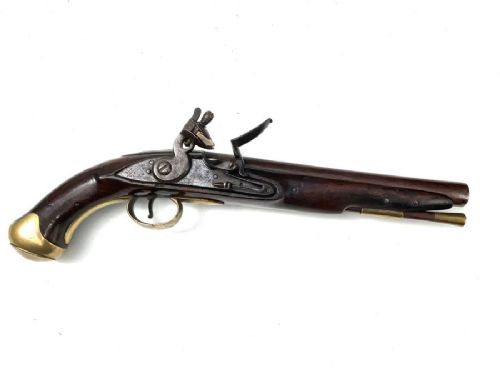
Many examples display distinct regional characteristics, reflecting the output of makers from London to Birmingham and Liverpool. Forms vary from overcoat pistols with turn-off barrels to military sidearms equipped with brass furniture.
Materials and Construction
Makers utilised cast brass for barrels and furniture, paired with iron and steel for internal lock mechanisms, springs, and bayonets. The warm metal contrasts with dense wooden stocks shaped from walnut and mahogany.
Gunsmiths formed flintlock and percussion actions by hand, integrating threaded breech sections and turn-off barrels on specialised pocket and coat pistols. Brass barrels resisted the corrosive effects of sea air and black powder residue better than plain iron.
Stocks received hand-finished shaping to accommodate the lock plates, triggers, and brass trigger guards, often complemented by iron ramrods held beneath the barrel.
Mail coach inspectors carried specialised blunderbusses to discourage highwaymen from interfering with the evening post.
Distinctions in Quality
The standard of engraving on lock plates, hammers, and brass mounts separates standard military arms from bespoke civilian duelling pistols. Signed locks by known makers add a layer of provenance and artisanal skill.
The crispness of action mechanism work and the precise fit of the wood stock against the metal furniture indicate the original cost and care put into the piece. Superior examples retain clear proof marks and sharp, unpolished brass surfaces.
Harrison Of London·Sargant And Son·Thomas Henshaw·H W Mortimer And Son·John Rimes·J Robinson
The Georgian Brass Firearm Glossary
- Flintlock
- An ignition mechanism that uses a piece of flint held in a cock to strike a steel frizzen, creating sparks to ignite the powder charge. This system dominated firearms technology throughout the eighteenth century.
- Blunderbuss
- A muzzle-loading firearm with a flared barrel designed to scatter shot at close range. These were frequently utilised by coach guards and homeowners for defence.
- Turn-off barrel
- A barrel that unscrews from the breech to allow direct loading of powder and ball from the front of the chamber. This design appears frequently on pocket and coat pistols.
- Brass furniture
- Decorative and functional metal components on a firearm, including trigger guards, butt caps, and side plates, cast in brass rather than iron. They provided durability and visual contrast against the wooden stock.
- Boxlock
- A firearm action where the lock mechanism is forged integrally with the breech or frame rather than mounted on a separate side plate. This sturdy construction became popular on pocket pistols.
Georgian Brass Firearm: Frequently Asked Questions
How did people use a blunderbuss?
A blunderbuss served as a close-quarter defensive weapon, famously carried by mail coach inspectors and homeowners. The flared muzzle allowed the shooter to scatter lead balls or slugs over a wide area.
Coach guards relied on these brass-barrelled arms to deter highwaymen during night journeys across poorly lit British turnpikes.
How do I identify a Tower pistol?
A Tower pistol bears official government inspection stamps, typically featuring a Crown over the letters GR and the word Tower marked on the lock plate. These military arms were issued to British dragoon regiments and infantry.
They combine walnut stocks with brass furniture and flintlock mechanisms produced under contract for the Board of Ordnance.
What is the difference between flintlock and percussion?
A flintlock uses a piece of flint striking steel to create a spark that ignites priming powder in an external pan. This system was standard throughout the eighteenth century.
A percussion lock, introduced later in the nineteenth century, uses a hammer striking a small copper percussion cap containing detonating powder placed on a nipple.