

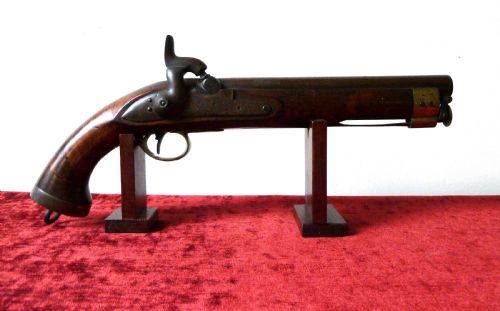


Brass Percussion Pistol
These brass percussion pistol examples are functional nineteenth-century firearms and military arms that collectors seek for their historical mechanics and period manufacture.

Brass Percussion Pistol
When you search for brass percussion pistol items, you encounter nineteenth-century military arms, officers' sidearms, and boxed revolvers originating from British, American, and Ottoman sources. These pieces include single-shot martial arms alongside multi-shot revolvers housed in fitted wooden cases complete with accessories.
The nineteenth-century variants on this page range from East India Company military issues to US martial service revolvers and refined Regency period smooth-bore arms. Most examples reflect active service or officer ownership during the Victorian era and the American Civil War period.
How they were made
The construction of these arms relies on a combination of cast brass frames, steel barrels and lock mechanisms, and shaped wooden stocks made from walnut or oak. Fitted presentation boxes often feature mahogany exteriors lined with velvet and paper compartments for accessories.
Makers utilised traditional metal casting and forging techniques alongside hand-finishing for the lockplates and trigger mechanisms. Mother-of-pearl inlays occasionally appear on Ottoman examples, demonstrating detailed regional decorative work on the stocks.
Brass Percussion Pistol Retail Price Guide 2026
Typical asking prices for brass percussion pistol among the pieces listed under this phrase on Sellingantiques today, from the lower quarter to the upper quarter. They describe what is for sale here now, not the wider market.
Listings feature nineteenth-century materials including brass, steel, walnut, velvet, oak, mahogany, paper, and wood across military and civilian forms.
What varies in quality
The distinction between standard military issue and top-tier pieces rests on the precision of the mechanical action and the finish of the metalwork. Officer-grade pistols and boxed sets with matching serial numbers display superior craftsmanship compared to standard service arms.
The grade of a piece also depends on the preservation of original wood stocks and the completeness of accompanying accessories in fitted boxes. High-quality examples retain crisp maker markings and clean internal components without excessive replacement parts.
Colt·Tower·East India Company·A.W Spires
The Brass Percussion Pistol Glossary
- Percussion lock
- An ignition system developed in the nineteenth century that uses a small percussion cap struck by the hammer to fire the powder charge. This mechanism replaced older flintlock systems across military and civilian arms.
- Smooth-bore
- A barrel lacking interior rifling, designed to fire lead balls without imparting spin. Many regulation military pistols and civilian pocket arms utilised this bore type during the early nineteenth century.
- Martial issue
- Firearms officially procured and marked for government military service rather than private purchase. These pieces often bear inspection stamps and regimental markings.
- Powder flask
- A protective container, frequently formed from copper or brass with decorative motifs like palmettes, used to carry loose gunpowder for muzzle-loading firearms. They form a standard part of nineteenth-century shooting accessories.
Brass Percussion Pistol: Frequently Asked Questions
How do I clean a brass percussion pistol?
Maintenance requires light oil on steel components to prevent oxidation and careful dry wiping of brass surfaces to preserve the natural patina. Avoid harsh chemical cleaners that strip historical finishes.
Store these firearms in dry environments away from direct sunlight, particularly when housed in velvet-lined wooden presentation boxes.
Were these pistols used in combat?
Many nineteenth-century examples saw active service with military officers, cavalry units, and troops during conflicts such as the American Civil War. Service marks and government inspection stamps often indicate official military deployment.
Other pieces served as civilian self-protection arms or officers' private purchases, reflecting the dual military and domestic role of sidearms in the period.
How do I identify the date of a percussion pistol?
Dating relies on maker stamps, serial numbers, proof marks, and specific mechanical configurations associated with known production decades. Patent dates stamped on frames or barrels provide a reliable baseline for manufacture.
Stylistic shifts in grip design and lockplate shape further help narrow the production period within the nineteenth century.
What accessories should come in a boxed set?
Complete cased sets typically include a bullet mould, powder flask, percussion cap tin, and cleaning rods fitted into designated compartments within the wooden box. Matching serial numbers across the firearm and its components indicate an original ensemble.
Missing tools are common in antique sets, though intact groupings retain higher collectible interest.