
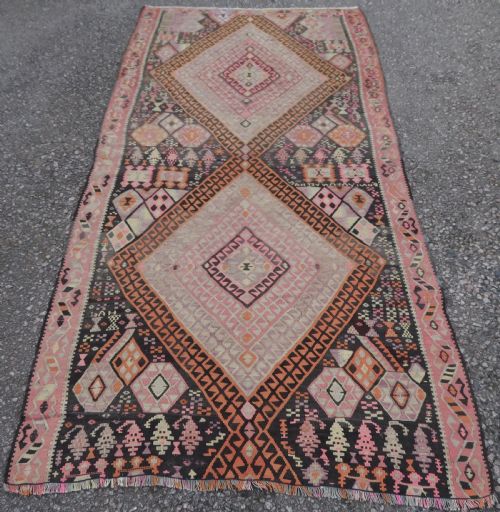


Anatolian Flatweave Runner
An anatolian flatweave runner brings long, narrow bands of traditional Turkish tribal pattern and rich wool texture into a hallway or narrow space.
Anatolian Flatweave Runner
An anatolian flatweave runner is a narrow, elongated textile piece originating from Turkey, designed primarily for corridors and extended interior spaces. These pieces encompass traditional styles such as Anatolian Tribal, Anatolian Traditional, and Tribal or Anatolian designs.
The selections available here span from the late nineteenth century into the early twentieth century, specifically covering periods around 1880, 1890, 1900, 1910, 1920, and 1930. Specific regional origins within Turkey include Malatya, Konya, Esme, Reyhanli, Mut, Kayseri, Fethiye, and Sharkoy.
Buyers frequently encounter items described as kilim rugs or runner rugs woven in distinct regional traditions. Certain examples are constructed in two parts joined together to achieve a larger format suitable for expansive flooring layouts.
What varies in quality
Quality in an anatolian flatweave runner rests in the clarity of the regional design and the vibrancy of the dye work. Examples from centres like Malatya or Konya distinguish themselves through striking visual depth and harmonious colour palettes.
Structural integrity also dictates quality, particularly in how securely two-part runners are joined and how evenly the flatweave holds its shape along the elongated runner format.
Listings feature traditional Turkish flatweaves spanning from the 1880s to the 1930s, utilising wool and cotton across regions like Malatya, Konya, and Esme.
The Anatolian Flatweave Runner Glossary
- Kilim
- A flat-woven carpet or rug produced in countries of the former Ottoman Empire, Persia, and Central Asia. These textiles lack a pile, relying instead on interlocking weft techniques.
- Warp
- The vertical threads stretched onto a loom before weaving begins. They form the foundational structure that holds the weft yarns.
- Weft
- The horizontal threads passed through the warp to create the pattern and colour of the textile. In flatweaves, these completely cover the vertical warp.
- Runner
- A long, narrow format of rug specifically proportioned for hallways, stairs, and corridors. Their dimensions emphasise length over width.
Anatolian Flatweave Runner: Frequently Asked Questions
Where should I place a runner?
These narrow textiles suit hallways, corridors, and long transitional spaces in a home where standard rectangular rugs do not fit. Their elongated format draws the eye along the length of a room.
Ensure the floor beneath is level and consider a secure underlay to keep the flatweave stable in high-traffic passageways.
How do I care for a flatweave?
Regular gentle vacuuming without a rotating brush roll helps remove dust from the tight weave without catching the threads. Professional textile cleaning suited for antique wool is recommended when deeper maintenance is required.
Keep these pieces out of harsh direct sunlight to protect the natural dyes used in traditional Turkish weaving.
What does two-part mean?
Certain large formats were woven in two separate long strips and expertly stitched together down the centre to achieve a broader runner. This traditional method allowed weavers on smaller looms to create substantial floor coverings.
The seam is an intentional part of the construction found in specific regional kilims from areas like Kayseri and Reyhanli.
How do I date these textiles?
Dating relies on recorded production periods spanning from the late nineteenth century through the early decades of the twentieth century, specifically around 1880 to 1930. Stylistic traits, regional weaving structures, and dye characteristics help place each piece.
Written records and historical attributions from specific Turkish towns provide the framework for these timelines.