
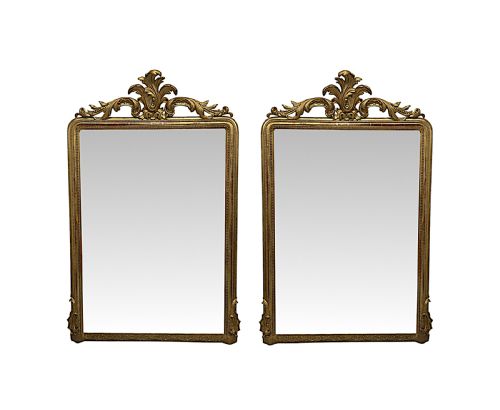
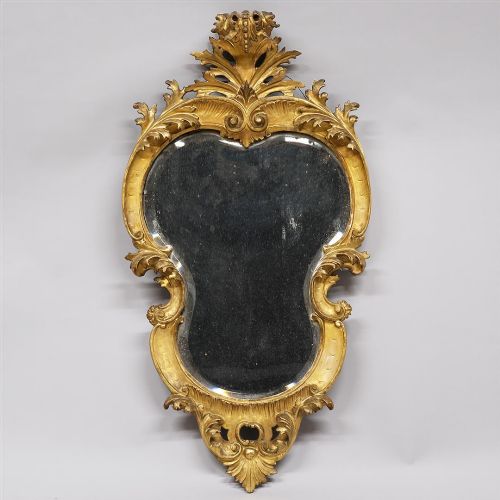
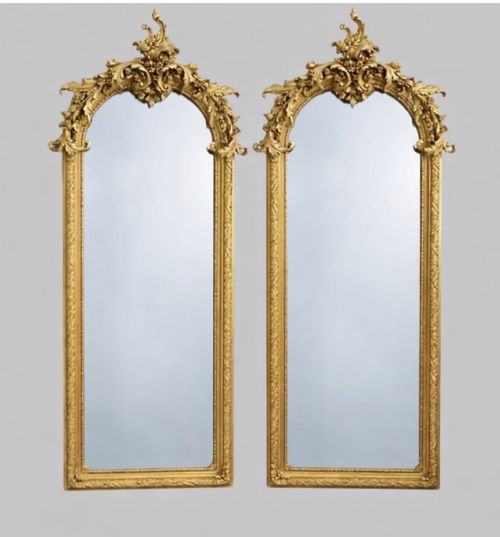
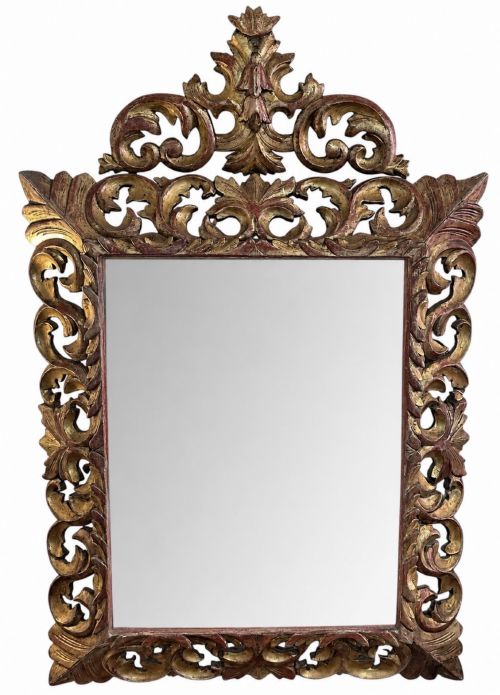


Acanthus Leaf Crest Mirror
These acanthus leaf crest mirror pieces bring carved wooden foliage and gilded surfaces into a room, offering the decorative presence collectors seek.
Acanthus Leaf Crest Mirror
An acanthus leaf crest mirror is defined by its carved foliage ornamentation surmounting the frame, taking forms from the Georgian, Regency, Victorian, and later periods. The selection on this page runs from the nineteenth century into the early twentieth century, spanning wall mirrors and overmantle mirrors.
The most frequent examples found here date to the nineteenth century, often executed in the Rococo revival style or with French and Italian Rococo influences. These pieces present substantial giltwood or gesso frames designed to dominate a wall or sit above a fireplace.
Buyers also encounter convex mirrors and cushion framed mirrors alongside grander overmantle formats. Pieces range from carved wood and ebonised details to large oval wall mirrors carrying distinct historical styles.
Materials and construction
Makers shaped these frames from carved wood, gesso, and composition materials, applying gold leaf or gilt finishes to achieve a bright surface. Carved giltwood forms the foundation of many pieces, requiring skilled joinery and manual carving for the intricate foliage crests.
Composed elements and gesso were frequently utilised alongside solid carved wood to build up intricate relief decoration around the glass plates. Artisans finished these frames with layered gilding techniques, creating the characteristic reflective sheen seen on period examples.
Listings span the Georgian, Regency, and Victorian periods, featuring glass, giltwood, gesso, and carved wood forms.
Assessing quality and craftsmanship
The distinction between ordinary and superior pieces rests on the depth and crispness of the hand carving within the acanthus crest. Superior examples display sharp undercut foliage and confident tool marks, whereas lesser items rely on heavy composition mouldings that blur finer details.
Original mercury or early silvered glass plates and intact, undisturbed gilding elevate a piece above those with modern replacements. The integrity of the underlying wooden frame and the restraint shown in the historical application of gold leaf dictate the overall character.
The Acanthus Leaf Crest Mirror Glossary
- Giltwood
- Wood that has been coated with gold leaf or metal leaf. This finish provides the bright, reflective surface characteristic of formal period frames.
- Gesso
- A plaster mix applied to wood frames to create a smooth surface for gilding or to build up low relief ornament. It allows artisans to impress or carve fine decorative details.
- Overmantle
- A large mirror designed to hang specifically on the wall above a fireplace mantel. These pieces were proportioned to fill the space beneath the ceiling and above the hearth.
- Convex mirror
- A round mirror with a curved glass surface that reflects a wide, distortion-heavy field of view. These often feature elaborate frames topped with eagles or leaf crests.
- Rococo Revival
- A nineteenth-century design movement that revived the ornate, asymmetrical scrollwork and naturalistic motifs of the eighteenth-century Rococo period.
Acanthus Leaf Crest Mirror: Frequently Asked Questions
How do I hang a heavy overmantle mirror?
These large frames require secure fixing directly into masonry or heavy wall studs using appropriate steel brackets. Weight distribution across the primary wooden framework prevents structural strain on the mitred corners.
Professional installation is recommended for oversized pieces, particularly when positioning them above a fireplace where heat and wall composition demand careful placement.
What periods do these mirrors come from?
The pieces span the Georgian, Regency, and Victorian eras, extending into the early twentieth century. Makers drew upon Italian and French Rococo styles across these different decades.
Nineteenth-century interpretations make up a significant portion of the available selection, reflecting sustained popularity for ornate gilt frames.
How should I clean a antique gilt frame?
Dust the carved surfaces gently with a dry, soft-bristled brush or feather duster to remove accumulated particles without disturbing the finish. Avoid liquid cleaners, oils, or abrasive cloths that can strip away historic gold leaf or gesso.
Water and chemical solvents will soften underlying composition material and damage the delicate gilding, so dry maintenance is essential.
How do I spot a reproduction?
Examine the construction of the frame joints, the backing boards, and the nature of the gilding under magnification. Older pieces show appropriate wear patterns, shrinkage cracks in the gesso, and hand-cut fixings rather than modern screws.
Composition ornaments on recent copies often lack the crisp undercutting found in period hand-carved acanthus crests.