


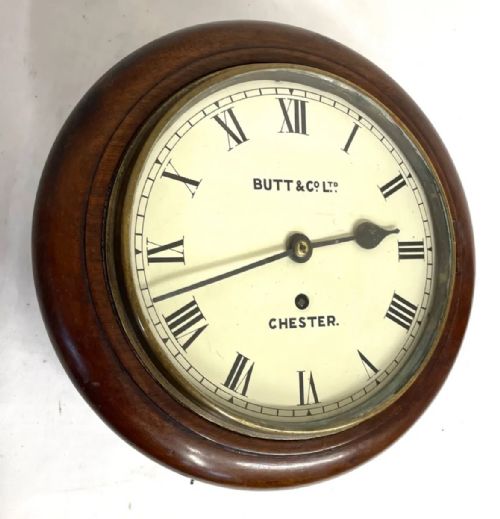


8 Inch Wall Clock
When you search for an 8 inch wall clock, you are looking at compact timepieces built for functional public and domestic spaces.
8 Inch Wall Clock
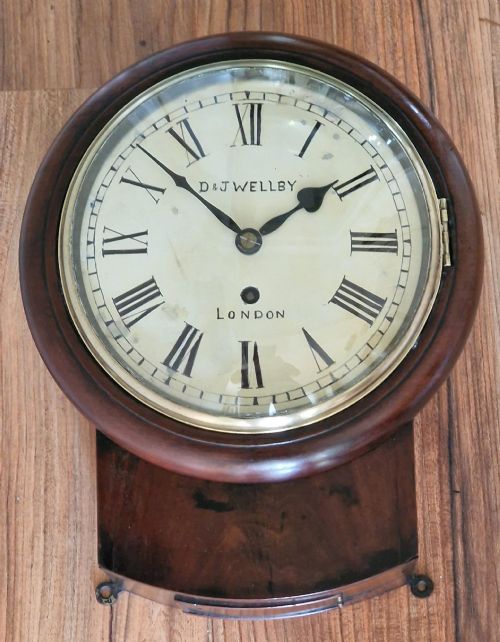
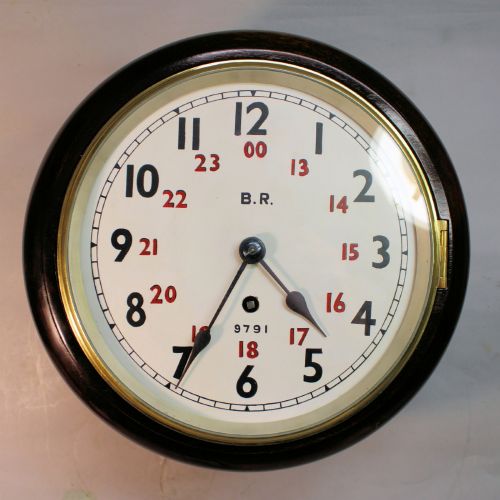
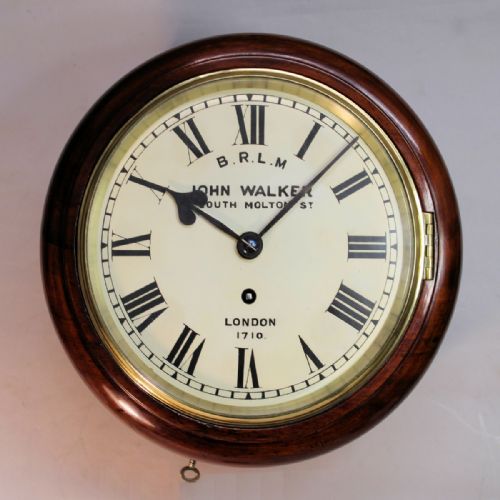
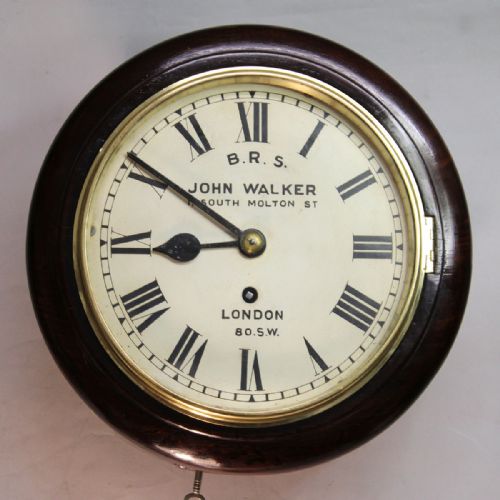
An 8 inch wall clock is a compact circular timepiece designed to be mounted securely in railway stations, offices, and domestic rooms where reliable timekeeping mattered. These pieces emerge primarily from the Victorian and later periods, carrying the solid proportions of their original working environments.
The version you are most likely to meet on this page is housed in a mahogany or oak case, often featuring a fusee movement designed for steady accuracy. Smaller examples frequently turn up with drop-dial or round drumhead configurations suited to tighter wall spaces.
Many of these instruments carry the names of notable makers on the dial face, linking domestic interiors directly to postal and railway networks of the nineteenth century.
How They Were Made
Cases were turned and joined from dense hardwoods such as mahogany and oak, protecting the precision mechanics housed inside from dust and dampness. Brass details and cast iron components formed the structural mounts and bezels that framed the glass dial covers.
Movements relied on fusee gear setups paired with enamel or painted iron dials, using black painted numerals for clear legibility from a distance.
Listings feature mahogany, oak, and brass materials paired with Victorian and twentieth century periods.
What Varies in Quality
Quality rests in the crispness of the timber joinery and the original integrity of the dial face without extensive repainting. Sharp secondary markings and well-preserved maker inscriptions on the dial separate standard utility pieces from finer examples.
The mechanical refinement of the fusee movement itself defines the higher tier, showing clean wheel-cutting and minimal wear to the pivot holes.
Richard Jones of Hereford·D and J Wellby·Joseph Bird of Stroud·John Walker·John Wilson·F W Elliott·Butt Co Ltd
The 8 Inch Wall Clock Glossary
- Fusee
- A conical pulley used in clock movements to maintain even driving force as the mainspring unwinds. This mechanism is crucial for the precise timekeeping found in quality dial clocks.
- Drop-dial
- A clock case featuring an extended lower section below the main dial, often designed to house a longer pendulum. This form is frequently seen in railway and office wall clocks.
- Convex dial
- A clock face that curves outward toward the viewer rather than sitting completely flat behind the glass. This shape reduced glare from gas or window lighting in public rooms.
- Drumhead
- A circular case design resembling the profile of a drum, enclosing the movement tightly behind the dial face. Such pieces offer a neat, self-contained silhouette on the wall.
- Chisel bottom
- A lower case profile ending in a sharp, tapered point rather than a curved box or rounded base. This geometric finish is typical of specific regional drop-dial variants.
8 Inch Wall Clock: Frequently Asked Questions
How do I wind an 8 inch wall clock?
Use the appropriate winding key to turn the arbour located on the dial face until light resistance indicates the spring is fully tensioned.
Take care not to overwind the movement, as steady, moderate turns preserve the original teeth on the brass arbours.
Where were these clocks originally used?
These compact timepieces were placed in railway stations, post offices, schools, and domestic hallways where reliable public timekeeping was essential.
Their size allowed them to fit neatly into restricted wall areas without dominating the room.
How can I tell a Victorian clock from a later one?
Victorian examples frequently utilise fusee movements housed in heavy mahogany or oak cases with hand-painted iron dials.
Later pieces from the twentieth century often incorporate alternative materials or different mounting systems as standard production methods shifted.
Do these clocks require professional setup?
Hanging the clock securely from a solid wall fixing is necessary to ensure the pendulum swings freely and evenly.
Adjusting the beat may require minor repositioning of the case until the ticking sound settles into a regular, balanced rhythm.