
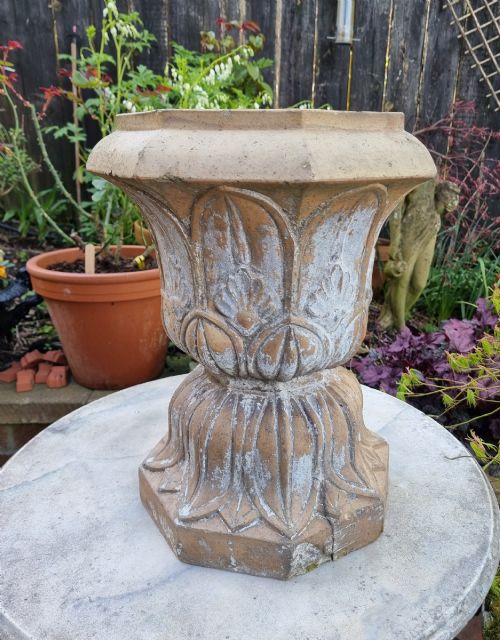
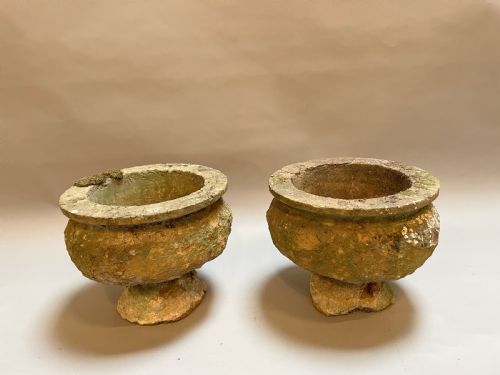


19th Century Stone Planters
These 19th century stone planters bring gravitas and enduring architecture to a garden, offering the weight and honest weathering that modern replicas lack.
19th Century Stone Planters
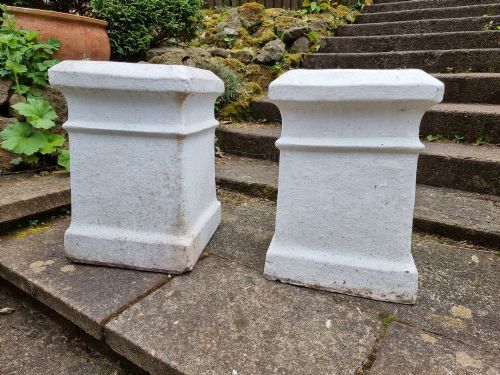
When you search for 19th century stone planters, you encounter a robust variety of vessels designed for the garden, spanning urns, tazzas, troughs, and sturdy pedestals. The selection ranges from classical Italian marble and Scottish terracotta to rustic limestone and composite stone, shaped by neoclassical, Gothic revival, and vernacular tastes of the era. You meet pairs as frequently as single pieces, often elevated on matching plinths or chimney pot bases.
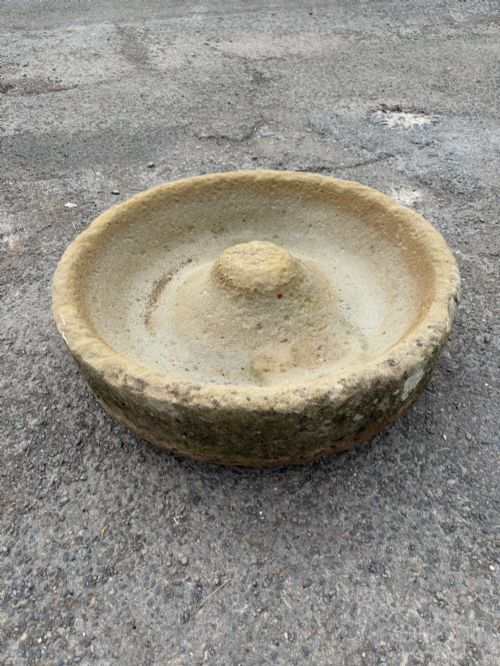
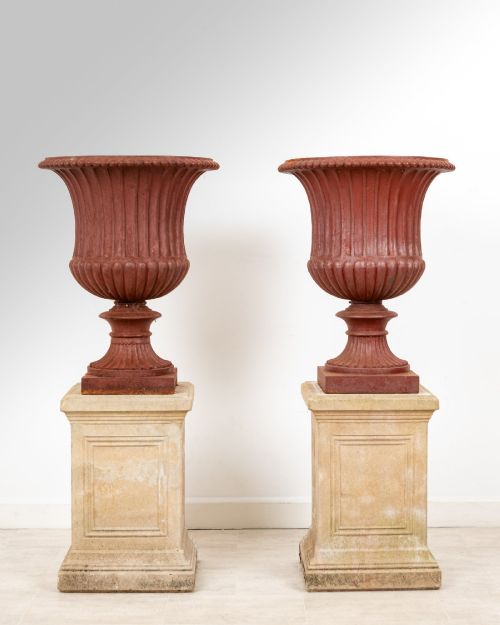
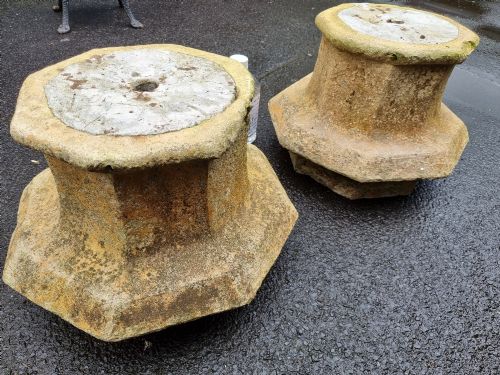
The forms draw heavily on classical antiquity, particularly the campana shape, alongside low stone pots, carved urns with detailed handles, and practical mill stone bases or grindstones adapted for outdoor use. Victorian and earlier nineteenth-century examples dominate, showing the period's taste for heavy, monumental garden ornaments. Buyers frequently select these vessels to anchor formal lawn layouts or provide a strong focal point in a courtyard.
How they were made
Masons and artisans shaped these pieces by hand-carving natural materials like limestone, soft stone, alabaster, Purbeck stone, and white marble, using chisels and mallets to achieve crisp classical details. Cast iron and composite stone introduced moulded precision, allowing workshops to replicate intricate neoclassical foliage and Gothic motifs consistently across pairs of urns and plinths. Terracotta pieces were thrown or pressed into moulds before firing, yielding porous garden vessels that naturally breathe and absorb moisture over decades outdoors.
Surface finishing involved manual tool work and painting, leaving distinct chisel marks, tooth-chisel lines, and tool textures across the stone. Garden urns and pedestals relied on the intrinsic density of granite, limestone, and marble to withstand frost and exposure, while paint was occasionally applied to protect or decorate the exterior. Over time, exposure to the elements caused natural patination, encrusting surfaces with moss, lichen, and mineral staining.
What varies in quality
Quality rests primarily on the depth and sharpness of the hand-carving, distinguishing a spirited artisan piece from a generic moulded output. Crisp detailing on handles, carved heads, and classical swags indicates superior craftsmanship and superior raw material selection. The integrity of the stone itself dictates longevity, with dense limestones and solid marbles holding fine edges far better than softer stones prone to deep weathering.
Proportion and architectural balance set the finest pedestals and urns apart from utilitarian garden items. A well-proportioned pair with harmonious matching plinths commands greater visual authority in a landscape than mismatched or clumsily cast equivalents. The character of the natural patina also plays a role, where honest, undisturbed age enhances the sculptural presence of the vessel.
The 19th Century Stone Planters Glossary
- Campana urn
- A bell-shaped garden vessel with an everted rim and a pedestal foot, originating in ancient Roman pottery and revived extensively during the nineteenth century. These urns are frequently mounted on stone plinths.
- Composite stone
- A durable man-made material manufactured by binding aggregate stone particles with a cementitious matrix, popular in the nineteenth century for replicating hand-carved garden ornaments and plinths accurately.
- Tazza
- A shallow cup or bowl-shaped vessel raised on a high foot and stem, often carved from Italian marble and utilised as a classical garden planter.
- Purbeck stone
- A fossiliferous limestone quarried in Dorset, prized for its density and distinct shell inclusions, frequently utilised for durability in British architectural and garden masonry.
- Mill stone base
- A heavy circular stone block, originally utilised for grinding grain, repurposed in gardens as a sturdy foundational base or low planter.
19th Century Stone Planters: Frequently Asked Questions
Can these stone planters stay outside all winter?
Most natural stone and composite stone vessels handle frost well due to their dense material structure, provided they have adequate drainage holes to prevent water expansion inside the bowl.
Terracotta and softer stone varieties require closer attention during freezing weather, as trapped moisture can cause spalling if left sitting directly on frozen ground.
How do I clean moss and lichen off a stone urn?
Light brushing with a soft bristle brush and plain water preserves the historic surface and the desirable weathered patina built up over generations outdoors.
Harsh chemical cleaners, acid washes, and high-pressure jet washing strip away the historic skin of the stone and should be strictly avoided.
How do I securely mount a heavy stone urn onto a plinth?
Positioning relies primarily on gravity and precise levelling, given the substantial dead weight of nineteenth-century stone, marble, and cast iron.
For added stability in exposed gardens, a thin layer of lime mortar or non-permanent bedding material secures the join without damaging the historic surfaces.
How can I tell natural stone apart from composite stone?
Natural stone exhibits random geological variations, fossil inclusions, and tool marks left by the mason's chisel during hand-carving.
Composite stone often reveals a uniform granular matrix under close inspection and may show mould seams from the casting process.