


19th Century German Vases
These 19th century german vases bring grand European ceramic traditions to a room, offering rich hand-painted detail and classical forms.
19th Century German Vases
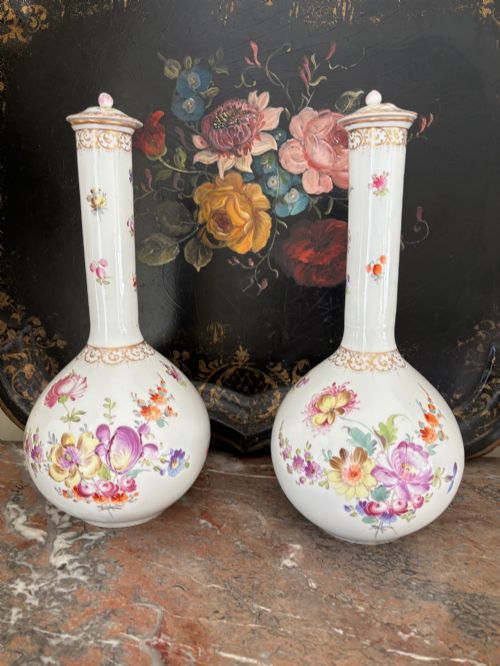
When you search for 19th century german vases, you encounter a diverse array of decorative vessels spanning porcelain, stoneware, and glass. The selection ranges from imposing lidded urns and ginger jars to delicate potpourri vases and matched pairs.
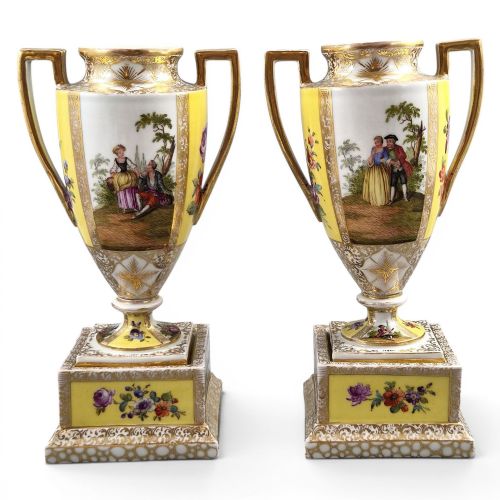
You are most likely to meet pieces produced by renowned factories such as Meissen, Sitzendorf, and Dresden during the later decades of the century. These items frequently display historical revival styles, including Rococo Revival, Neoclassical Revival, and German Historismus.
The forms often incorporate functional elements like handles and covers, alongside decorative adaptations such as pierced porcelain bodies or converted table lamps. Collectors find these pieces valued for their distinct regional manufacturing marks and intricate painted surfaces.
How they were made
Potters and ceramists utilised hard-paste porcelain and dense stoneware as the primary bodies for these vessels, shaped through moulding and throwing. Stoneware pieces often benefited from specialised glazes, while porcelain bodies provided a smooth, white canvas for subsequent decoration.
Artisans applied polychrome enamel paints and gold leaf highlights by hand, often depicting floral motifs or Watteau scenes. Firing in high-temperature kilns fused these mineral colours and gilding into the glaze, ensuring lasting brilliance.
Listings feature hard-paste porcelain, stoneware, and glass vessels spanning from the early nineteenth century through to nineteen hundred.
What varies in quality
The precision and detail of the hand-painted decoration set individual pieces apart, with finer works showing delicate brushwork and nuanced shading in floral and figural scenes. Standard production pieces might rely on simpler repeated motifs or transfer prints under the glaze.
The weight and finish of the porcelain or stoneware body, together with the richness of the gilding and gold leaf application, indicate the standing of the manufactory. Well-preserved factory marks and crisp moulding on relief details also elevate a piece.
Sitzendorf·Helena Wolfsohn·Meissen·Mettlach Pottery·Berlin·Augustas Rex·KPM
The 19th Century German Vases Glossary
- Hard-Paste Porcelain
- A durable ceramic composition fired at very high temperatures, made from kaolin and petuntse. This material provides the bright white, vitrified body typical of fine European decorative wares.
- Historismus
- A nineteenth-century cultural and artistic movement focused on the revival of historical styles. Makers drew inspiration from Gothic, Renaissance, and Baroque precedents.
- Bisque Porcelain
- Unglazed porcelain fired once to produce a matte, porous surface resembling white marble. It is frequently utilised for sculptural figures and fine decorative details.
- Ginger Jar
- A decorative lidded vessel featuring a broad shoulders and a tapering base, originally designed for storing spices. Nineteenth-century European makers adapted this shape for ornamental display.
- Potpourri Vase
- A lidded vessel with a pierced or perforated body designed to diffuse scent from dried flower petals. These pieces often feature elaborate Rococo scrollwork and painted panels.
19th Century German Vases: Frequently Asked Questions
How do I identify a Dresden vase?
Dresden pieces frequently exhibit colourful hand-painted floral motifs, Watteau scenes, and rich gilding on hard-paste porcelain bodies. Many carry specific factory ciphers or blue monogram marks associated with decorators in the region.
It helps to examine the quality of the enamel work and the style of the handles, which often draw on Rococo Revival designs popular during the late nineteenth century.
Were these vases used for flowers?
While some vessels served a practical purpose for holding floral arrangements, many larger lidded urns, ginger jars, and potpourri pieces were created strictly as decorative display items for formal interiors.
Pieces with pierced covers or delicate bisque figures were intended to be admired for their craftsmanship rather than subjected to daily handling and water.
What is German Historismus style?
Historismus refers to the nineteenth-century artistic movement where makers drew direct inspiration from earlier historical periods, particularly the Renaissance and Baroque eras. In ceramics, this translated to grand, architectural urns and ornate ornamentation.
Such pieces combine classical proportions with heavy surface decoration, reflecting the nineteenth-century fascination with past European design traditions.
How should I clean porcelain with gold leaf?
Dust these decorative pieces gently with a soft, dry brush to prevent accumulation in recessed areas and around pierced sections. Avoid liquid cleaners and chemical solvents, which can damage delicate enamel paints and wear away the gold leaf.
If deeper cleaning is necessary, consult a professional restorer to ensure the historical glaze and hand-painted surfaces remain protected.