
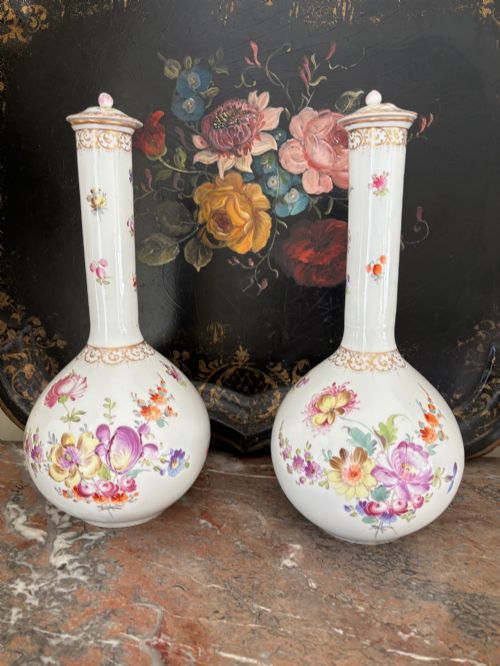
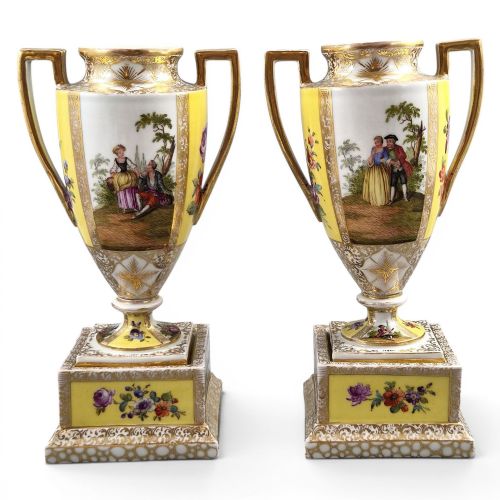


Antique German Ceramic Urns
Antique german ceramic urns bring continental presence to a room, combining painted scenes with neoclassical revival and rococo forms.
Antique German Ceramic Urns
When you search for antique german ceramic urns, you encounter substantial lidded vessels, ginger jars, and jardinieres originating from the nineteenth century. The examples on this page span the 1880s, 1890s, and 1900, reflecting the output of renowned factories and potteries.
You are most likely to meet pairs of lidded vases and urns featuring bulbous forms, hand-painted floral decoration, and Watteau scenes. Styles range from rococo revival and victorian to neoclassical revival and art nouveau.
Originating from production centres like Meissen, Dresden, Sitzendorf, Berlin, and Mettlach, these pieces serve as decorative focal points. They demonstrate the diverse ceramic traditions of Germany during a period of high artistic ambition.
What varies in quality
The standard of painting on antique german ceramic urns separates standard production from superior examples. Finely executed Watteau scenes and delicate floral motifs demonstrate the skill of the studio painter.
The crispness of moulding in the underlying porcelain or stoneware also determines quality. Strong relief work in rococo revival and neoclassical revival pieces preserves sharp detail through the firing process, whereas lesser pieces lose definition.
Some nineteenth-century decorators painted pastoral scenes so small you need a magnifying glass to appreciate the stray sheep.
Sitzendorf·Helena Wolfsohn Dresden·Meissen·Mettlach Pottery·Berlin·Royal Bonn·KPM
The Antique German Ceramic Urns Glossary
- Hard-Paste Porcelain
- A dense, vitrified ceramic material composed of kaolin and petuntse. It fires at high temperatures to produce a durable, bright white body.
- Salt Glaze
- A finish created by throwing common salt into the kiln during high-temperature firing. This produces a textured, pitted surface resembling orange peel.
- Gilding
- The application of gold leaf or gold powder to ceramic surfaces. It accentuates rims, handles, and sculptural details.
- Enamel
- Opaque glass applied to pottery and fired for colour. It provides vibrant hues for hand-painted decoration.
- Jardiniere
- An ornamental ceramic pot or stand designed to hold growing plants. These pieces often match the decorative style of companion urns.
Antique German Ceramic Urns: Frequently Asked Questions
How do I identify a Dresden urn?
Dresden urns frequently feature hand-painted Watteau scenes and elaborate floral decoration on hard-paste porcelain bodies. They often date from the late nineteenth century and employ rococo revival forms.
Many pieces carry factory or decorator marks associated with the region. Examining the quality of the enamel work helps confirm the origin.
What is salt glazed stoneware?
Salt glazed stoneware involves introducing salt into the kiln during the high-temperature firing process. This chemical reaction creates a durable, slightly textured surface with a distinct sheen.
This technique produces robust jardinieres and vases designed for heavy use. The finish resists moisture and wear effectively.
Where were Mettlach vases made?
Mettlach pottery originates from the town of Mettlach in Germany, produced by the Villeroy & Boch factory. These pieces typically utilise stoneware rather than porcelain.
They display characteristic nineteenth-century manufacturing techniques and regional decorative styles. Their heavy body sets them apart from porcelain urns.
How should I display antique urns?
Antique german ceramic urns require stable surfaces away from high traffic areas to prevent accidental impact. Pairs look effective when placed symmetrically on mantelpieces or sideboards.
Keep them out of direct sunlight to protect hand-painted enamel and gold leaf gilding. Regular dusting with a soft cloth maintains the glazed surface.