
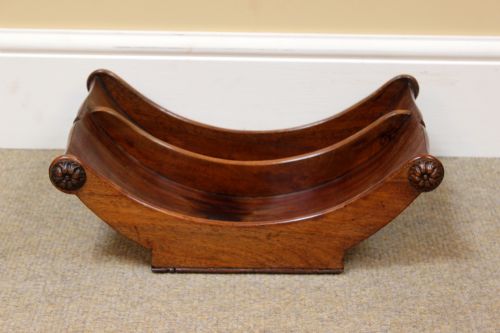


19th Century Coasters
These 19th century coasters protect your dining table in style, bringing period craftsmanship straight to your decanter service.
19th Century Coasters
When searching for 19th century coasters, you encounter functional serveware designed to hold wine bottles and decanters safely across dining tables. The pieces on this page span the Georgian, Regency, and Victorian periods, taking forms from standard wine bottle holders to larger cheese coasters and rotating lazy susans.
You meet pairs and sets constructed for entertaining, alongside single larger items intended for ships decanters. The assortment includes bottle sleeves, low trays, and carriages built to slide easily across polished mahogany surfaces without causing harm.
Origins stretch across English workshops, utilising established forms from the turn of the nineteenth century through to the later Victorian decades. Each item reflects the social dining habits of its era, keeping bottles stable during post-dinner port circulation.
How they were made
Cabinetmakers turned timber on lathes or carved solid blocks to produce mahogany, oak, and papier-mâché bodies. Wood examples often incorporate turned details, bone roundels, or applied carved mounts to finish the rim.
Metal versions rely on silver plating, old Sheffield plate, and brass applied over base metals, sometimes carrying armorial engravings or pierced galleries. Papier-mâché pieces utilise layers of paper pulp and resin finished with dark lacquer, gold leaf, and gilding.
Materials span mahogany, oak, papier-mâché, silver plate, brass, and gold leaf across the listed items.
What varies in quality
The standard of materials and depth of handwork separate items across the range. Superior papier-mâché employs crisp gilded decoration and smooth lacquer finishes, whereas simpler pieces show wear in the surface painting.
Silver-plated items demonstrate quality through the crispness of chased borders and the retention of the original plate over the base metal. Turned wooden pieces depend on the grain selection and the precision of the turned contours or bone inlays.
Rupert Favell & Co·James Mein of Kelso·John & Thomas Settle·William Howe & Co·Henry Waterhouse·Mappin & Webb
The 19th Century Coasters Glossary
- Old Sheffield Plate
- A fused composite material made by melting a sheet of silver to a copper ingot. This technique was widely utilised for bottle coasters before modern electroplating took over.
- Papier-mâché
- A composite material made from paper pulp or layers of paper mixed with glue and resin, then moulded and lacquered. It provided a lightweight base for gilded table wares.
- Cheese Coaster
- A larger, boat-shaped trough designed to hold a wedge of cheese at the table. These often feature turned wooden bases and low sides to roll alongside wine holders.
- Decanter Carriage
- A framed bottle holder fitted on small wheels or castors. This design allowed diners to roll heavy decanters smoothly down the length of a long dining table.
19th Century Coasters: Frequently Asked Questions
How were wine coasters used?
Dinners in the period involved passing wine bottles around the table after the meal concluded. Coasters protected polished wood surfaces from rings and drips while making it simple to slide bottles between guests.
Larger versions accommodated wide ships decanters or cheeses, remaining low to the table for stability during movement.
What is Old Sheffield Plate?
Old Sheffield Plate is an early method of fusing a thin sheet of silver to a thick copper base using heat and pressure. It differs from later electroplate by showing subtle hints of copper showing through on high points.
This technique produced durable serving items throughout the Georgian and Regency eras.
How do I care for papier-mâché coasters?
Papier-mâché requires a dry environment away from direct heat and moisture to protect the underlying paper layers and lacquer. Clean surfaces gently with a soft, dry cloth without using liquid polishes.
Avoid placing sweating bottles directly onto unprotected lacquer surfaces where condensation might pool.