



1930s French Landscape
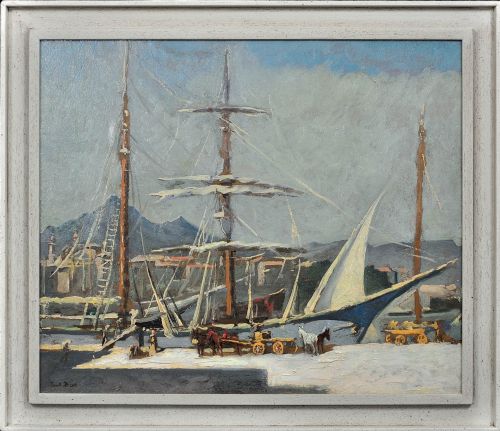
These 1930s French landscape paintings capture the Mediterranean light, rural provinces and coastal ports of the interwar period.
1930s French Landscape
A 1930s French landscape transports the viewer directly into the sun-drenched coastal ports, quiet farmhouses of Provence and rolling countryside views characteristic of the period. When exploring this selection, buyers encounter original works capturing scenes from the Côte d'Azur to rural riverbanks.
The pieces appearing here predominantly take the form of oil paintings on canvas or board, alongside occasional works on paper. These encompass stylistic approaches running from Post-Impressionism and Fauvism through to Art Deco and twentieth-century realism.
Subjects range widely across maritime views with moored boats and lighthouses, pastoral scenes featuring haystacks and farm gates, and architectural studies of old Venetian mansions or Roman ruins. Most examples originate from the decade itself, supported by related works from surrounding years.
Assessing Quality
Quality across these works rests upon the confidence of the brushwork and the artist's command of light, colour and atmospheric perspective. Stronger examples demonstrate a distinctive personal interpretation of landscape forms rather than mere transcription.
The preservation of the original paint surface and the harmony of the framing contribute significantly to the standing of an individual piece. Superior compositions capture the specific qualities of regional French light with genuine conviction.
1930s French Landscape Retail Price Guide 2026
Typical asking prices for 1930s french landscape among the pieces listed under this phrase on Sellingantiques today, from the lower quarter to the upper quarter. They describe what is for sale here now, not the wider market.
Listings feature oil on canvas, oil on board, and ink on paper supporting Post-Impressionist, Fauvist, and Art Deco landscape styles.
Paul Bret·Gustave Vidal·Claude Jousset
The 1930s French Landscape Glossary
- Post-Impressionism
- An artistic movement following Impressionism that extends its use of vivid colours and thick brushstrokes while emphasising geometric forms or expressive content. This style informs many rural and coastal scenes of the era.
- Fauvism
- A style characterised by strong colours and painterly qualities developed by the Fauves, evident in works celebrating Mediterranean warmth and light. Painters utilised bold hues to evoke emotional resonance.
- Plein air
- Painting outdoors to capture the direct effects of light and atmosphere upon the subject. Artists working in this manner recorded transient shifts in weather and sunlight.
- Art Deco
- A design style of the interwar period influencing the decorative geometry and stylised forms found within certain landscape compositions. It brings a sleek architectural sensibility to pastoral subjects.
- Oil on board
- A painting executed on a rigid wooden or composite panel rather than stretched canvas. This support offers a firm surface favoured for smaller studies.
1930s French Landscape: Frequently Asked Questions
What subjects appear in these paintings?
The works depict a diverse range of French scenery, including Mediterranean coastlines, fishing ports, Provençal farmhouses and winding country paths.
Artists also recorded Venetian architecture, Roman ruins and quiet riverbanks during their travels.
How do I date a 1930s French landscape?
Dating relies upon artist signatures, period framing styles, exhibition labels and inherent stylistic markers tied to interwar movements.
Many pieces carry specific dates or approximate years corresponding to the active periods of the painters.
Where were these rural scenes painted?
Locations span across southern France, including the Côte d'Azur, Provence, Concarneau in Brittany and the ports of the Mediterranean.
Artists worked both on location outdoors and within regional studios.
How should I frame and display them?
Many examples retain their period wooden frames, which complement the original oil on canvas or board substrates.
Displaying them away from direct sunlight preserves the pigment stability of the oil paint and any accompanying gilt work.