


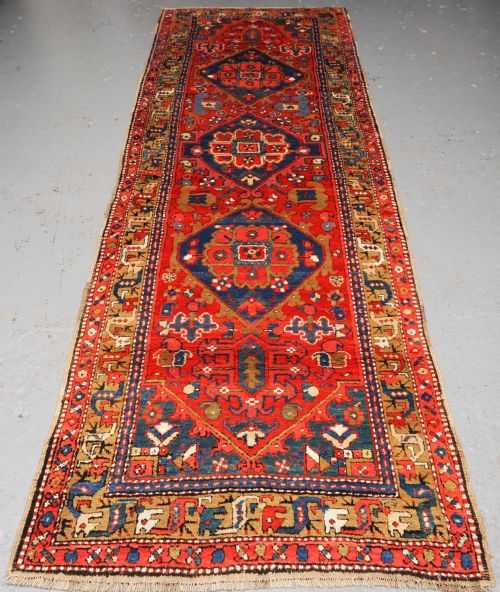


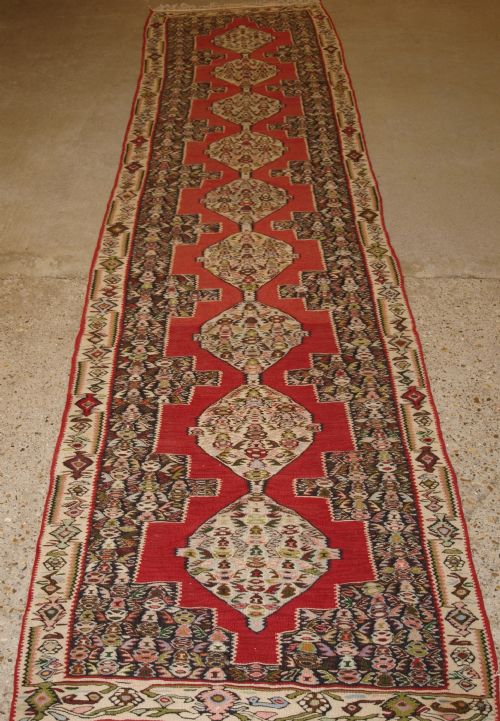
1920s Persian Runner
A 1920s persian runner brings enduring tribal warmth and distinctive long geometry into hallways and corridors.
1920s Persian Runner
When you search for a 1920s persian runner, you are looking at narrow, elongated carpets woven across various regions and villages of Persia and neighbouring areas during the early twentieth century. These textiles served practical purposes in long spaces while displaying the traditional designs and cultural motifs of their specific weaving communities.
The pieces you meet on this page include specific regional formats such as Sarab village runners, Heriz runners, and narrow runners attributed to the Luri tribe. Alongside these, you will find related village and tribal formats including kilim runners and Afghan Mushwani Baluch examples from the same period.
Forms span from narrow hallway runners to long rugs and Kelleh formats, all sharing the characteristic elongated proportions suited to corridors and gallery spaces. They unite traditional Persian styles with the distinct geometry of tribal weaving.
How they were made
These textiles rely on foundations of cotton or wool supporting hand-spun wool pile woven tightly on traditional vertical looms. The choice of materials dictates the weight and flexibility of each runner.
Natural dyes provide the foundational colour palette across the woven surfaces, interacting with the hand-spun wool to create rich depth. Weavers employed traditional techniques passed down through generations within specific villages and tribal groups.
Current listings feature village and tribal pieces utilising wool, cotton, and natural dyes from the nineteen-twenties.
What varies in quality
Quality rests upon the fineness of the knotting and the precision with which regional designs are executed across the elongated format. Finer village and tribal weaving displays tighter structural integrity and greater clarity in the motifs.
The consistency of the hand-spun wool and the vibrancy derived from natural dyes influence the visual depth of the runner. Superior examples maintain balanced proportions and harmonious colour distribution along their entire length.
The 1920s Persian Runner Glossary
- Runner
- A long, narrow carpet format specifically proportioned for hallways, corridors, and stairs. These pieces guide movement through a home while protecting timber floors.
- Kilim
- A flatweave textile produced without a pile by tightly interweaving warp and weft threads. Senneh kilim runners exemplify this lighter, reversible construction technique.
- Kelleh
- A traditional sub-category of larger long rugs with extended rectangular proportions. They sit between standard area rugs and full-length runners.
- Natural Dyes
- Colourants derived from plant, root, and mineral sources prior to the widespread adoption of synthetic alternatives. They yield the characteristic organic tones seen in period pieces.
- Hand-spun Wool
- Fleece spun manually into yarn using a drop spindle or simple wheel, resulting in variable thickness and lively texture. This yarn absorbs natural dyes with subtle variations in shade.
1920s Persian Runner: Frequently Asked Questions
Where should I place a runner?
These long formats suit hallways, corridors, entryways, and narrow galley kitchens where foot traffic benefits from floor covering.
They also function effectively alongside beds or in transitional spaces that require an elongated textile element.
How do I care for wool runners?
Regular gentle vacuuming without a rotating brush roll helps remove embedded dust and grit from the wool pile.
Professional specialist cleaning is recommended when deeper maintenance is required to protect natural dye integrity.
Are these runners durable?
The combination of hand-spun wool pile and sturdy foundational materials provides robust construction suited to everyday domestic use.
Traditional weaving methods yield resilient textiles designed to withstand generations of foot traffic in active homes.
What is a tribal design?
Tribal designs originate from nomadic or village weavers working from memory and traditional local motifs rather than formal workshop cartoons.
These patterns often feature geometric medallions, repeating lattice structures, and stylized flora unique to specific groups like the Luri or Baluch.