


1920s Oriental Carpet
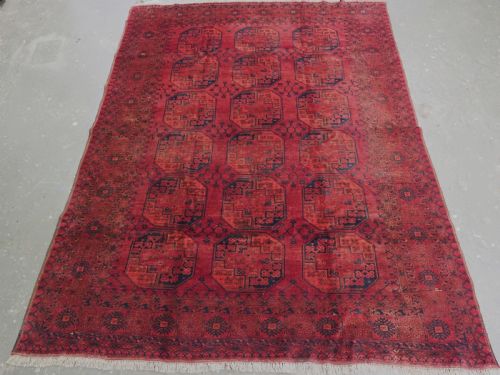
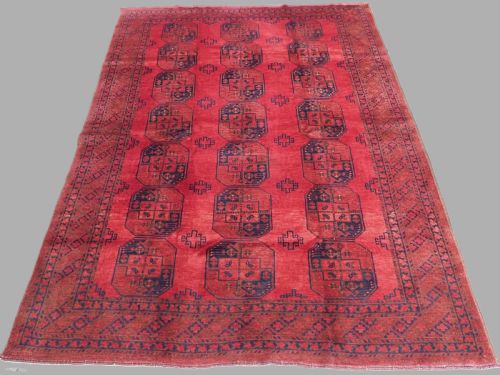
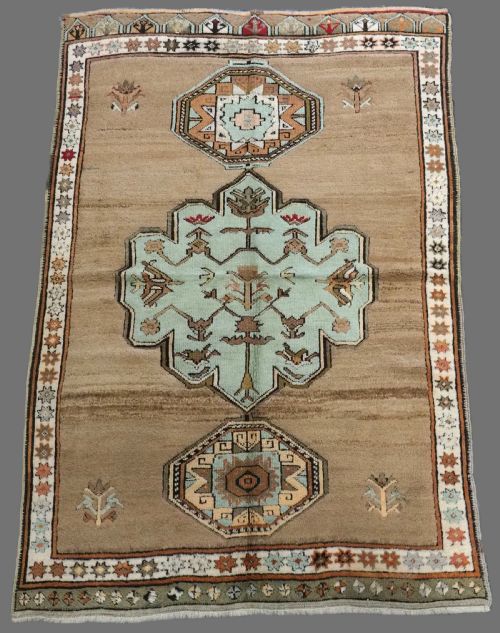
When you search for 1920s oriental carpet, you encounter hand-knotted village and tribal floor coverings defined by warm red palettes, geometric guls, and intricate prayer designs.
1920s Oriental Carpet
A 1920s oriental carpet encompasses diverse regional floor coverings, including Afghan tribal weavings, Persian workshop rugs, Anatolian kilims, and Caucasian geometric pieces. These textiles served both practical domestic functions and specific ritual purposes, such as Islamic prayer.
The most common examples on this page are Afghan village carpets and prayer rugs, often displaying traditional Turkmen motifs, Ersari designs, and multiple mihrab arches. Persian city formats from Kashan, Tabriz, and Heriz also appear frequently alongside Balkan flatweaves.
How they were made
These floor coverings rely primarily on hand-knotted wool pile secured on cotton or wool foundations, utilising natural dyes to achieve rich red, ivory, and soft pastel colourways. Certain regional pieces incorporate specialty fibres like camel wool and lambswool for varied texture and durability.
Flatwoven examples such as kilims employ a slit-tapestry technique without pile, creating crisp geometric patterns with long kelim ends. Weavers constructed durable utility carpets designed for heavy wear alongside finely knotted decorative pieces.
1920s Oriental Carpet Retail Price Guide 2026
Typical asking prices for 1920s oriental carpet among the pieces listed under this phrase on Sellingantiques today, from the lower quarter to the upper quarter. They describe what is for sale here now, not the wider market.
Listings feature wool, cotton, camel wool, and silk foundations combined with natural dyes and hand-knotted pile techniques.
What varies in quality
Quality differences stem from knot density, precision of tribal design execution, and the purity of the wool and dye materials. Finer workshop carpets display intricate curvilinear floral vases and detailed medallions, whereas robust village work prioritises dense, hard-wearing utility.
The sophistication of the palette and the complexity of border variants also divide standard production from superior examples. Pieces retaining long kilim ends and crisp secondary motifs demonstrate higher structural integrity and adherence to traditional aesthetics.
Benlian
The 1920s Oriental Carpet Glossary
- Mihrab
- The niche in a prayer rug that points toward Mecca, often repeated in multiple arches known as seh mihrab designs. This architectural form dictates the orientation of the textile during daily worship.
- Gul
- An octagonal or medallion-like motif frequently repeated across Turkmen and Afghan tribal carpets. Each pattern often identifies a specific clan or weaving group.
- Kilim
- A flatwoven textile produced by tightly interweaving warp and weft strands without creating a pile. These pieces function as lightweight floor coverings or wall hangings.
- Herati
- A classic all-over Persian pattern composed of a central rosette enclosed by a diamond lattice and flanked by curved leaves. It appears frequently in workshop carpets from Tabriz.
- Warp
- The vertical foundation threads stretched lengthwise on the loom before knotting begins. Cotton and wool serve as the primary materials for these structural elements.
1920s Oriental Carpet: Frequently Asked Questions
What is a prayer rug?
A prayer rug is a smaller format textile featuring a distinct arched mihrab design used to indicate the direction of Mecca during ritual worship.
These pieces were woven by various tribal and village groups, often incorporating specific motifs such as lamps, ewers, or multiple arches to aid personal devotion.
How do I care for an old rug?
Living with these textiles requires gentle maintenance, primarily regular vacuuming without a rotating brush bar and prompt professional attention for spills.
Keeping them away from direct sunlight preserves the natural dyes used in wool and camel hair piles.
Where were these carpets made?
These carpets originate from across Central Asia, Persia, Anatolia, the Caucasus, and the Balkans, reflecting distinct regional weaving traditions.
Nomadic tribes, village workshops, and urban looms each contributed specific stylistic elements such as geometric guls or floral vases.
What is a kilim?
A kilim is a flatwoven rug produced without a pile, resulting in a lightweight, reversible textile with sharp geometric patterns.
Weavers created these versatile flatweaves for floor coverings, storage sacks, and decorative hangings across the Balkans and Central Asia.