






18th Century Wall Barometer
An 18th century wall barometer brings precise Georgian science and exceptional cabinetmaking into a room.
18th Century Wall Barometer
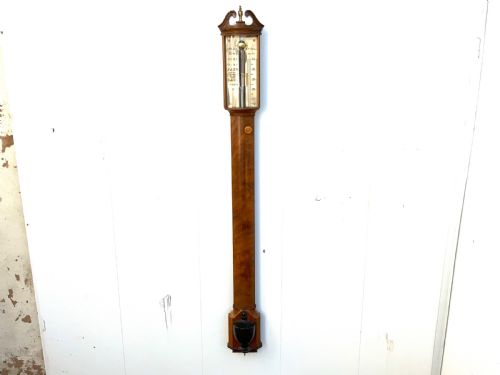
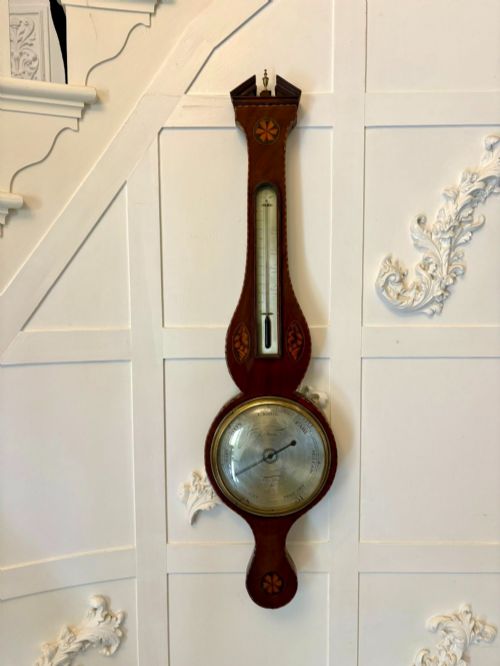
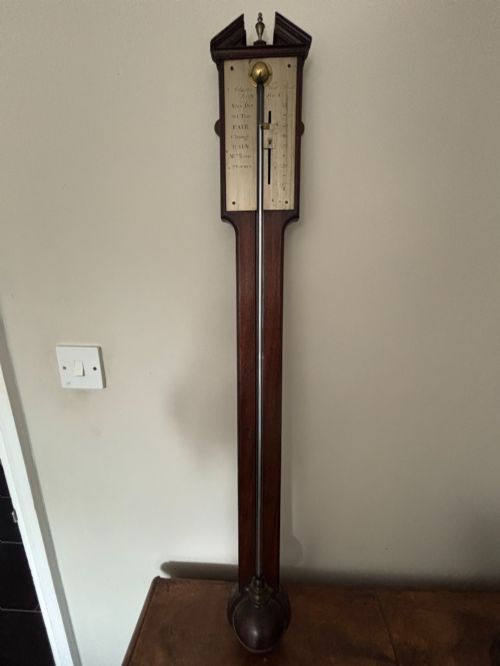
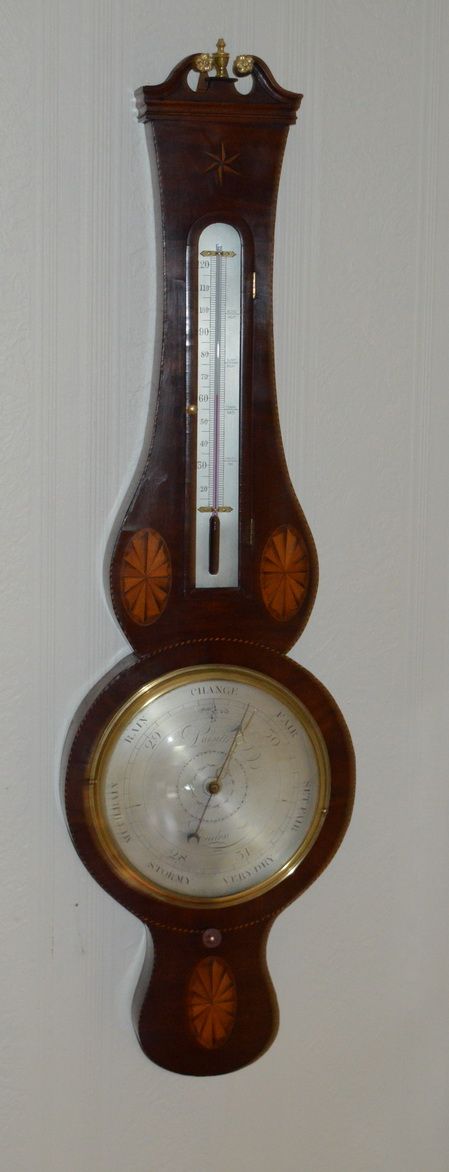
An 18th century wall barometer is a functional weather-glass housed in a timber case, designed to hang on a wall. When you search for an 18th century wall barometer, you encounter instruments spanning the Georgian, George III, Regency and 1750 periods. The stick barometer and the banjo or wheel barometer form the main varieties met on this page.
Most examples originate from London makers and employ rich timbers such as mahogany and walnut. The stick barometer presents a long, slender trunk with an exposed glass tube, while the banjo shape broadens at the base to accommodate a circular dial.
How they were made
Cabinetmakers constructed the primary cases from solid mahogany and figured walnut, often selecting dense timbers that resisted warping with changes in humidity. They integrated delicate boxwood and ebony inlay along the edges and perimeters to frame the slender proportions of the trunk.
Glass tubes were mounted alongside ivory or bone vernier scales, protected by glazed brass or wooden bezels. Specialised makers fitted mercury-filled cisterns at the base to measure atmospheric pressure accurately.
Even eighteenth-century London barometer makers occasionally struggled with spelling, leaving delightfully eccentric signatures on their ivory scales.
What varies in quality
The sophistication of the cabinetwork and the subtlety of the woodwork distinguish the finest examples from standard pieces. Finely figured mahogany veneers, crisp shell inlay, and delicate boxwood stringing signal superior craftsmanship by established metropolitan workshops.
The reputation of the maker inscribed on the dial or scale plate significantly influences the standing of the instrument. Signed works by recorded London instrument makers command greater interest due to the documented skill of their mechanical and optical assemblies.
George Adams London·Luisetti of London·Charles Aiano London·Tarone Gally And Co
The 18th Century Wall Barometer Glossary
- Stick barometer
- A tall, vertical barometer where the mercury column is housed in a narrow wooden trunk with an exposed glass tube. This form provides a direct reading of barometric pressure against a vertical scale.
- Banjo barometer
- A domestic barometer featuring a bulbous or expanded lower section shaped like a banjo, housing a dial face. It evolved toward the end of the century to display weather indications more dramatically.
- Vernier scale
- A small sliding auxiliary scale used to obtain more precise fractional readings from the main barometer scale. It enables accurate measurement of atmospheric pressure changes.
- Boxwood inlay
- Narrow strips of pale boxwood set flush into the darker mahogany carcase to create decorative geometric or floral borders. It demonstrates the cabinetmaker's skill in ornamental embellishment.
- Angle barometer
- An instrument featuring an inclined glass tube that magnifies the vertical movement of the mercury. This specialised form allowed easier reading of small atmospheric fluctuations.
18th Century Wall Barometer: Frequently Asked Questions
How do stick and banjo barometers differ?
Stick barometers present a long, narrow wooden trunk showing the direct mercury column. Banjo barometers expand at the bottom into a circular dial face.
Both types utilise atmospheric pressure, but the banjo style became more common towards the close of the century.
Where were most of these barometers made?
The majority of these instruments originate from workshops based in London. Many bear the signatures of immigrant and British instrument makers working in the capital.
These makers often combined precision glassblowing with high-end cabinetmaking.
What woods were used for the cases?
Mahogany and walnut form the primary timbers for the cases. Cabinetmakers also incorporated boxwood and satinwood for contrasting stringing and shell inlay.
These dense hardwoods protected the delicate glass tubes while offering a polished decorative surface.
How do I read an antique barometer?
You read the height of the mercury column against the engraved scale, often utilising a small sliding vernier for precision. Weather inscriptions such as stormy or fair guide the interpretation of pressure.
Changes in the height indicate impending shifts in local weather conditions.