
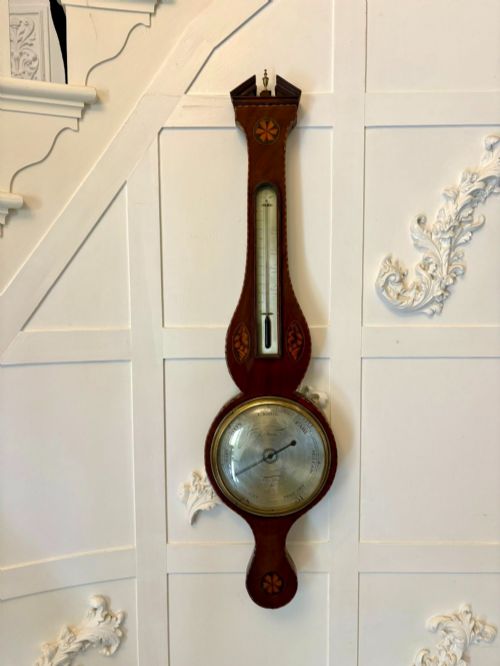


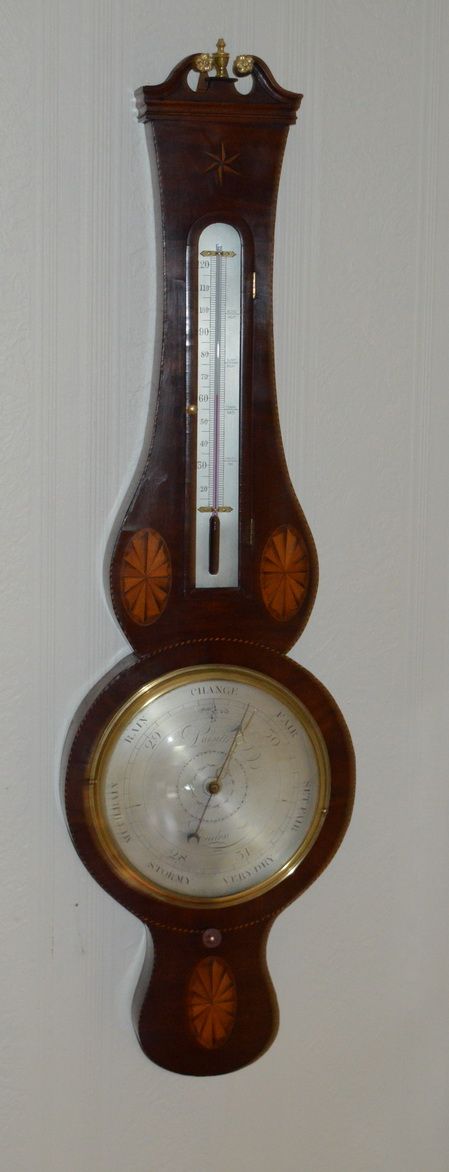


Dark Mahogany Wheel Barometer
These dark mahogany wheel barometers combine practical weather-reading with striking wall presence, offering timeless Georgian and Victorian craftsmanship.
Dark Mahogany Wheel Barometer
When you search for a dark mahogany wheel barometer, you are looking at domestic wall instruments designed to measure atmospheric pressure through a dial mechanism. These pieces typically take the banjo form, featuring a rounded top for the dial and a long trunk below.
The versions you are most likely to meet on this page span the Georgian, Regency, and Victorian periods, dating from the eighteenth century through to the late nineteenth century. They originate primarily from British workshops, executed in rich timber housings.
Many examples incorporate additional instrumentation such as thermometers or hygrometers set into the trunk, alongside dampness indicators and spirit levels inscribed on bone dials. Their primary function was to forecast local weather changes inside the home.
How they were made
The construction relies on solid mahogany and carefully selected mahogany veneers applied to a supportive wood carcase. Cabinetmakers shaped the distinct banjo silhouette by steaming and bending the timber to form the sweeping curves.
Surface ornamentation often includes delicate wood inlay, satinwood stringing, and shell marquetry motifs set into the grain. Brass bezels, indicators, and dials frame the glass faces, while mercury systems operate the internal pressure mechanics.
Listings feature eighteenth and nineteenth century periods, utilising mahogany, brass, glass, satinwood, wood inlay, and bone materials.
What varies in quality
The distinction between standard and superior pieces rests largely on the fineness of the cabinetwork and the intricacy of the wood inlay. Richness of figure in the mahogany timber and the presence of detailed shell marquetry elevate the visual weight of the instrument.
The precision of the dial engraving and the reputation of the maker inscribed upon it also define the upper tier. Dial plates executed in silvered brass with crisp lettering signal greater investment by the original commissioner.
Giana Shrewsbury·Watkins·Roncoroni·Luisetti of London·J C Moretti of King's Lynn·Negretti and Zambra·Russell of Liverpool
The Dark Mahogany Wheel Barometer Glossary
- Banjo barometer
- A wall barometer shaped with a circular dial head above an elongated tapering trunk. This layout became the dominant domestic style during the Georgian and Regency eras.
- Wheel barometer
- An instrument utilising a mechanical pulley system connected to a mercury tube to drive a pointer around a dial. It translates vertical mercury movement into circular rotation.
- Marquetry
- Decorative patterns formed by fitting contrasting veneers into a prepared wooden surface. Makers utilised satinwood and various timbers to create shell and geometric motifs.
- Aneroid barometer
- A barometer measuring pressure through the expansion and contraction of a sealed metal capsule rather than liquid mercury. This later development appeared towards the Victorian period.
- Bezel
- The metal ring that holds the glass cover in place over the dial face. Brass served as the primary material for these protective frames.
Dark Mahogany Wheel Barometer: Frequently Asked Questions
What is a wheel barometer?
A wheel barometer is a wall-hanging weather glass that uses a mechanical pulley to turn a dial pointer in response to changing atmospheric pressure.
These instruments replaced older straight-tube designs by making pressure readings easier to view from across a room.
How do I date a mahogany barometer?
Dating relies on stylistic details such as the shape of the case, the presence of inlay, and the construction of the dial. Georgian examples often feature sharp swan-neck pediments and delicate shell marquetry.
Victorian instruments tend to show heavier proportions and simpler geometric stringing. Maker signatures and inscribed address plates also help narrow down the decade of production.
Where should I hang a wall barometer?
These instruments suit principal reception rooms, hallways, or studies where wall space permits a vertical display. They perform best away from direct sunlight and strong sources of artificial heat.
Mounting them securely to a solid wall ensures the internal mechanical linkage remains stable and accurate.
Are these barometers still accurate?
Many historical barometers retain working internal movements that respond faithfully to local weather shifts. Minor calibration adjustments may be necessary depending on changes in altitude and atmospheric conditions.
Even when the mercury mechanism requires specialist attention, the instrument remains a striking decorative antique.