


Vintage Banjo Weather Station
A vintage banjo weather station brings together domestic science and cabinet-making, offering a reliable barometer housed in a distinctive wall-hanging wooden frame.
Vintage Banjo Weather Station
A vintage banjo weather station takes the shape of a traditional stringed instrument, widening at the base to accommodate the main weather glass while tapering near the top for the dial. These wall-mounted instruments combine barometers, thermometers, and occasionally clocks into a single vertical wooden chassis.
The pieces on this page span the nineteenth and early twentieth centuries, drawing heavily on Victorian and Edwardian domestic tastes. Buyers encounter both mercury tube designs and later aneroid movements housed in various regional and imported styles.
Most examples function as combined meteorological instruments and hallway ornaments, reflecting the historical domestic desire to monitor atmospheric pressure before stepping outside. Oak, mahogany, and walnut dominate the forms, shaped into both plain functional units and elaborate carved presentations.
Materials and construction methods
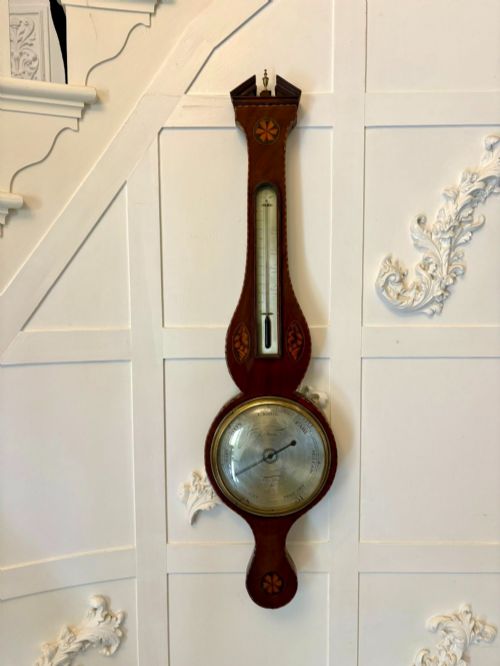
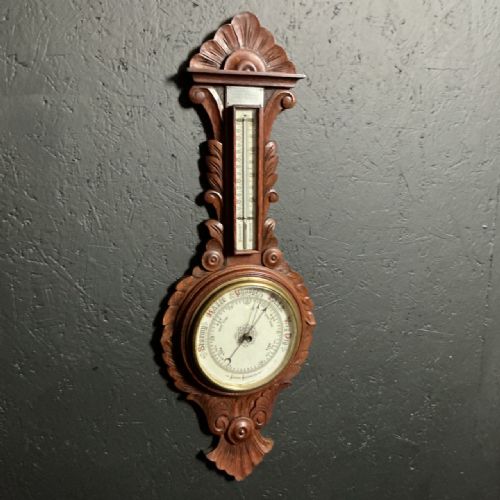
Cabinet-makers built the characteristic frames using solid hardwoods like mahogany, oak, and walnut, frequently applying satinwood stringing or shell marquetry for visual depth. These timbers were selected for stability and grain pattern, allowing them to hold intricate carvings around the dial bezels and cistern covers without warping.
The internal mechanics rely on sensitive glass components, utilising sealed mercury tubes or spring-loaded aneroid metal chambers connected to visible indicator needles. Brass bezels, silvered metal dials, and protective glass plates complete the face, securing the delicate measurement scales against household dust and damage.
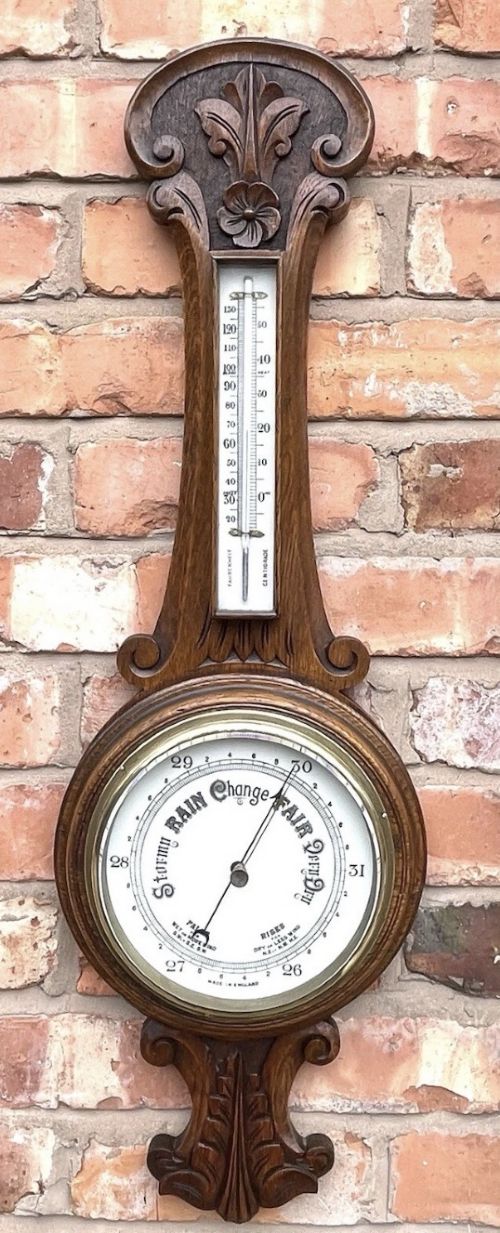
The listings show a transition from eighteenth-century mahogany mercury instruments to carved oak aneroid designs produced through the Victorian and Edwardian eras.
Distinctions in craftsmanship
Quality rests heavily on the crispness of the woodwork, separating mass-produced nineteenth-century units from pieces featuring deep, hand-chiselled oak foliage or precise neoclassical marquetry. Finer examples retain their original brass fittings, hand-engraved silvered dials, and unbroken wooden crests above the thermometer housing.
The mechanical pedigree alters the standing of a piece, distinguishing standard workshop instruments from those signed by established instrument makers or high-end retailers. The clarity of the glass, the legibility of the scale engravings, and the structural integrity of the long wooden neck dictate the overall standard.
W Watson & Sons·Maple & Co·Vecchio & Co·L. Malacrida·Negretti & Zambra
The Vintage Banjo Weather Station Glossary
- Aneroid barometer
- An instrument that measures atmospheric pressure through the expansion and contraction of a sealed metal capsule rather than liquid mercury. It became common in domestic weather stations by the late Victorian period.
- Banjo barometer
- A wall barometer housed in a vertical wooden case shaped broadly like a banjo, featuring a circular dial at the top and a larger bulbous base enclosing the cistern.
- Marquetry
- The art of applying decorative veneer pieces to a wooden structure to create pictorial or geometric patterns. On these pieces, floral or shell motifs frequently appear on the central trunk.
- Silvered metal
- A brass or copper dial plate treated with a silver finish and etched with weather scales and graduations. The markings are typically filled with black wax for legibility.
Vintage Banjo Weather Station: Frequently Asked Questions
How do I read a vintage banjo weather station?
The upper dial displays atmospheric pressure readings such as rain, change, or fair, while the indicator needle points to the current measurement. Tapping the glass gently before reading helps settle the mechanism to show true pressure.
The accompanying thermometer registers ambient temperature in Fahrenheit or Celsius, depending on the manufacturing period. Together, these indicators allow observers to track short-term meteorological trends inside the home.
Can I calibrate these barometers for my home?
Many aneroid instruments feature a small adjustment screw accessible from the back or through the dial face. Aligning this with local meteorological reports brings the reading into line with current regional pressure.
Mercury instruments require careful handling and professional setup if moved significantly in altitude. Once fixed to a stable wall away from direct heat sources, they maintain their calibration reliably.
Where should I hang a banjo weather station?
Choose an interior wall that experiences minimal temperature fluctuations and is sheltered from direct sunlight and radiators. Hallways and studies provide stable environments that protect both the wooden case and the internal mechanics.
Ensure the wall anchor is secure enough to bear the weight of the hardwood chassis and glass components. Hanging the unit plumb is essential for the correct operation of mercury tubes and suspended indicators.
How do I tell an 1800s piece from a later one?
Early nineteenth-century examples typically feature mahogany frames with delicate shell inlay and mercury-filled tubes. The lettering on the dials is often hand-engraved with distinctive regional flourish.
Later Victorian and Edwardian pieces frequently utilise carved oak with aneroid movements, reflecting industrial manufacturing shifts. The presence of factory stamps or retailer plaques usually points towards the latter half of the nineteenth century or beyond.