




Inlaid Wood Weather Glass
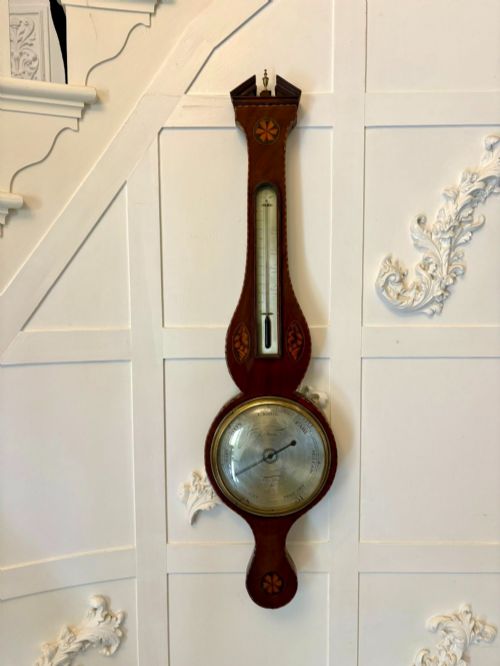
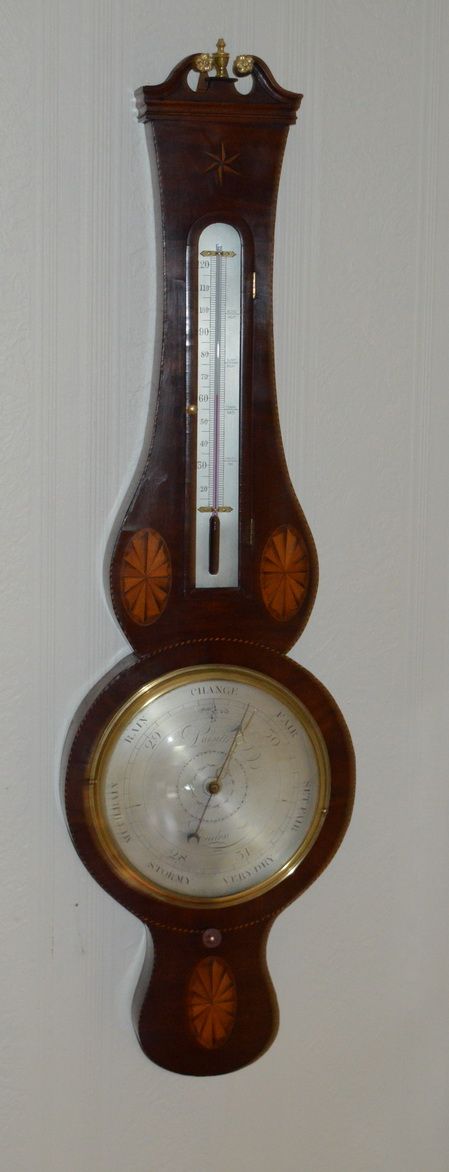
An inlaid wood weather glass brings domestic forecasting into the parlour with traditional mercury or aneroid movements housed in figured timber.
Inlaid Wood Weather Glass
An inlaid wood weather glass is primarily encountered on this page as a banjo, wheel, or stick barometer from the Georgian, Victorian, and Edwardian eras. These instruments combine practical barometric measurement with decorative cabinetry, often pairing humidity and temperature dials with the main weather scale.
Mahogany and rosewood dominate the timber selection, frequently decorated with contrasting boxwood inlay, shell motifs, or mother of pearl. Wall barometers of the banjo form represent the most common layout, though occasional mantel clock combinations and stick barometers appear in the selection.
How they were made
Cabinetmakers utilised dense tropical hardwoods like mahogany and rosewood as a stable foundation for delicate stringing and pictorial veneers. Boxwood inlay and mother of pearl were set flush into the timber ground to create contrasting geometric borders and shell emblems.
The delicate mercurial or aneroid glass tubes required precise mounting alongside silvered metal dial plates, which were engraved and filled with dark pigment for legibility. Brass bezels and mercury cistern covers completed the functional mechanical assemblies.
Mother of pearl catches the parlour gaslight just enough to remind you that telling the weather used to be an excuse for interior decoration.
What varies in quality
Quality rests in the crispness of the cabinetwork and the complexity of the timber figure, where finely selected mahogany grain or detailed shell marquetry elevates a piece far above plain utility. The finesse of the engraved silvered dial plate and the retention of original mercury tubes dictate the technical standing of the instrument.
Makers recorded on the dials, such as London firms or provincial artisans, introduce a layer of provenance that separates standard workshop production from signed masterwork instruments.
Fagioli of Clerkenwell London·Luisetti of London·Charles Aiano·Pozzoby London
The Inlaid Wood Weather Glass Glossary
- Banjo barometer
- A wall-mounted weather glass shaped vaguely like a banjo, featuring a damp or dry dial at the top and a larger circular dial below. This form became the standard domestic layout during the Georgian and Victorian periods.
- Aneroid barometer
- A weather instrument that measures atmospheric pressure through the expansion and contraction of a sealed metal capsule rather than liquid mercury. This movement allows for horizontal or compact mantel clock configurations.
- Mercurial barometer
- A traditional weather glass that registers atmospheric pressure by balancing it against a column of liquid mercury in a sealed glass tube. These instruments require careful handling during transport.
- Silvered metal
- A brass or copper dial plate treated to achieve a bright silver finish before being engraved with weather forecasts and scales. The engraved lines are typically blackened for clear reading.
- Marquetry
- The art of applying decorative pieces of veneer to a structure to form intricate pictorial or geometric designs. This technique often employs contrasting woods like boxwood and satinwood.
Inlaid Wood Weather Glass: Frequently Asked Questions
How do I read an inlaid wood weather glass?
The main dial displays air pressure readings marked in inches of mercury alongside descriptive weather words like 'Fair', 'Change', and 'Rain'. By observing whether the pointer rises or falls relative to the set hand, you can anticipate local atmospheric shifts.
Secondary dials often include thermometers for temperature and hygrometers for humidity, giving a complete meteorological picture at a glance.
Where should I hang a wall barometer?
Select an interior wall away from direct sunlight, central heating radiators, and damp exterior stone. Rapid temperature fluctuations can destabilise the wood case and affect the internal movement.
Ensure the fixing point is secure and capable of supporting the full weight of the hardwood and glass assembly.
Can antique barometers still be calibrated?
Many mercurial and aneroid instruments retain working movements that respond accurately to modern barometric pressure changes. Minor calibration can often be adjusted via the screw mechanism linked to the pointer.
Professional restoration is recommended if the internal mercury column is broken or if the aneroid capsule has lost its seal.
How do I distinguish a Georgian weather glass from a Victorian one?
Georgian instruments frequently feature fine mahogany veneers with understated boxwood stringing and classical pediments. They often incorporate mercurial stick or wheel movements signed by London instrument makers.
Victorian and Edwardian examples lean towards rosewood cases, heavier mother of pearl inlay, and the widespread adoption of the aneroid movement.