
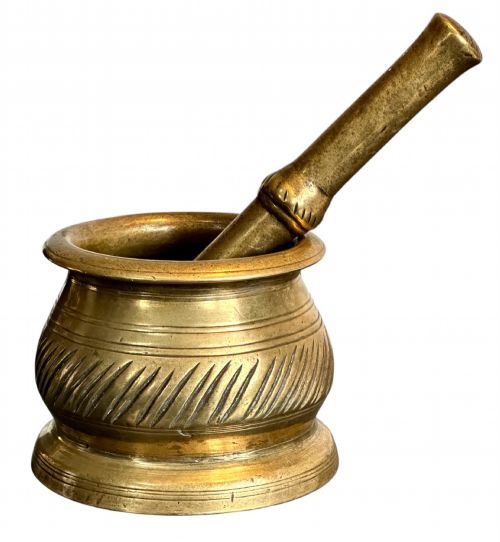


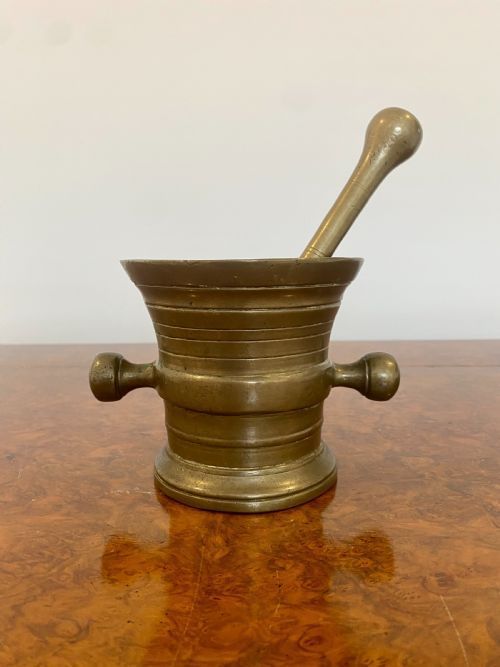
18th Century Brass Mortar
These heavy metal vessels are enduring kitchen and apothecary implements that bring tactile history and rich alloy colour into a modern interior.
18th Century Brass Mortar
When you search for an 18th century brass mortar, you find robust grinding vessels paired with pestles, forged for domestic kitchens and apothecary use. The examples on this page span the Georgian era and the seventeenth century, alongside occasional nineteenth-century interpretations.
Most pieces appear in cast bronze or brass, taking sturdy bowl forms designed to withstand heavy crushing and pounding. You encounter single vessels and matching sets, often originating from English workshops or continental centres like the Netherlands.
The forms range from plain utilitarian bowls to pieces bearing decorative ribbing, flared rims, and distinct mouldings. These metalware objects survive as functional sculptures that reflect centuries of culinary and medicinal preparation.
How they were made
Makers cast these vessels using copper alloy combinations such as brass, bronze, and bell metal, poured into sand or loam moulds. The metal was cast thick to absorb the repeated impact of a matching pestle without cracking.
After casting, many vessels were turned on a lathe to refine the exterior profile, smooth the rim, and polish the metal surface. The interior bowl often retains the subtle scoring or smooth patina left by historical grinding work.
Some surviving pestles feature subtle wear facets worn flat by centuries of vigorous kitchen prep.
What varies in quality
The distinction between ordinary and superior pieces lies in the weight of the casting and the crispness of the mouldings. Heavier bronze and bell metal vessels demonstrate a more substantial presence and a resonant alloy composition.
Surface finish and the preservation of original pestles elevate certain pieces above standard examples. Mortars with well-matched pestles and undisturbed historical patination offer a more complete historical record.
The 18th Century Brass Mortar Glossary
- Mortar
- A heavy bowl used with a pestle for grinding and crushing substances. These vessels served both kitchen cookery and apothecary dispensing.
- Pestle
- A heavy club-shaped tool with a rounded end, used for pounding materials inside a mortar. Finding a set with its original matching pestle is particularly satisfying.
- Bell Metal
- A hard alloy containing copper and tin, traditionally used for bells and high-grade mortars. It produces a distinct resonant tone when struck.
- Apothecary
- A practitioner who prepared and sold medicines to physicians and patients. Apothecary vessels often display robust proportions built for grinding dried roots and resins.
- Georgian
- Relating to the reigns of the first four British monarchs named George, spanning the eighteenth century. Pieces from this period exhibit characteristic classical proportions.
18th Century Brass Mortar: Frequently Asked Questions
How were these mortars used?
These vessels were employed to grind herbs, spices, seeds, and medicinal ingredients into powders and pastes. Cooks and apothecaries used a vigorous hand motion with the pestle against the hard metal interior.
Over decades of daily use, the friction wore smooth paths inside the bowl, leaving a direct physical record of historical food preparation and medicine.
Can I still use an antique mortar?
While these metal vessels remain structurally robust, modern cooks typically display them as decorative objects rather than active kitchen tools. The historical alloy and patina deserve careful preservation.
If you choose to grind dry spices, wash the interior gently by hand and dry it thoroughly to protect the ancient metal surface from moisture.
How do I clean a brass or bronze mortar?
Dust the surface regularly with a soft dry cloth and avoid harsh chemical dips or abrasive metal polishes. Natural ageing and dark oxidation form a protective skin that collectors prize.
Aggressive cleaning strips away centuries of character and reduces the visual depth of the metal alloy.
How do I tell an 18th-century mortar apart from a later copy?
Examine the surface for evidence of sand casting marks, lathe turning lines, and natural wear patterns built up over generations. Eighteenth-century pieces show heavy, honest proportions rather than lightweight modern casting.
The specific alloy composition, such as bell metal or heavy bronze, also points directly to earlier manufacturing methods.