

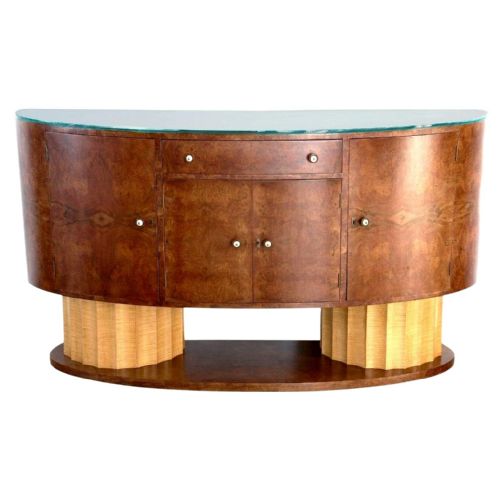

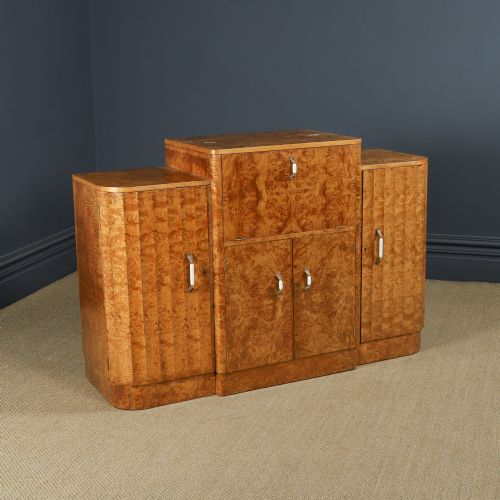
Art Deco Sideboards
A low, long dining-room case piece of the 1920s to 1940s, built to store and serve table wares, restyled with veneered flat surfaces, stepped or curved outlines and often a fitted drinks compartment.
Art Deco Sideboards
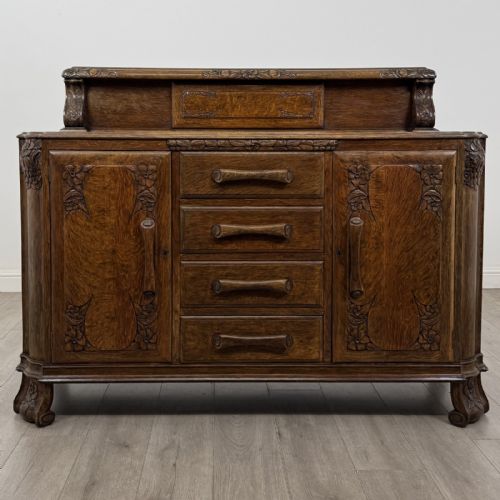
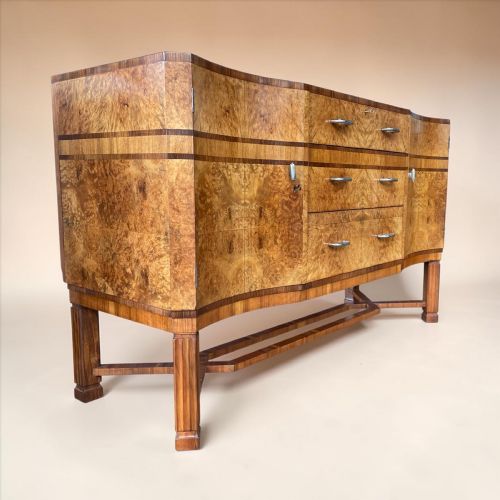
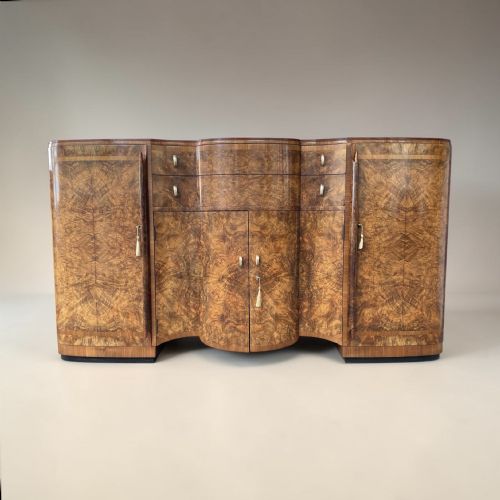
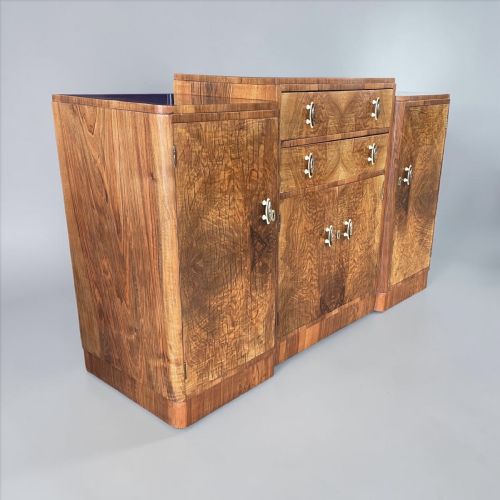
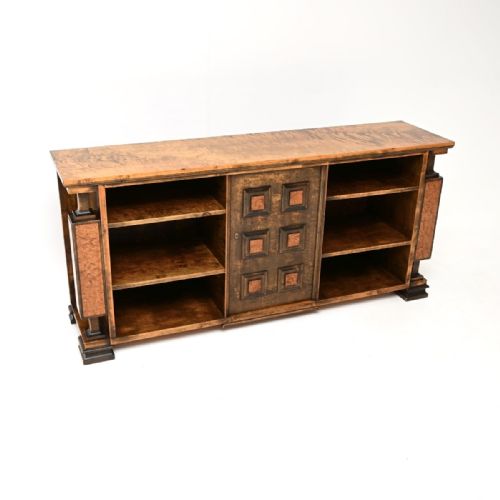
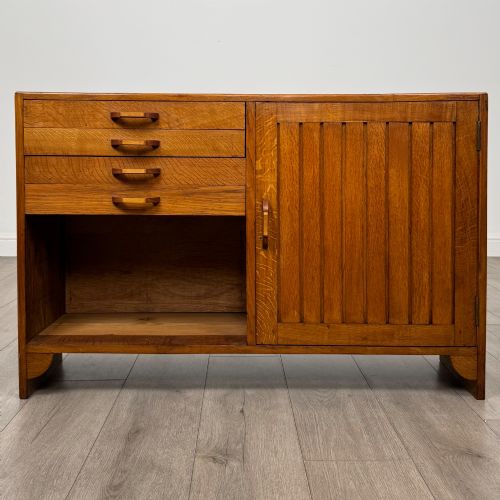
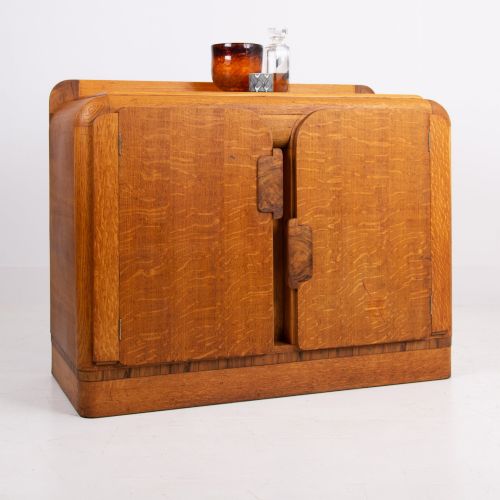
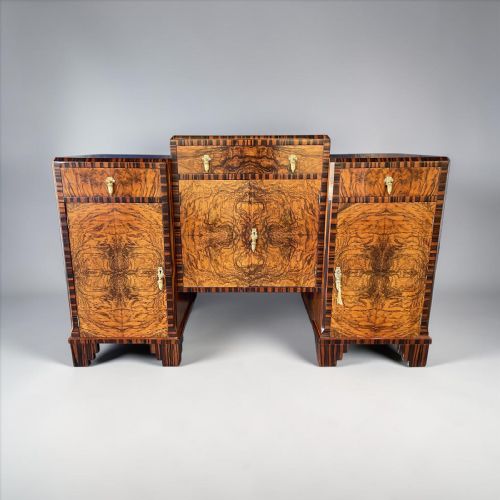
The sideboard was already a long-settled form by the twentieth century: low, long, cupboards and drawers below a serving top. What changed in the interwar years was the surface and the outline. Broad veneered panels, stepped and curved fronts, and a drinks compartment worked into the carcase.
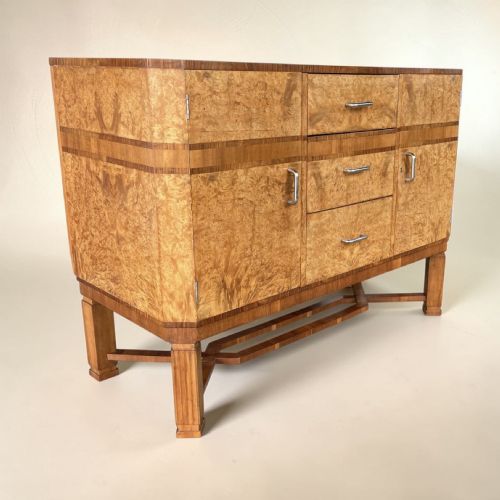
The piece you are most likely to meet is an English walnut-veneered sideboard of the 1930s, veneer laid over an oak carcase. Walnut is named in a third of titles, burr walnut in a good number of those. Oak follows, including golden, limed and cerused oak, and there is a scattering of maple, elm, macassar and rosewood.
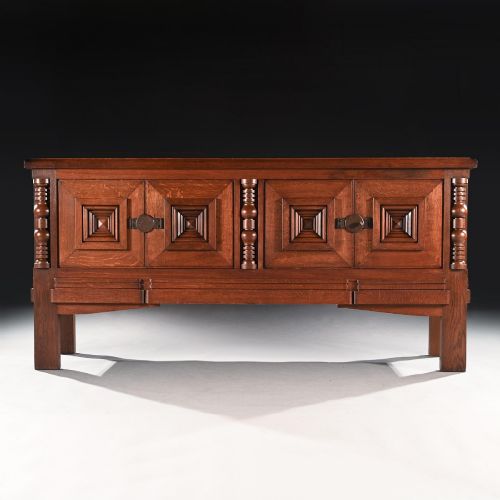
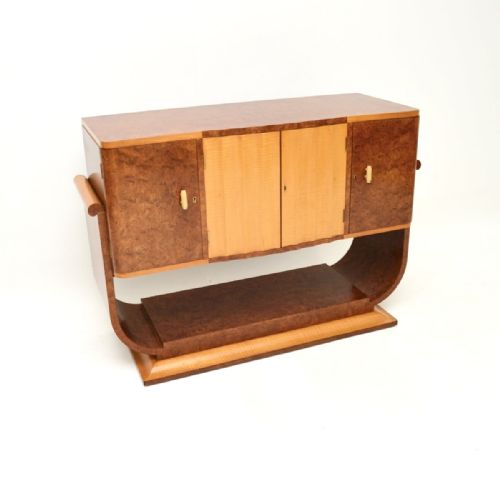
The heading covers a family rather than one article. Servers, buffets, side cabinets, console and serving tables, low cupboards, drinks and cocktail cabinets all sit under it, and around a fifth of titles use 'cabinet' for the same or an adjacent form. A French and Continental strand runs alongside the English one, carrying marble tops and bronze mounts, with occasional Swedish and Italian pieces.
Dating is unusually tidy, and unusually blunt: nearly every listing carries a clean year between 1920 and 1940, with the 1930s far ahead of the 1920s. Almost all are round decade numbers, so read them as a bracket rather than a year of making. A handful of period labels contradict their own titles, one filed as 19th century and one as Edwardian, so the title tells you more than the field.
Where The Range Sits
Veneer does most of the work. Burr and figured walnut, and combinations such as burr walnut with sycamore, satinwood or burl amboyna, cluster in the upper part of the range. Plain and golden oak titles sit at the lower end, and the plain oak low cupboards hold the bottom.
Form and fitting move a piece up from there. Bow-front, serpentine, cloud-shape and U-base console outlines appear above the middle, as do sideboards with an integrated cocktail or drinks fitting, including a couple described as electric. Scale pulls the same way: 'large' and 'long' sit noticeably higher, while the nine or so titles naming a small piece cluster low.
A name lifts a piece clearly. English cabinetmaker attributions are concentrated well above the middle, and the very top of the category is held by signed French designer pieces in marquetry and parquetry, an order of magnitude above the plainest oak. Against that, dozens of titles read simply 'Art Deco Sideboard' with no wood, size or maker given at all.
Art Deco Sideboards Retail Price Guide 2026
Typical UK retail prices for art deco sideboards, calculated from the Sellingantiques database of over a million retail prices indexed since 2003. This retail price guide relies exclusively on Sellingantiques data; no external sources or auction records are used, so the figures do not describe the wider market.
About twenty Art Deco sideboards are listed on Sellingantiques each year, and forty-six different dealers have listed one.

Hille·Harry and Lou Epstein
The Art Deco Sideboards Glossary
- Sideboard
- Long low case piece for the dining room, with cupboards and drawers for serving.
- Server
- A shallower sideboard variant meant mainly for serving rather than storage; sometimes listed as a serving table.
- Buffet
- The French term used in titles for the same form, often with a marble top.
- Side cabinet
- Shorter cupboard form, listed alongside sideboards and at times interchangeably with them.
- Burr walnut
- Veneer cut from a burr growth, giving dense swirled figure; it is named outright in a good many titles.
- Limed oak
- Oak with white filler worked into the grain for a pale, open-grained finish. Cerused is the French equivalent, and turns up in a Continental title.
Art Deco Sideboards: Frequently Asked Questions
What wood are Art Deco sideboards usually made from?
Walnut dominates, named in about a third of titles, with burr walnut a strong sub-group and figured walnut alongside it. The veneer normally sits over an oak carcase.
Oak is the next material, taking in golden, limed and cerused finishes. Beyond that there are smaller numbers in maple, elm, macassar and rosewood.
Why are so many dated 1930?
The dated field is disciplined but rounded. Nearly all listings carry a clean year, and almost all of those are 1920, 1930 or 1940 rather than a precise date.
Only one listing names an exact year, 1925. Treat a 1930 date as a decade bracket, and note that the 1930s account for the bulk of the category.
Do these sideboards have drinks compartments?
Fitted drinks compartments recur throughout, and two cabinets are described as electric. Some pieces are sold outright as cocktail or drinks cabinets under this heading.
The cocktail strand is small in the archive but larger in current stock, and titles combining sideboard with a drinks fitting sit in the upper half of the range.
Are French Art Deco sideboards different?
The Continental strand shows up as buffets, enfilades and commodes, often with a marble top and sometimes bronze mounts. Marble tops belong almost entirely to this group.
English pieces, by contrast, lean on burr and figured walnut and cabinetmaker work. Signed French designer pieces in marquetry and parquetry hold the top of the category.
How many come up for sale each year?
Around twenty come to market in a year on Sellingantiques, listed by forty-six different dealers over time, so no one dealer sets the tone of the category.
Titles are often bare. Dozens read simply 'Art Deco Sideboard' with nothing on wood, size or maker.
Which unusual pieces turn up under this heading?
Oddities pass through. An aluminium 'aviator' sideboard, a lacquered chinoiserie drinks cabinet, a fossil-marble-topped commode and a matched pair of console tables have all been listed.
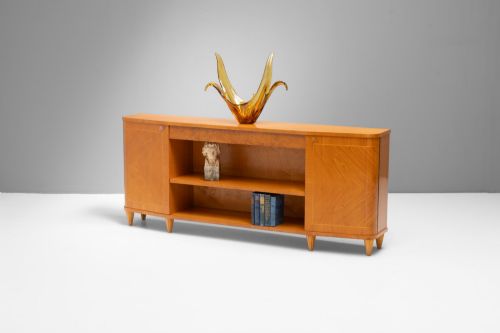
Single-appearance origins include one Italian piece, a Parisian macassar cabinet and two Swedish cabinets in birds-eye maple and satin birch.