9,806  PAGES BROWSED TODAY PAGES TODAY 13  ANTIQUES UPLOADED TODAY NEW ARRIVALS
ID #SA575143
FOR SALE
£4,500
Email
Save
After Rembrandt Harmenszoon Van Rijn , 1606-1669 "The Night Watch" the Shooting Company of Frans Banning Cocq and Willem Van Ruytenburch
Artware Fineart
for sale €5,265     $5,715
£4,500

Artware Fineart

Sellingantiques Verified Since Sep 2008
View Dealers Stock Page
Id #SA575143
PDF SHARE
SAVE

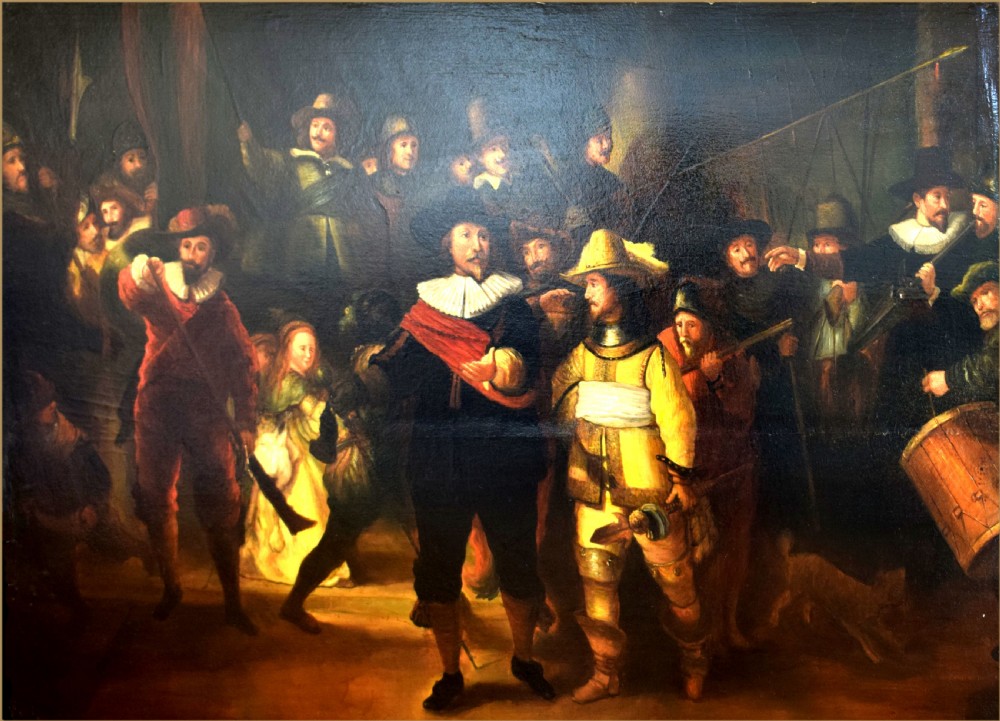
After Rembrandt Harmenszoon Van Rijn , 1606-1669 "The Night Watch" the Shooting Company of Frans Banning Cocq and Willem Van Ruytenburch

18th century
For Sale by Artware Fineart
Description

After Rembrandt Harmenszoon van Rijn , 1606-1669

"The Night Watch" The Shooting Company of Frans Banning Cocq and Willem van Ruytenburch

oil on panel

40 x 60 cm. (16 x 24 in.)

Provenance

Property of a Nobleman

Notes

In popular culture The Night Watch is probably regarded as currently the fourth most famous painting in the Western world, after the Mona Lisa, the Last Supper and the ceiling of the Sistine Chapel.

Militia Company of District II under the Command of Captain Frans Banninck Cocq,also known as The Shooting Company of Frans Banning Cocq and Willem van Ruytenburch, but commonly referred to as The Night Watch (Dutch: De Nachtwacht), is a 1642 painting by Rembrandt van Rijn. It is in the collection of the Amsterdam Museum but is prominently displayed in the Rijksmuseum as the best known painting in its collection. The Night Watch is one of the most famous Dutch Golden Age paintings.

The painting is famous for three things: its colossal size (363 cm × 437 cm (11.91 ft × 14.34 ft)), the dramatic use of light and shadow (tenebrism) and the perception of motion in what would have traditionally been a static military group portrait. The painting was completed in 1642, at the peak of the Dutch Golden Age. It depicts the eponymous company moving out, led by Captain Frans Banning Cocq (dressed in black, with a red sash) and his lieutenant, Willem van Ruytenburch (dressed in yellow, with a white sash). With effective use of sunlight and shade, Rembrandt leads the eye to the three most important characters among the crowd: the two gentlemen in the centre (from whom the painting gets its original title), and the woman in the centre-left background carrying a chicken. Behind them, the company's colours are carried by the ensign, Jan Visscher Cornelissen. The figures are almost life-size.

Rembrandt has displayed the traditional emblem of the arquebusiers in a natural way, with the woman in the background carrying the main symbols. She is a kind of mascot herself; the claws of a dead chicken on her belt represent the clauweniers (arquebusiers), the pistol behind the chicken represents clover and she is holding the militia's goblet. The man in front of her is wearing a helmet with an oak leaf, a traditional motif of the arquebusiers. The dead chicken is also meant to represent a defeated adversary. The colour yellow is often associated with victory.

For much of its existence, the painting was coated with a dark varnish, which gave the incorrect impression that it depicted a night scene, leading to the name by which it is now commonly known. This varnish was removed only in the 1940s.

In 1715, upon its removal from the Kloveniersdoelen to the Amsterdam Town Hall, the painting was trimmed on all four sides. This was done, presumably, to fit the painting between two columns and was a common practice before the 19th century. This alteration resulted in the loss of two characters on the left side of the painting, the top of the arch, the balustrade, and the edge of the step. This balustrade and step were key visual tools used by Rembrandt to give the painting a forward motion. A 17th-century copy of the painting by Gerrit Lundens at the National Gallery, London shows the original composition.

The painting was commissioned (around 1639) by Captain Banning Cocq and seventeen members of his Kloveniers (civic militia guards).[3] Eighteen names appear on a shield, painted circa 1715, in the centre right background, as the hired drummer was added to the painting for free.[4] A total of 34 characters appear in the painting. Rembrandt was paid 1,600 guilders for the painting (each person paid one hundred), a large sum at the time. This was one of a series of seven similar paintings of the militiamen (Dutch: Schuttersstuk) commissioned during that time from various artists.

The painting was commissioned to hang in the

Physical Dimensions
Height
40cm (15.75")
Width
60cm (23.62")
Depth
0.5cm (0.20")
Declaration

Artware Fineart has dated this Rembrandt Night Watch Painting to the 18th Century.

Reference Numbers
Sellingantiques Reference
SA575143
Dealers Internal Reference
3969
Description
After Rembrandt Harmenszoon van Rijn , 1606-1669

"The Night Watch" The Shooting Company of Frans Banning Cocq and Willem van Ruytenburch

oil on panel

40 x 60 cm. (16 x 24 in.)

Provenance

Property of a Nobleman

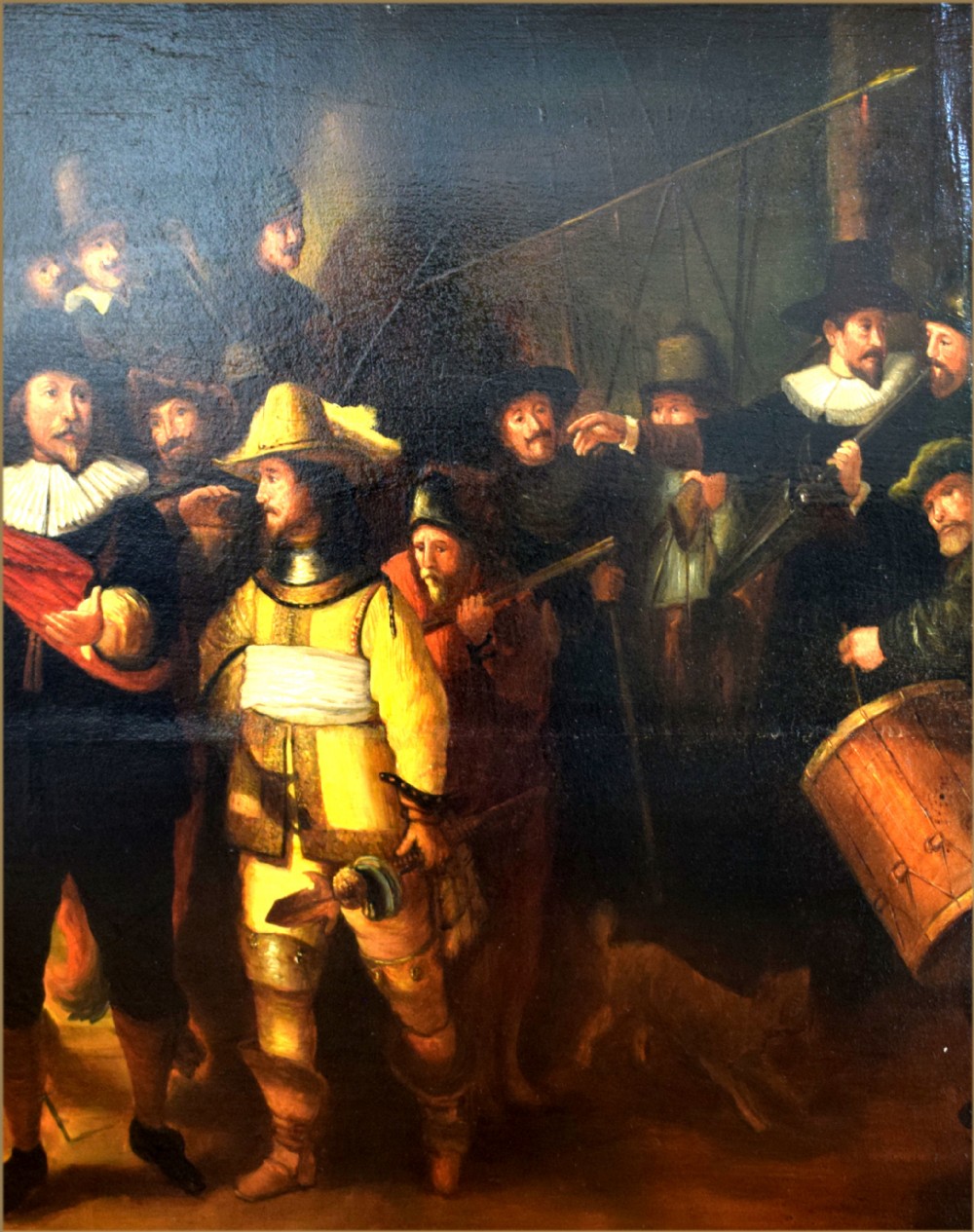
fig 1. An oil painting depicting a group of seventeenth-century Dutch militia figures illuminated by dramatic lighting against a dark background.
fig 1. After Rembrandt Harmenszoon Van Rijn , 1606-1669 "The Night Watch" the Shooting Company of Frans Banning Cocq and Willem Van Ruytenburch

Notes

In popular culture The Night Watch is probably regarded as currently the fourth most famous painting in the Western world, after the Mona Lisa, the Last Supper and the ceiling of the Sistine Chapel.
Artware Fineart
fig 2. An oil painting depicting a group of seventeenth-century Dutch militia figures illuminated by dramatic lighting against a dark background.
fig 2. After Rembrandt Harmenszoon Van Rijn , 1606-1669 "The Night Watch" the Shooting Company of Frans Banning Cocq and Willem Van Ruytenburch

Militia Company of District II under the Command of Captain Frans Banninck Cocq,also known as The Shooting Company of Frans Banning Cocq and Willem van Ruytenburch, but commonly referred to as The Night Watch (Dutch: De Nachtwacht), is a 1642 painting by Rembrandt van Rijn. It is in the collection of the Amsterdam Museum but is prominently displayed in the Rijksmuseum as the best known painting in its collection. The Night Watch is one of the most famous Dutch Golden Age paintings.

fig 3. An oil painting depicting a group of seventeenth-century Dutch militia figures illuminated by dramatic lighting against a dark background.
fig 3. After Rembrandt Harmenszoon Van Rijn , 1606-1669 "The Night Watch" the Shooting Company of Frans Banning Cocq and Willem Van Ruytenburch

The painting is famous for three things: its colossal size (363 cm × 437 cm (11.91 ft × 14.34 ft)), the dramatic use of light and shadow (tenebrism) and the perception of motion in what would have traditionally been a static military group portrait. The painting was completed in 1642, at the peak of the Dutch Golden Age. It depicts the eponymous company moving out, led by Captain Frans Banning Cocq (dressed in black, with a red sash) and his lieutenant, Willem van Ruytenburch (dressed in yellow, with a white sash). With effective use of sunlight and shade, Rembrandt leads the eye to the three most important characters among the crowd: the two gentlemen in the centre (from whom the painting gets its original title), and the woman in the centre-left background carrying a chicken. Behind them, the company's colours are carried by the ensign, Jan Visscher Cornelissen. The figures are almost life-size.

Rembrandt has displayed the traditional emblem of the arquebusiers in a natural way, with the woman in the background carrying the main symbols. She is a kind of mascot herself; the claws of a dead chicken on her belt represent the clauweniers (arquebusiers), the pistol behind the chicken represents clover and she is holding the militia's goblet. The man in front of her is wearing a helmet with an oak leaf, a traditional motif of the arquebusiers. The dead chicken is also meant to represent a defeated adversary. The colour yellow is often associated with victory.

For much of its existence, the painting was coated with a dark varnish, which gave the incorrect impression that it depicted a night scene, leading to the name by which it is now commonly known. This varnish was removed only in the 1940s.

In 1715, upon its removal from the Kloveniersdoelen to the Amsterdam Town Hall, the painting was trimmed on all four sides. This was done, presumably, to fit the painting between two columns and was a common practice before the 19th century. This alteration resulted in the loss of two characters on the left side of the painting, the top of the arch, the balustrade, and the edge of the step. This balustrade and step were key visual tools used by Rembrandt to give the painting a forward motion. A 17th-century copy of the painting by Gerrit Lundens at the National Gallery, London shows the original composition.

The painting was commissioned (around 1639) by Captain Banning Cocq and seventeen members of his Kloveniers (civic militia guards).[3] Eighteen names appear on a shield, painted circa 1715, in the centre right background, as the hired drummer was added to the painting for free.[4] A total of 34 characters appear in the painting. Rembrandt was paid 1,600 guilders for the painting (each person paid one hundred), a large sum at the time. This was one of a series of seven similar paintings of the militiamen (Dutch: Schuttersstuk) commissioned during that time from various artists.

The painting was commissioned to hang in the

Height
40cm (15.75")
Width
60cm (23.62")
Depth
0.5cm (0.20")
Date of Manufacture

Artware Fineart has dated this Rembrandt Night Watch Painting to the 18th Century.

Reference Numbers
Sellingantiques Ref
SA575143
Dealers Internal Ref
3969
Artware Fineart
Sellingantiques verified Since Sep 2008
Dealer Profile

You can view the stock and full dealer information on the Artware Fineart Profile Page
PDF SHARE
SAVE
An oil painting depicting a group of seventeenth-century Dutch militia figures illuminated by dramatic lighting against a dark background.
1 / 4
Archive I An oil painting depicting a group of seventeenth-century Dutch militia figures illuminated by dramatic lighting against a dark background.

After Rembrandt Harmenszoon Van Rijn , 1606-1669 "The Night Watch" the Shooting Company of Frans Banning Cocq and Willem Van Ruytenburch

Archive II An oil painting depicting a group of seventeenth-century Dutch militia figures illuminated by dramatic lighting against a dark background. View II
Archive III An oil painting depicting a group of seventeenth-century Dutch militia figures illuminated by dramatic lighting against a dark background. View III
Archive IV An oil painting depicting a group of seventeenth-century Dutch militia figures illuminated by dramatic lighting against a dark background. View IV
FURTHER BROWSING

Visitors also looked at these ⇣

Enlarged Archival View
Telephone 07958 699 645
Location
18 La Gare
51 Surrey Row
London
SE1 0BZ
United Kingdom
Verified Since Sep 2008
Items For Sale 243
Items Sold 223
Artware Fineart
Verified Since Sep 2008
View Dealer Info
Location: 18 La Gare , 51 Surrey Row , London , SE1 0BZ , United Kingdom
Verified
Sep 2008
For Sale
243
Sold
223
An oil painting depicting a group of seventeenth-century Dutch militia figures illuminated by dramatic lighting against a dark background.
After Rembrandt Harmenszoon van Rijn , 1606-1669 "The Night Watch" The Shooting Company of Frans Banning Cocq and Willem van Ruytenburch
Ref: SA575143
An oil painting depicting a group of seventeenth-century Dutch militia figures illuminated by dramatic lighting against a dark background.
Detail View 1
Detail View 2
Detail View 3
Archival Detail
Every single antique dealer on our platform is individually approved by our internal team. We verify their professional trade history, ethical standards, and photographic quality to ensure a secure, high-standard buying environment. Upon joining, every dealer agrees to a strict 9-point code of conduct. While issues can occasionally arise, our dealers typically resolve them swiftly and directly with the buyer. In fact, since our founding in 2002, Sellingantiques has only had to step in to help resolve an issue on roughly five occasions—a true testament to the quality of our dealers and their dedication to your happiness.
Our dealers are highly experienced in packing and shipping fragile, high-value antiques. Because you are in direct contact with the dealer, you will be able to easily go through all available shipping and insurance options together to ensure your item arrives safely.
Antiques are the ultimate green purchase. By choosing historical pieces over newly manufactured goods, you completely eliminate the carbon footprint of modern mass production while preserving exceptional, timeless craftsmanship.

The original composition, created in 1642 during the Dutch Golden Age, depicts a civic guard company displaying dynamic movement rather than static posing. Historic copies and works created after Rembrandt reflect the enduring influence of his dramatic use of shadow and light, known as chiaroscuro.

Artworks of this era were typically executed using natural mineral and earth pigments bound with linseed oil, applied onto stretched linen canvas or wooden panels. Canvas preparation involved animal glue sizing and a ground layer composed of gesso or oil base.

Identification involves examining craquelure patterns, stretcher bar construction, canvas weave density, and pigment layer composition. Period copies often exhibit natural age-related varnish yellowing, craquelure, and oxidisation on the reverse of the canvas.

A dark, dramatic narrative canvas creates a visual focal point when paired with contemporary furniture, muted wall finishes, and directional lighting. Placing historical imagery within modern spaces provides a balanced aesthetic contrast.

Display the canvas away from direct sunlight, open heat sources, and fluctuating humidity levels. Dust the surface gently using a soft, dry natural bristle brush, and consult a qualified conservator for varnish removal or structural stabilization.
items
Add keywords to the filter
Price
£100
£250000
Era
Movements
Material
Origin
Stock Location
Freshness
Online Payments
Categories