14,899  PAGES BROWSED TODAY PAGES TODAY 47 ANTIQUES UPLOADED TODAYNEW ARRIVALS
47 ITEMS ADDED TODAY
Sort Order
Items Per Page
Browse Categories
Sort order
Relevant Links
Items per page
ID #SA547389
FOR SALE
£700
Email
Save
River Landscape - Oil Painting
Rue des Fontenelles
for sale €819     $889
£700

Rue des Fontenelles

Sellingantiques Verified Since Mar 2015
View Dealers Stock Page
  • About Us
    Specialists in french antiiques, decorative objects and french and european paintings.
Id #SA547389
PDF SHARE
SAVE

River Landscape - Oil Painting

1920 - 1940
Description

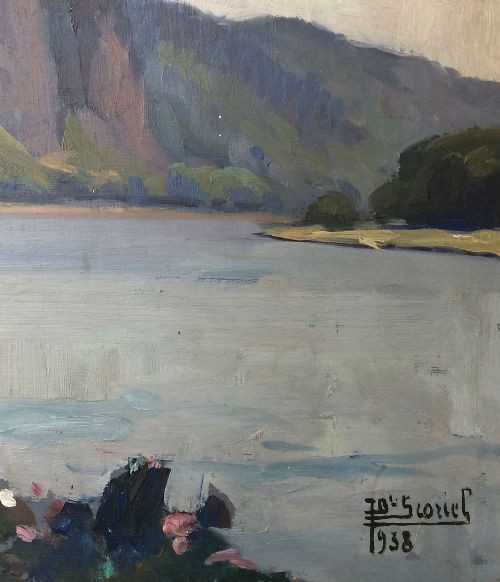
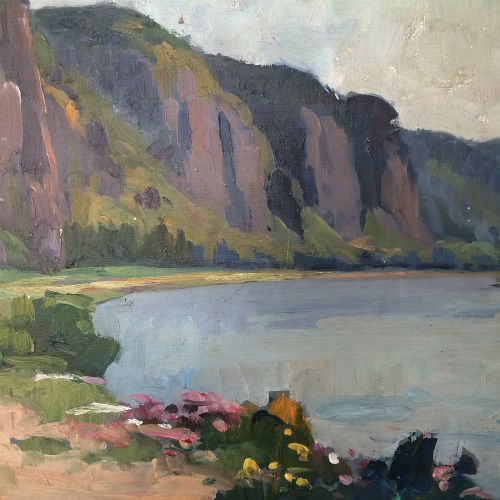
Oil of panel of a view of a river by the listed Belgium painter Jean Baptiste Scoriel (1883 - 1956). The painting is signed and dated 1938. It is mounted in a quality wooden frame.

Scoriel was the son of a miner of Roton (Farciennes), and of Flemish origin. He was only three when his family moved to Tamines and was orphaned at twelve. JB Scoriel found his artistic vocation from an early age. Although from the age of eleven years old, he has to work for the family as a worker in a brickyard and then a foundry. He nevertheless manages to enroll in the School of Fine Arts in Namur, led by Theodore Baron. He was taught by D. Merny and in1905 he made a very fast passage to the Brussels Academy. After an exhibition in 1906 and encouraged by a promising success, he then focused on the task he had set himself - to be a landscape painter. He attended for a while the workshop of landscape gardener Henri Deglume, then Félix Delahaut. He then went on to complete his training at the School of Emile Claus, realist painter. Scoriel took most of his imspiration from the Sambre will always remain the great inspirer, the Sambre.

During the First World War, he volunteered with his four brothers and experienced the hard existence of the trenches. After being wounded in battle, he returned to painting in Dieppe where married his nurse. After a few years in Dieppe, he moved back to Tamines where he remained except for a few trips to Italy and France.

Strong friendships will be formed with Pierre Paulus of Châtelet and the sculptor Victor Demanet.

A special place must be reserved for Snows JB Scoriel, which is rightly called "Master of the Snow", no less than "Master of the Sambre". His predilection for snow was early. Very early in 1922 he felt the attraction, the power of evocation. The snow corresponds well to the gravity of his temperament. The Master had, indeed, an inimitable talent to seize and render the winters bitter of our campaigns, such as our ancestors knew them and lived, but also their seduction under an ephemeral ray of sun whose fleeting gleams colour the immaculate manna . The Scoriel Snows are fascinating with their transcendent spell, their evocative power. However, they can not hide the rest of the work, so fruitful and diverse, the painter of the Lower Sambre.

During the exodus of 1940 he was refugee in the South, in Castelsagrat (Tarn-et-Garonne). The southern light dazzled Scoriel and left us some interesting pictorial testimonies. After the war, the artist revised his technique and shows a return to respect for line and form. Back in Tamines, the artist will return to his first love the Neiges and was inspired by his master Pierre Breughel. He is also inspired by his technique, uses a resin-based medium to dilute his now over-finished colours .
J B Scoriel became an eminent professor of great value who has trained a large number of future artists. Scoriel can realise, by simple means, vast landscapes. The colours are frank and effects very bright. His theory for his pupils was "Simplify!"

Bibliography taken from the Abécédaire des peintres du Pays de Charleroi, Frédéric Mac Donough, éditions Labor, 2006.

Dimensions - 73 x 62 cms

Physical Dimensions
Height
73cm (28.74")
Width
62cm (24.41")
Depth
4cm (1.57")
Declaration

Rue des Fontenelles has dated this Vintage River Landscape Painting to the 1930s.

Reference Numbers
Sellingantiques Reference
SA547389
Description
Oil of panel of a view of a river by the listed Belgium painter Jean Baptiste Scoriel (1883 - 1956). The painting is signed and dated 1938. It is mounted in a quality wooden frame.

Scoriel was the son of a miner of Roton (Farciennes), and of Flemish origin. He was only three when his family moved to Tamines and was orphaned at twelve. JB Scoriel found his artistic vocation from an early age.

Although from the age of eleven years old, he has to work for the family as a worker in a brickyard and then a foundry.
Rue des Fontenelles

He nevertheless manages to enroll in the School of Fine Arts in Namur, led by Theodore Baron. He was taught by D. Merny and in1905 he made a very fast passage to the Brussels Academy. After an exhibition in 1906 and encouraged by a promising success, he then focused on the task he had set himself - to be a landscape painter. He attended for a while the workshop of landscape gardener Henri Deglume, then Félix Delahaut. He then went on to complete his training at the School of Emile Claus, realist painter. Scoriel took most of his imspiration from the Sambre will always remain the great inspirer, the Sambre.

fig 1. An original mid-twentieth-century oil painting depicting a river scene bordered by steep rocky cliffs and green foliage under a cloudy sky.
fig 1. River Landscape - Oil Painting

During the First World War, he volunteered with his four brothers and experienced the hard existence of the trenches. After being wounded in battle, he returned to painting in Dieppe where married his nurse. After a few years in Dieppe, he moved back to Tamines where he remained except for a few trips to Italy and France.

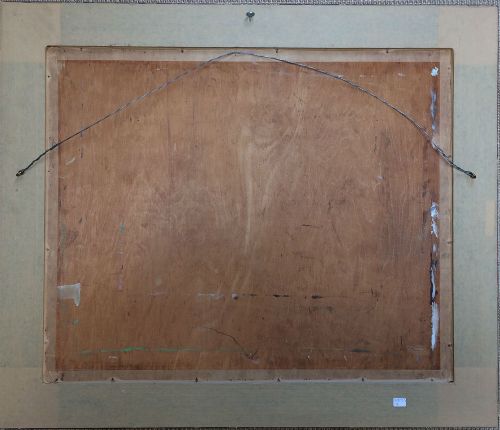
fig 2. An original mid-twentieth-century oil painting depicting a river scene bordered by steep rocky cliffs and green foliage under a cloudy sky.
fig 2. River Landscape - Oil Painting

Strong friendships will be formed with Pierre Paulus of Châtelet and the sculptor Victor Demanet.

A special place must be reserved for Snows JB Scoriel, which is rightly called "Master of the Snow", no less than "Master of the Sambre". His predilection for snow was early. Very early in 1922 he felt the attraction, the power of evocation. The snow corresponds well to the gravity of his temperament. The Master had, indeed, an inimitable talent to seize and render the winters bitter of our campaigns, such as our ancestors knew them and lived, but also their seduction under an ephemeral ray of sun whose fleeting gleams colour the immaculate manna . The Scoriel Snows are fascinating with their transcendent spell, their evocative power. However, they can not hide the rest of the work, so fruitful and diverse, the painter of the Lower Sambre.

fig 3. An original mid-twentieth-century oil painting depicting a river scene bordered by steep rocky cliffs and green foliage under a cloudy sky.
fig 3. River Landscape - Oil Painting

During the exodus of 1940 he was refugee in the South, in Castelsagrat (Tarn-et-Garonne). The southern light dazzled Scoriel and left us some interesting pictorial testimonies. After the war, the artist revised his technique and shows a return to respect for line and form. Back in Tamines, the artist will return to his first love the Neiges and was inspired by his master Pierre Breughel. He is also inspired by his technique, uses a resin-based medium to dilute his now over-finished colours .

fig 4. An original mid-twentieth-century oil painting depicting a river scene bordered by steep rocky cliffs and green foliage under a cloudy sky.
fig 4. River Landscape - Oil Painting

J B Scoriel became an eminent professor of great value who has trained a large number of future artists. Scoriel can realise, by simple means, vast landscapes. The colours are frank and effects very bright. His theory for his pupils was "Simplify!"

Bibliography taken from the Abécédaire des peintres du Pays de Charleroi, Frédéric Mac Donough, éditions Labor, 2006.

Dimensions - 73 x 62 cms

Height
73cm (28.74")
Width
62cm (24.41")
Depth
4cm (1.57")
Date of Manufacture

Rue des Fontenelles has dated this Vintage River Landscape Painting to the 1930s.

Reference Numbers
Sellingantiques Ref
SA547389
Rue des Fontenelles
Sellingantiques verified Since Mar 2015

Specialists in french antiiques, decorative objects and french and european paintings.

Dealer Profile

You can view the stock and full dealer information on the Rue des Fontenelles Profile Page

PDF SHARE
SAVE
An original mid-twentieth-century oil painting depicting a river scene bordered by steep rocky cliffs and green foliage under a cloudy sky.
1 / 7
Archive I An original mid-twentieth-century oil painting depicting a river scene bordered by steep rocky cliffs and green foliage under a cloudy sky.

River Landscape - Oil Painting

Archive II An original mid-twentieth-century oil painting depicting a river scene bordered by steep rocky cliffs and green foliage under a cloudy sky. View II
Archive III An original mid-twentieth-century oil painting depicting a river scene bordered by steep rocky cliffs and green foliage under a cloudy sky. View III
Archive IV An original mid-twentieth-century oil painting depicting a river scene bordered by steep rocky cliffs and green foliage under a cloudy sky. View IV
Archive V An original mid-twentieth-century oil painting depicting a river scene bordered by steep rocky cliffs and green foliage under a cloudy sky. View V
Archive VI An original mid-twentieth-century oil painting depicting a river scene bordered by steep rocky cliffs and green foliage under a cloudy sky. View VI
Archive VII An original mid-twentieth-century oil painting depicting a river scene bordered by steep rocky cliffs and green foliage under a cloudy sky. View VII
FURTHER BROWSING

Visitors also looked at these ⇣

Enlarged Archival View
Location
Chagford
Devon
United Kingdom
Verified Since Mar 2015
Items For Sale 155
Items Sold 1,180
Rue des Fontenelles
Verified Since Mar 2015
View Dealer Info
Location: Chagford, Devon, United Kingdom
Verified
Mar 2015
For Sale
155
Sold
1,180
An original mid-twentieth-century oil painting depicting a river scene bordered by steep rocky cliffs and green foliage under a cloudy sky.
River Landscape - Oil Painting
Ref: SA547389
An original mid-twentieth-century oil painting depicting a river scene bordered by steep rocky cliffs and green foliage under a cloudy sky.
Detail View 1
Detail View 2
Detail View 3
Detail View 4
Detail View 5
Detail View 6
Archival Detail
Every single antique dealer on our platform is individually approved by our internal team. We verify their professional trade history, ethical standards, and photographic quality to ensure a secure, high-standard buying environment. Upon joining, every dealer agrees to a strict 9-point code of conduct. While issues can occasionally arise, our dealers typically resolve them swiftly and directly with the buyer. In fact, since our founding in 2002, Sellingantiques has only had to step in to help resolve an issue on roughly five occasions—a true testament to the quality of our dealers and their dedication to your happiness.
Our dealers are highly experienced in packing and shipping fragile, high-value antiques. Because you are in direct contact with the dealer, you will be able to easily go through all available shipping and insurance options together to ensure your item arrives safely.
Antiques are the ultimate green purchase. By choosing historical pieces over newly manufactured goods, you completely eliminate the carbon footprint of modern mass production while preserving exceptional, timeless craftsmanship.

Mid-twentieth-century landscape oil paintings often feature simplified forms, expressive brushwork, and muted colour palettes influenced by post-impressionism and modernist movements. Artists focused on capturing texture, atmosphere, and light rather than minute photo-realistic detail.

Paintings from this era typically utilized artists oil colours applied directly to stretched linen canvas, cotton duck, or solid wood panels. Frames were commonly constructed from stained or painted softwood with cloth or gilt slip inserts.

Authentic 1950s oil paintings generally exhibit natural aging, such as subtle craquelure, slight yellowing of varnish layers, and oxidation on the exposed reverse canvas or timber stretcher bars. An artists signature accompanied by a contemporary date provides key verification.

A vintage landscape painting can serve as a focal point above a sideboard or mantelpiece, bridging historical character with contemporary furniture. Combining the artwork with neutral wall tones allows the soft natural pigments of the canvas to highlight the rooms scheme.

Preserve oil paintings by hanging them away from direct sunlight, dampness, and heat sources to prevent cracking or warping. Surface dust should be gently removed using a soft, dry artists brush rather than liquid cleaners or damp cloths.
items
Add keywords to the filter
Price
£100
£250000
Era
Movements
Material
Origin
Stock Location
Freshness
Online Payments
Categories