



Muted Grey Wall Art
Muted grey wall art brings together subtle tones and historical depth, offering peaceful landscapes and townscapes that anchor a room without dominating it.
Muted Grey Wall Art
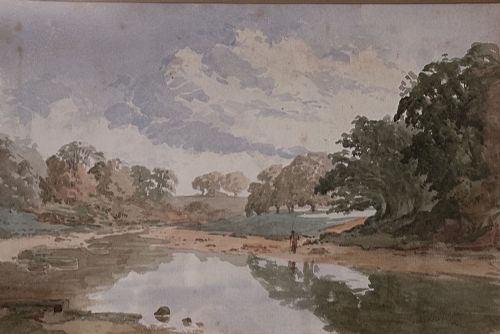
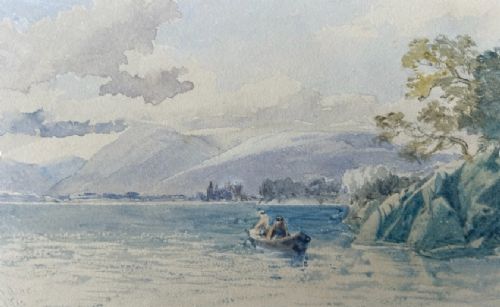
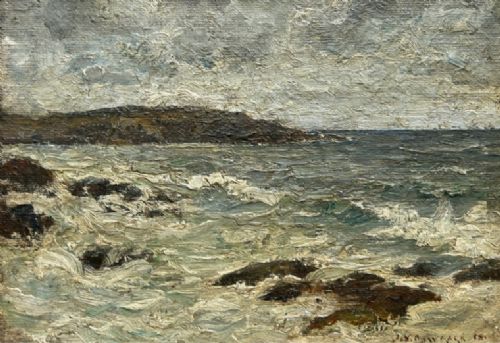
Muted grey wall art encompasses historical paintings and works on paper created across the nineteenth and twentieth centuries. The selection focuses on subdued palettes, capturing coastal waters, winter scenes, industrial cityscapes, and quiet rural harbours.
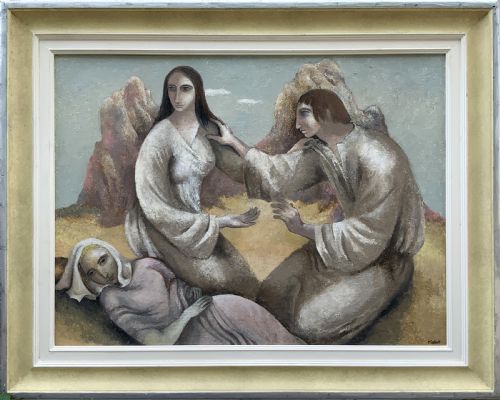
Buyers encounter oil paintings on canvas and board alongside delicate watercolour and pastel paintings. These works originate from British and French movements, moving from Victorian realism through to mid-century modernism and post-impressionism.
Pieces range from intimate depictions of domestic livestock and cart horses to sweeping views of rivers, ports, and rooftops. Each item reflects the artist's engagement with tonal atmosphere and restricted colour harmony.
How they were made
Makers utilised traditional oil paint on canvas and board, often building textured surfaces using impasto techniques alongside smooth, blended applications. Watercolours were applied to paper with fluid washes, capturing atmospheric light in coastal and river landscapes.
Pastels and mixed media also appear, adding a dry, chalky softness to depictions of northern industrial towns and French ports. Supports varied from stretched canvas to primed board and heavy rag paper.
Quiet horses and heavy cart ponies share gallery space with bustling industrial docks and snowy rooftops.
What varies in quality
Quality rests in the sureness of the handling and the cohesion of the tonal palette. Stronger pieces display confident brushwork and a balanced composition that unifies grey and neutral shades into a compelling atmospheric whole.
Handling of light and depth distinguishes accomplished works from simpler decorative pieces. The ability to suggest weather, texture, and space through a restrained palette marks the finer examples in this grouping.
Kenneth Cozens·Thomas Miles Richardson Jnr·Arthur Reginald Smith·Ernest Higgins Rigg·Ernest F Hill·Rowland Henry Hill·Fred Mayor·Fred Stead·Donald Mcintyre·William Lee Hankey·Frank Shenton·Henry John Sylvester Stannard·Carleton Grant·Matthew Hale
The Muted Grey Wall Art Glossary
- Impasto
- Paint applied thickly to a canvas or board, leaving visible brush or palette knife marks that catch the light. This technique adds tactile dimension to surfaces.
- Watercolour
- A paint consisting of pigment suspended in a water-based solution, traditionally worked on paper. It relies on the white of the paper to shine through translucent washes.
- Post-Impressionism
- An art movement extending roughly from the late nineteenth century that rejected naturalistic depiction in favour of expressive forms and colour. Artists focused on subjective visions rather than purely optical recording.
- Mid-Century Modernist
- A style spanning the middle decades of the twentieth century, characterised by simplified forms and a departure from traditional academic representation.
- Board
- A rigid flat support made of wood, pulp, or composition material used by artists as an alternative to stretched canvas.
Muted Grey Wall Art: Frequently Asked Questions
How do I care for antique watercolours?
Watercolours are sensitive to strong sunlight and excessive moisture. Framing them behind glass with acid-free mounts protects the paper from fading and deterioration.
Keep them away from direct heat sources and humid environments like kitchens or bathrooms to preserve the integrity of the pigments and paper.
What is the difference between oil on canvas and oil on board?
Oil on canvas involves stretched woven fabric, providing slight give and a textured weave beneath the paint surface. Oil on board uses a rigid wooden or composite backing, which offers a completely stable and smooth base.
Both methods were common across the nineteenth and twentieth centuries, chosen by artists depending on portability and preferred working resistance.
How can I date these paintings?
Dating relies on stylistic evidence, artist signatures, framing methods, and materials. Many works carry period signatures or exhibition labels on the reverse that narrow down the decade of creation.
Comparing brushwork and subject matter to documented movements like British Impressionism or mid-century modernism provides a reliable chronological anchor.
Where were these rural and marine scenes painted?
The locations span British coastal ports like St. Ives and Newlyn, Scottish rivers, Welsh landscapes, and French coastal towns such as Rouen and the Riviera. Artists travelled extensively to capture maritime activity and industrial growth.
Many works document specific historical wharves, harbours, and rural farms that have since changed significantly.