37,975  PAGES BROWSED TODAY PAGES TODAY 277 ANTIQUES UPLOADED TODAYNEW ARRIVALS
277 ITEMS ADDED TODAY
Sort Order
Items Per Page
Browse Categories
Sort order
Relevant Links
Items per page
ID #SA1232872
FOR SALE
£7,200
Email Buy
Save
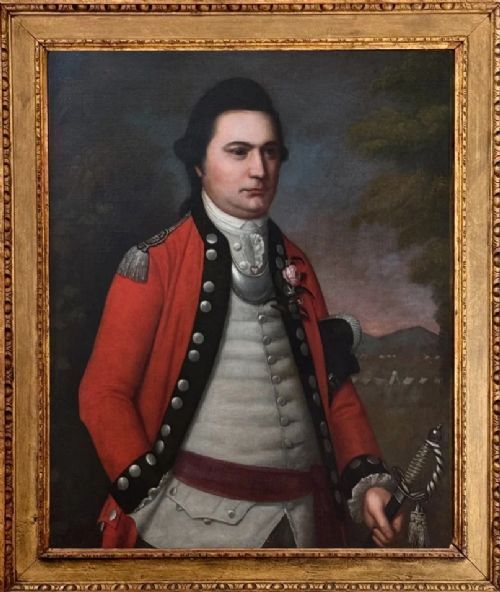
Stickland Lowry (1737-85) - Portrait of an Infantry Officer C.1780.
Period Portraits
for sale €8,424     $9,144
£7,200
Period Portraits

Period Portraits

Sellingantiques Verified Since Jan 2017
View Dealers Stock Page
  • About Us
    Specialist dealer in portraits from the 17th century to the 20th century. Our stock includes quality oil paintings, drawings, and mezzotints
Id #SA1232872
PDF SHARE
SAVE

Stickland Lowry (1737-85) - Portrait of an Infantry Officer C.1780.

19th century
For Sale by Period Portraits
Description

18th century British portrait of an infantry officer c.1780 attributed to Stickland Lowry (1737-85)

Stickland Lowry (1737-85)

Lowry was a portrait painter who was born in Whitehaven Cumbria and is recorded as working in Staffordshire, Shropshire, Dublin and particularly the North of Ireland where he stayed until the early 1780s.

He contributed thirteen engraved views of churches, which appeared in History and Antiquities of Shrewsbury (1779). He was patronised by Sir John Rawdon, 1st Earl of Moira and besides portraits, his output embraced still-life and trompe l’oeil paintings, works which show him to have been a versatile and accomplished painter.
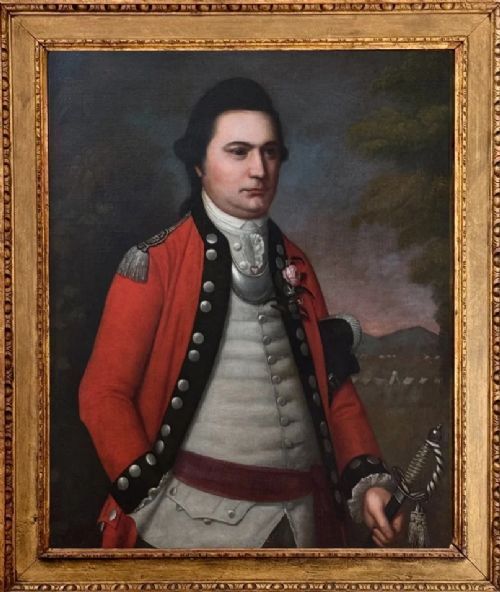
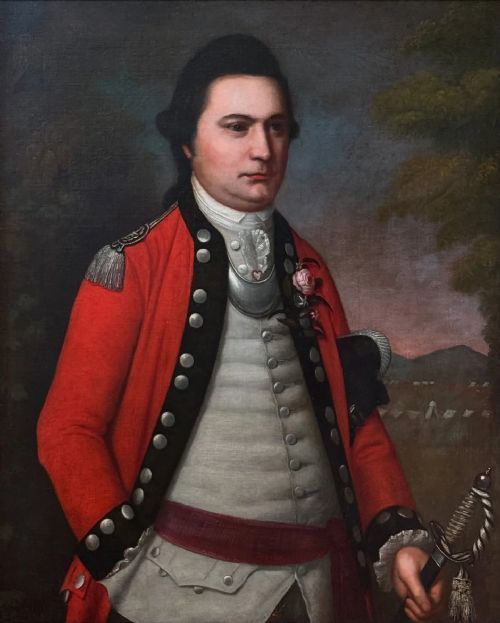
The elegant sitter is depicted three quarter length between foliage against a stormy sky and military encampment. His left hand is in his pocket, whilst his right hand grasps his sword, and his hat is tucked in his arm. With his head and eyes are averted away from the viewer, he gazes off as if lost in thought.
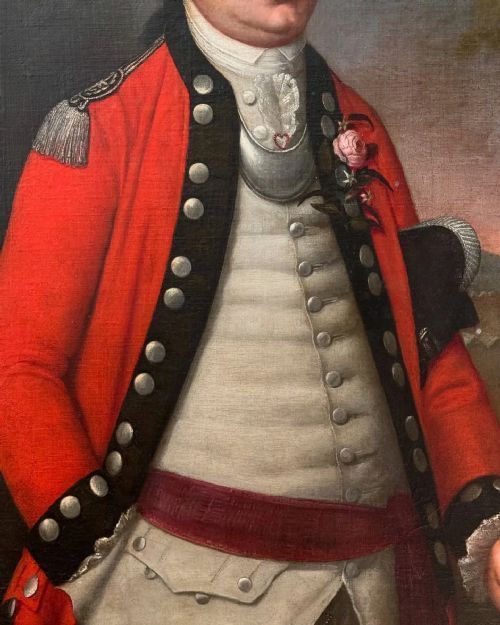
We know that this gentleman is an infantry officer as his uniform is cut according to the 1768 Clothing Warrant, and his costume is comprised of a scarlet coat with black facings and silver paired buttons, worn over a frilled white shirt, grey waistcoat and silver gorget which glistens in the light.
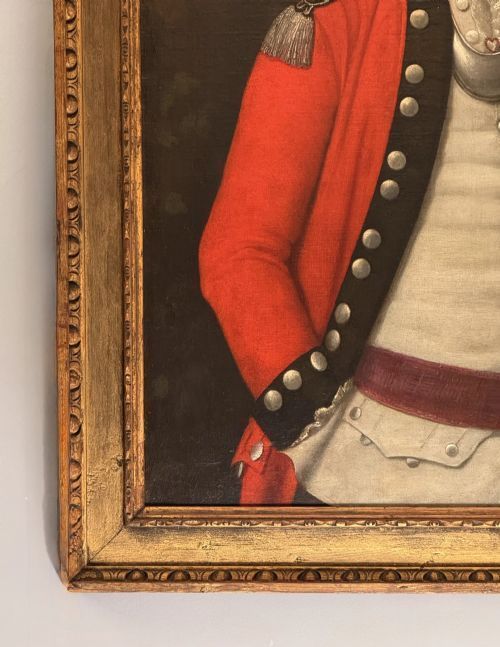
It is likely that this officer is a Militia officer because his buttons are not numbered and also because his sword knot. From 1767 regiments were ordered to number their buttons with their regimental precedence number and these could appear in Arabic or Roman numerals, but there are none here. His silver lace knot with black stripe is also not of the type worn by officers since at least 1751 by regular officers.
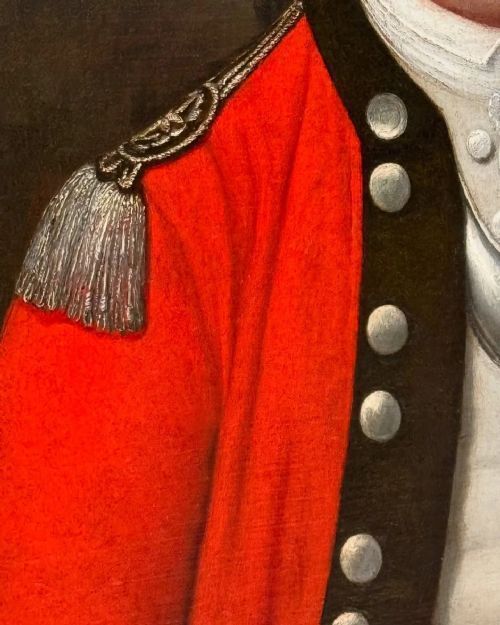
Militia, part-time soldiers officered by the local land-owning class and organised by county or, in the case of Yorkshire, by Riding. The Militia was for Home Defence only and could not be sent overseas. It was “embodied” - called out for active duty - during wartime and, in combination with those Regular regts that remained in GB, it constituted the army that would repel any invasion from France. After the French and Spanish joined in the American War of Independence in 1778, the Militia was embodied and did not stand down until early 1783.
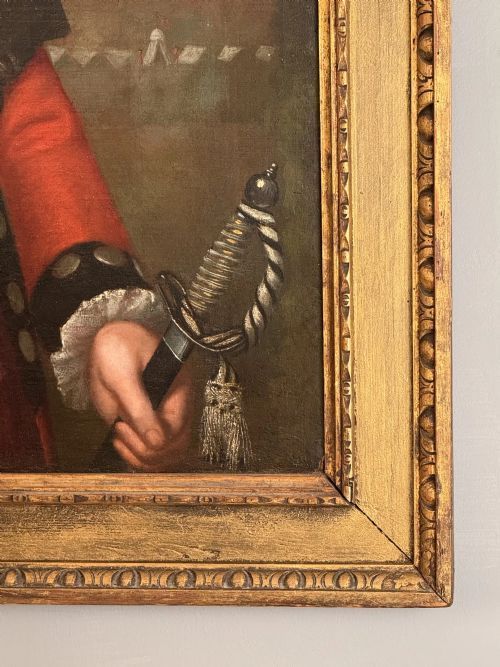
During the Summer both Regulars and Militia went into camps of exercise strategically positioned in Kent and Essex in order to be on hand to repel invasion. The background shows exactly the sort of encampment that one would expect.
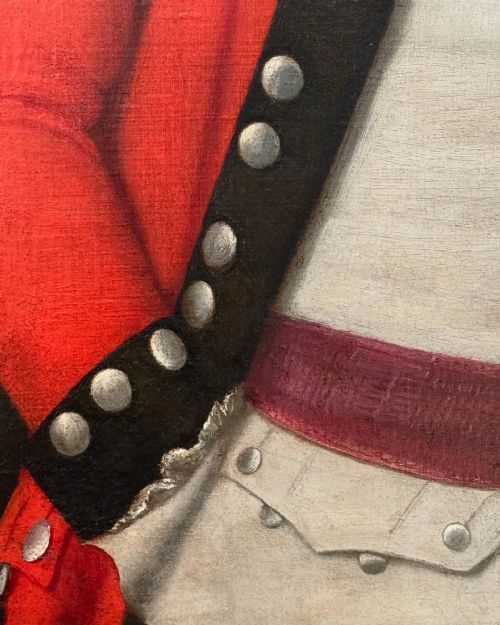
Of particular note here are the rose the officers lapel as well as the heart-shaped jewel on his shirt ruffle. The Regular regiments that fought the battle of Minden in 1759 always (and still do) wear roses in their buttonholes to commemorate that date, but no regt at Minden had black facings.
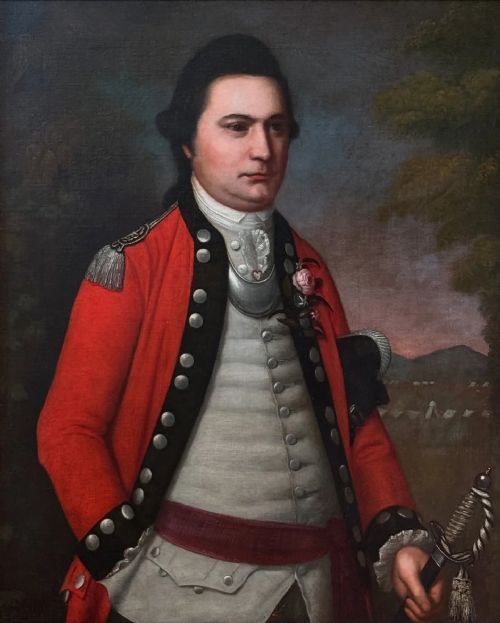
This work may even be a rare surviving example of a marriage portrait, charged with emotion and referring to a private matrimonial event. In an excellent state of conservation, it is ready to hang and enjoy in its original carved black wooden frame with gilt highlights.
I am most grateful to art historian Adam Busiakiewicz for his generous suggestion regarding the authorship of this work and Dr Andrew Cormack for his invaluable assistance with military and historical details.

Provenance: Private collection New England USA.

Higher resolution images on request.

Worldwide shipping available.

Canvas: 38 x 30 in / 97cm x 76.5cm

Frame: 44 1/2 x 38 in / 113cm x 97cm

Physical Dimensions
Height
113cm (44.49")
Width
97cm (38.19")
Depth
4cm (1.57")
Declaration

Period Portraits has dated this Georgian Officer Oil Portrait to the 19th Century.

Reference Numbers
Sellingantiques Reference
SA1232872
Description
18th century British portrait of an infantry officer c.1780 attributed to Stickland Lowry (1737-85)

Stickland Lowry (1737-85)

Lowry was a portrait painter who was born in Whitehaven Cumbria and is recorded as working in Staffordshire, Shropshire, Dublin and particularly the North of Ireland where he stayed until the early 1780s.

He contributed thirteen engraved views of churches, which appeared in History and Antiquities of Shrewsbury (1779).
Period Portraits

He was patronised by Sir John Rawdon, 1st Earl of Moira and besides portraits, his output embraced still-life and trompe l’oeil paintings, works which show him to have been a versatile and accomplished painter.

fig 1. An eighteenth-century oil painting depicting a British military infantry officer in a red uniform holding a sword, framed in carved giltwood.
fig 1. Stickland Lowry (1737-85) - Portrait of an Infantry Officer C.1780.

The elegant sitter is depicted three quarter length between foliage against a stormy sky and military encampment. His left hand is in his pocket, whilst his right hand grasps his sword, and his hat is tucked in his arm. With his head and eyes are averted away from the viewer, he gazes off as if lost in thought.

fig 2. An eighteenth-century oil painting depicting a British military infantry officer in a red uniform holding a sword, framed in carved giltwood.
fig 2. Stickland Lowry (1737-85) - Portrait of an Infantry Officer C.1780.

We know that this gentleman is an infantry officer as his uniform is cut according to the 1768 Clothing Warrant, and his costume is comprised of a scarlet coat with black facings and silver paired buttons, worn over a frilled white shirt, grey waistcoat and silver gorget which glistens in the light.

fig 3. An eighteenth-century oil painting depicting a British military infantry officer in a red uniform holding a sword, framed in carved giltwood.
fig 3. Stickland Lowry (1737-85) - Portrait of an Infantry Officer C.1780.

It is likely that this officer is a Militia officer because his buttons are not numbered and also because his sword knot. From 1767 regiments were ordered to number their buttons with their regimental precedence number and these could appear in Arabic or Roman numerals, but there are none here. His silver lace knot with black stripe is also not of the type worn by officers since at least 1751 by regular officers.

fig 4. An eighteenth-century oil painting depicting a British military infantry officer in a red uniform holding a sword, framed in carved giltwood.
fig 4. Stickland Lowry (1737-85) - Portrait of an Infantry Officer C.1780.

Militia, part-time soldiers officered by the local land-owning class and organised by county or, in the case of Yorkshire, by Riding. The Militia was for Home Defence only and could not be sent overseas. It was “embodied” - called out for active duty - during wartime and, in combination with those Regular regts that remained in GB, it constituted the army that would repel any invasion from France. After the French and Spanish joined in the American War of Independence in 1778, the Militia was embodied and did not stand down until early 1783.

fig 5. An eighteenth-century oil painting depicting a British military infantry officer in a red uniform holding a sword, framed in carved giltwood.
fig 5. Stickland Lowry (1737-85) - Portrait of an Infantry Officer C.1780.

During the Summer both Regulars and Militia went into camps of exercise strategically positioned in Kent and Essex in order to be on hand to repel invasion. The background shows exactly the sort of encampment that one would expect.

fig 6. An eighteenth-century oil painting depicting a British military infantry officer in a red uniform holding a sword, framed in carved giltwood.
fig 6. Stickland Lowry (1737-85) - Portrait of an Infantry Officer C.1780.

Of particular note here are the rose the officers lapel as well as the heart-shaped jewel on his shirt ruffle. The Regular regiments that fought the battle of Minden in 1759 always (and still do) wear roses in their buttonholes to commemorate that date, but no regt at Minden had black facings.

fig 7. An eighteenth-century oil painting depicting a British military infantry officer in a red uniform holding a sword, framed in carved giltwood.
fig 7. Stickland Lowry (1737-85) - Portrait of an Infantry Officer C.1780.

This work may even be a rare surviving example of a marriage portrait, charged with emotion and referring to a private matrimonial event. In an excellent state of conservation, it is ready to hang and enjoy in its original carved black wooden frame with gilt highlights.

fig 8. An eighteenth-century oil painting depicting a British military infantry officer in a red uniform holding a sword, framed in carved giltwood.
fig 8. Stickland Lowry (1737-85) - Portrait of an Infantry Officer C.1780.

I am most grateful to art historian Adam Busiakiewicz for his generous suggestion regarding the authorship of this work and Dr Andrew Cormack for his invaluable assistance with military and historical details.

Provenance: Private collection New England USA.

Higher resolution images on request.

Worldwide shipping available.

Canvas: 38 x 30 in / 97cm x 76.5cm

Frame: 44 1/2 x 38 in / 113cm x 97cm

Height
113cm (44.49")
Width
97cm (38.19")
Depth
4cm (1.57")
Date of Manufacture

Period Portraits has dated this Georgian Officer Oil Portrait to the 19th Century.

Reference Numbers
Sellingantiques Ref
SA1232872
Period Portraits
Period Portraits
Sellingantiques verified Since Jan 2017

Specialist dealer in portraits from the 17th century to the 20th century. Our stock includes quality oil paintings, drawings, and mezzotints

Dealer Profile

You can view the stock and full dealer information on the Period Portraits Profile Page
PDF SHARE
SAVE
An eighteenth-century oil painting depicting a British military infantry officer in a red uniform holding a sword, framed in carved giltwood.
1 / 9
Archive I An eighteenth-century oil painting depicting a British military infantry officer in a red uniform holding a sword, framed in carved giltwood.

Stickland Lowry (1737-85) - Portrait of an Infantry Officer C.1780.
Archive II An eighteenth-century oil painting depicting a British military infantry officer in a red uniform holding a sword, framed in carved giltwood. View II
Archive III An eighteenth-century oil painting depicting a British military infantry officer in a red uniform holding a sword, framed in carved giltwood. View III
Archive IV An eighteenth-century oil painting depicting a British military infantry officer in a red uniform holding a sword, framed in carved giltwood. View IV
Archive V An eighteenth-century oil painting depicting a British military infantry officer in a red uniform holding a sword, framed in carved giltwood. View V
Archive VI An eighteenth-century oil painting depicting a British military infantry officer in a red uniform holding a sword, framed in carved giltwood. View VI
Archive VII An eighteenth-century oil painting depicting a British military infantry officer in a red uniform holding a sword, framed in carved giltwood. View VII
Archive VIII An eighteenth-century oil painting depicting a British military infantry officer in a red uniform holding a sword, framed in carved giltwood. View VIII
Archive IX An eighteenth-century oil painting depicting a British military infantry officer in a red uniform holding a sword, framed in carved giltwood. View IX
FURTHER BROWSING

Visitors also looked at these ⇣

Enlarged Archival View
Telephone 07889 859729
Location
North Yorkshire
United Kingdom
Verified Since Jan 2017
Items For Sale 47
Items Sold 61
Period Portraits
Period Portraits
Verified Since Jan 2017
View Dealer Info
Location: North Yorkshire, United Kingdom
Verified
Jan 2017
For Sale
47
Sold
61
An eighteenth-century oil painting depicting a British military infantry officer in a red uniform holding a sword, framed in carved giltwood.
STICKLAND LOWRY (1737-85) - PORTRAIT OF AN INFANTRY OFFICER c.1780.
Ref: SA1232872
An eighteenth-century oil painting depicting a British military infantry officer in a red uniform holding a sword, framed in carved giltwood.
Detail View 1
Detail View 2
Detail View 3
Detail View 4
Detail View 5
Detail View 6
Detail View 7
Detail View 8
Archival Detail
Every single antique dealer on our platform is individually approved by our internal team. We verify their professional trade history, ethical standards, and photographic quality to ensure a secure, high-standard buying environment. Upon joining, every dealer agrees to a strict 9-point code of conduct. While issues can occasionally arise, our dealers typically resolve them swiftly and directly with the buyer. In fact, since our founding in 2002, Sellingantiques has only had to step in to help resolve an issue on roughly five occasions—a true testament to the quality of our dealers and their dedication to your happiness.
Our dealers are highly experienced in packing and shipping fragile, high-value antiques. Because you are in direct contact with the dealer, you will be able to easily go through all available shipping and insurance options together to ensure your item arrives safely.
Antiques are the ultimate green purchase. By choosing historical pieces over newly manufactured goods, you completely eliminate the carbon footprint of modern mass production while preserving exceptional, timeless craftsmanship.

Georgian military portraiture typically depicts high-ranking officers in formal regimentals, highlighting rank, military accoutrements, and social standing during the eighteenth century.

Artists executed these paintings using oil-based pigments applied to stretched linen canvas, frequently presented within hand-carved wood frames coated in gold leaf or composition gesso.

Authentic works display natural craquelure consistent with age, period-correct canvas weave, original stretcher construction, and hand-carved giltwood framing techniques typical of the era.

Position the artwork as a central focal point above a mantelpiece, sideboard, or within a dark-painted library setting to add historical texture and visual interest.

Display the painting away from direct sunlight, dampness, and heat sources, dusting the frame gently with a soft brush and consulting a professional restorer for varnish cleaning.
items
Add keywords to the filter
Price
£100
£250000
Era
Movements
Material
Origin
Stock Location
Freshness
Online Payments
Categories