45,407  PAGES BROWSED TODAY PAGES TODAY • 112 ANTIQUES UPLOADED TODAYNEW ARRIVALS
GIFTSNEW
112 ITEMS ADDED TODAY
Sort Order
Items Per Page
Browse Categories
Sort order
Relevant Links
Items per page
ID #SA1226527
FOR SALE
£9,000
Email Phone
Save
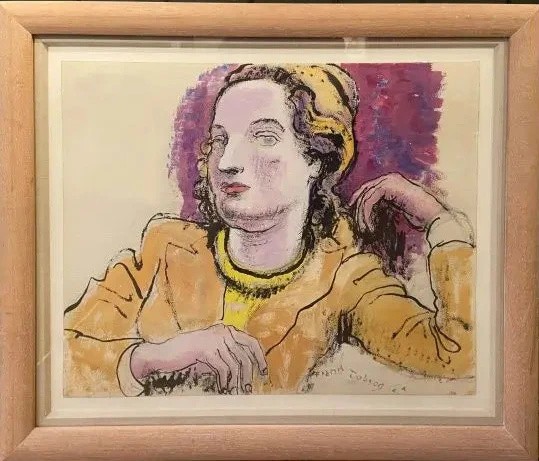
Frank Dobson Portrait of the Artist's Assistant
For sale by Darnley Fine Art
Id #SA1226527
PDF SHARE
SAVE

Frank Dobson Portrait of the Artist's Assistant

1920 - 1940
For Sale by Darnley Fine Art
Description

Watercolour, ink and graphite on paper, signed lower right

Image size: 22 x 17 1/2 inches (56 x 44.5 cm)

Original frame

Inscribed on reverse ‘Frank Dobson’s Assistant – Celia Gills’

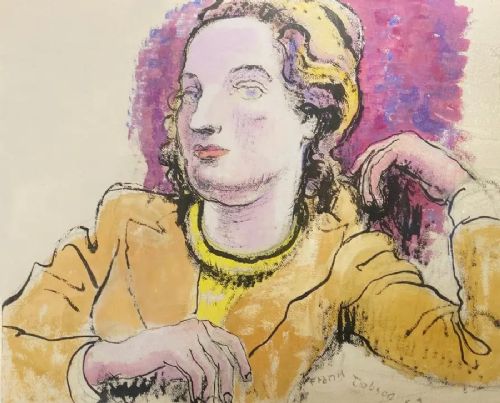
This painting was likely to have been created by the artist in the late 1930s just as his reputation began to soar. Although most well-known for his sculptures the artist began as a painter and continued this practice throughout his career. Similarly to his well-known sculptural works, we can see here Dobson’s unfaltering interest in the depiction of the female form.
This is a rare work as sadly few of Dobson’s paintings have survived. In 1995, the art critic Brian Sewell recalled the great loss of much of Frank Dobson's work after his death, “After his death, his widow asked me to help her clear the studio at Stamford Bridge, and I was appalled at the destruction that she wrought, smashing to smithereens small clay and terracotta models, tearing fine drawings in red and black chalk, hundreds of paintings, their fragments left in a dustbin’.

Frank Dobson

Dobson, Frank (1886–1963). British sculptor, born in London, the son of an illustrator of the same name. From 1902 to 1904 he worked as an assistant to William Reynolds-Stephens. He then spent two years in Cornwall, earning his living with landscape watercolours, before winning a scholarship to Hospitalfield Art Institute, Arbroath, where he studied 1906–10.

After returning to London, he continued his studies at the City and Guilds School, Kennington, then again lived in Cornwall, where he shared a studio with Cedric Morris in Newlyn. His early work consisted mainly of paintings, the few surviving examples showing how impressed he was by Roger Fry’s Post-Impressionist exhibitions (Stanhope Forbes, whom Dobson met in Newlyn, had been shocked by his modernism). He made his first carving in 1913, but his first one-man exhibition—at the Chenil Gallery, London, in 1914—consisted of paintings and drawings. After the First World War (when he served in France with the Artists’ Rifles), he turned increasingly to sculpture, and had his first one-man exhibition as a sculptor in 1920, at the Leicester Galleries, London.

During the 1920s and 1930s Dobson gained an outstanding reputation: in 1925 Roger Fry described his work as ‘true sculpture and pure sculpture … almost the first time that such a thing has been even attempted in England’. The monumental dignity of his work was in the tradition of Maillol, and like him Dobson found the female nude the most satisfactory subject for three-dimensional composition, as in Cornucopia (University of Hull, 1925–7), described by Clive Bell as ‘the finest piece of sculpture by an Englishman since—I don’t know when’. His work was more stylized than Maillol’s, however, and his sophisticated simplifications of form made him one of the pioneers of modern sculpture in Britain.

Dobson was also outstanding as a portrait sculptor, his best-known work in this field being the head of Sir Osbert Sitwell in polished brass (Tate Gallery, London, 1923). He worked in various other materials including bronze, terracotta, and stone, and he was prominent in the revival of direct carving. His craftsmanship in all these materials was superb and he played an important role as a liberal-minded and kind-hearted teacher at the Royal College of Art, where he was professor of sculpture from 1946 to 1953.

Dobson is represented in many public galleries, including the Tate Gallery, London. There was an Arts Council memorial exhibition in 1966 and more recently there was a major retrospective at the Henry Moore Institute in Leeds, in 1994.

Physical Dimensions
Height
44.5cm (17.52")
Width
56cm (22.05")
Declaration

Darnley Fine Art has dated this Frank Dobson Portrait Artwork to the 1930s.

Reference Numbers
Sellingantiques Reference
SA1226527
Description
Watercolour, ink and graphite on paper, signed lower right

Image size: 22 x 17 1/2 inches (56 x 44.5 cm)

Original frame

Inscribed on reverse ‘Frank Dobson’s Assistant – Celia Gills’

“
This painting was likely to have been created by the artist in the late 1930s just as his reputation began to soar.
Darnley Fine Art

Although most well-known for his sculptures the artist began as a painter and continued this practice throughout his career. Similarly to his well-known sculptural works, we can see here Dobson’s unfaltering interest in the depiction of the female form.

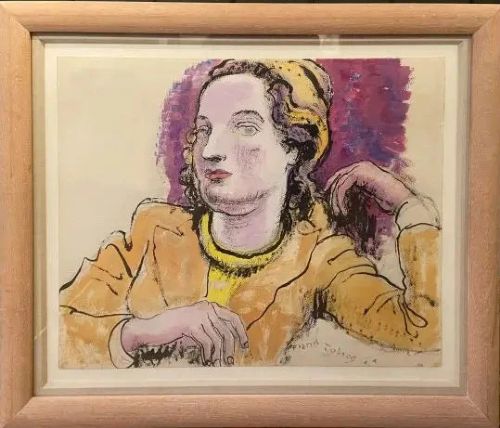
fig 1. A framed portrait drawing of a seated woman wearing a yellow garment against a purple background.
fig 1. Frank Dobson Portrait of the Artist's Assistant

This is a rare work as sadly few of Dobson’s paintings have survived. In 1995, the art critic Brian Sewell recalled the great loss of much of Frank Dobson's work after his death, “After his death, his widow asked me to help her clear the studio at Stamford Bridge, and I was appalled at the destruction that she wrought, smashing to smithereens small clay and terracotta models, tearing fine drawings in red and black chalk, hundreds of paintings, their fragments left in a dustbin’.

Frank Dobson

Dobson, Frank (1886–1963). British sculptor, born in London, the son of an illustrator of the same name. From 1902 to 1904 he worked as an assistant to William Reynolds-Stephens. He then spent two years in Cornwall, earning his living with landscape watercolours, before winning a scholarship to Hospitalfield Art Institute, Arbroath, where he studied 1906–10.

After returning to London, he continued his studies at the City and Guilds School, Kennington, then again lived in Cornwall, where he shared a studio with Cedric Morris in Newlyn. His early work consisted mainly of paintings, the few surviving examples showing how impressed he was by Roger Fry’s Post-Impressionist exhibitions (Stanhope Forbes, whom Dobson met in Newlyn, had been shocked by his modernism). He made his first carving in 1913, but his first one-man exhibition—at the Chenil Gallery, London, in 1914—consisted of paintings and drawings. After the First World War (when he served in France with the Artists’ Rifles), he turned increasingly to sculpture, and had his first one-man exhibition as a sculptor in 1920, at the Leicester Galleries, London.

During the 1920s and 1930s Dobson gained an outstanding reputation: in 1925 Roger Fry described his work as ‘true sculpture and pure sculpture … almost the first time that such a thing has been even attempted in England’. The monumental dignity of his work was in the tradition of Maillol, and like him Dobson found the female nude the most satisfactory subject for three-dimensional composition, as in Cornucopia (University of Hull, 1925–7), described by Clive Bell as ‘the finest piece of sculpture by an Englishman since—I don’t know when’. His work was more stylized than Maillol’s, however, and his sophisticated simplifications of form made him one of the pioneers of modern sculpture in Britain.

Dobson was also outstanding as a portrait sculptor, his best-known work in this field being the head of Sir Osbert Sitwell in polished brass (Tate Gallery, London, 1923). He worked in various other materials including bronze, terracotta, and stone, and he was prominent in the revival of direct carving. His craftsmanship in all these materials was superb and he played an important role as a liberal-minded and kind-hearted teacher at the Royal College of Art, where he was professor of sculpture from 1946 to 1953.

Dobson is represented in many public galleries, including the Tate Gallery, London. There was an Arts Council memorial exhibition in 1966 and more recently there was a major retrospective at the Henry Moore Institute in Leeds, in 1994.

Height
44.5cm (17.52")
Width
56cm (22.05")
Date of Manufacture

Darnley Fine Art has dated this Frank Dobson Portrait Artwork to the 1930s.

Reference Numbers
Sellingantiques Ref
SA1226527
Darnley Fine Art
Sellingantiques verified Since Jul 2026
Dealer Profile

You can view the stock and full dealer information on the Darnley Fine Art Profile Page
PDF SHARE
SAVE
A framed portrait drawing of a seated woman wearing a yellow garment against a purple background.
1 / 2
Archive I A framed portrait drawing of a seated woman wearing a yellow garment against a purple background.

Frank Dobson Portrait of the Artist's Assistant
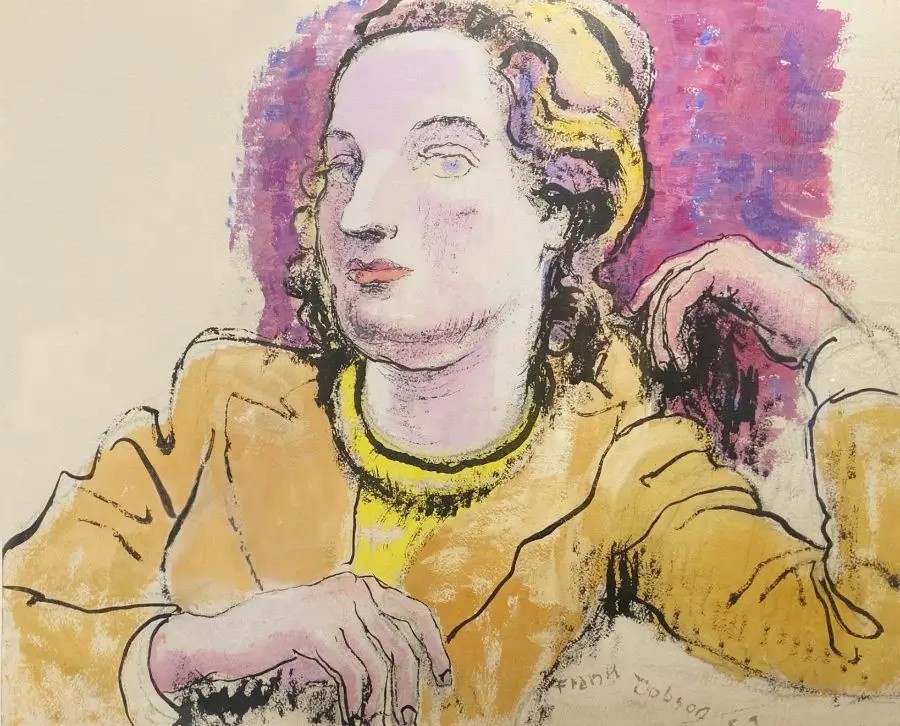
Archive II A framed portrait drawing of a seated woman wearing a yellow garment against a purple background. View II
Enlarged Archival View
Telephone 0207 379 0499
Location
2-4 Cecil Court
London
WC2N 4HE
United Kingdom

Opening Times
Monday to Saturday: 10:30 - 5:30
(excluding Bank Holidays)
Dealer Profile Page sellingantiques.co.uk/dfa
Verified Since Jul 2026
Items For Sale 77
Darnley Fine Art
Verified Since Jul 2026
View Dealer Info
Location: 2-4 Cecil Court, London, WC2N 4HE, United Kingdom, , Opening Times, Monday to Saturday: 10:30 - 5:30, (excluding Bank Holidays)
Verified
Jul 2026
For Sale
77
A framed portrait drawing of a seated woman wearing a yellow garment against a purple background.
Frank Dobson Portrait of the Artist's Assistant
Ref: SA1226527
A framed portrait drawing of a seated woman wearing a yellow garment against a purple background.
Detail View 1
Archival Detail
Every single antique dealer on our platform is individually approved by our internal team. We verify their professional trade history, ethical standards, and photographic quality to ensure a secure, high-standard buying environment. Upon joining, every dealer agrees to a strict 9-point code of conduct. While issues can occasionally arise, our dealers typically resolve them swiftly and directly with the buyer. In fact, since our founding in 2002, Sellingantiques has only had to step in to help resolve an issue on roughly five occasions—a true testament to the quality of our dealers and their dedication to your happiness.
Our dealers are highly experienced in packing and shipping fragile, high-value antiques. Because you are in direct contact with the dealer, you will be able to easily go through all available shipping and insurance options together to ensure your item arrives safely.
Antiques are the ultimate green purchase. By choosing historical pieces over newly manufactured goods, you completely eliminate the carbon footprint of modern mass production while preserving exceptional, timeless craftsmanship.
Written by Sellingantiques from the dealer’s photographs and listing
  • ObjectFramed Artwork
  • Period1920 - 1940
  • StyleModern British
  • MaterialPaper, Wood, Gouache, Ink
  • ColourYellow, Purple
  • MotifsExpressive line work, Figural pose, Yellow jacket
  • SizeH 44.5 cm (18 in) x W 56 cm (22 in)

This framed artwork from 1930 is an original Modern British painting by Frank Dobson, created using watercolour, ink, and graphite on paper. The composition portrays a seated female figure wearing a yellow jacket against a vibrant purple background, showcasing expressive line work and a figural pose. The portrait is signed in the lower right corner and is housed in its original wooden frame behind glass. Visible details include delicate ink outlines, washes of yellow and purple pigment, and a pale cream mount surrounding the paper. The piece measures 44.5 cm high and 56 cm wide. In a home today, it works well placed on a wall above a sideboard in a living room, dining room, or hallway, adding a touch of mid-century modern character to the interior scheme.

Modern British portraiture from the mid-twentieth century is characterised by a departure from strict academic realism in favour of expressive draughtsmanship, simplified forms, and unconventional colour palettes. Artists of this era frequently integrated European modernist influences while maintaining focus on individual figurative studies.

Artists during this period commonly utilised gouache, pastel, ink, watercolour, and charcoal applied to woven or rag paper. Works were typically mounted behind glass with acid-free board and secured within hardwood or softwood frames to preserve the medium.

Authenticity is evaluated through physical signatures, gallery labels on the backing board, and documented provenance in exhibition catalogues. Examination of paper condition, media oxidisation, and characteristic brushwork or line technique also assists in verification.

A framed portrait work can serve as a focal anchor when hung above a console table or mantelpiece. Alternatively, combining mid-century figurative pieces alongside architectural studies or abstract works on a structured gallery wall creates visual balance.

Framed works on paper must be kept away from direct sunlight and high humidity to prevent fading, foxing, and paper distortion. Utilising UV-filtering glass and archival mount materials prevents chemical degradation over extended periods.
items
Add keywords to the filter
Price
£100
£250000
Era
Period
Style
Material
Origin
Stock Location
Recently Added
Online Payments
Categories