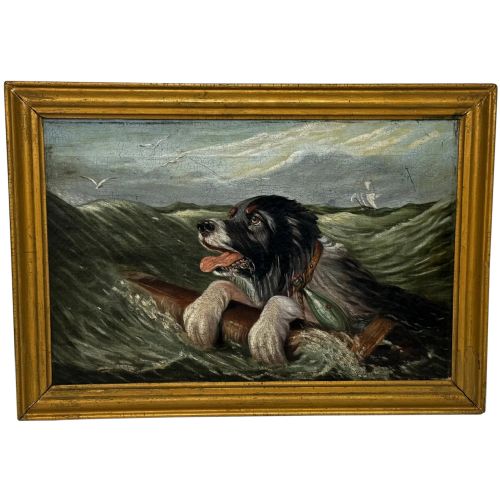
Isherwood Fine Art has dated this 19th Century Dog Portrait to the 19th Century.
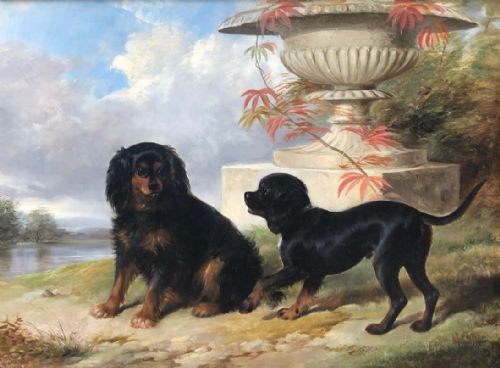
Provenance:
Paul Methuen, 1st Baron Methuen (1779-1849), Corsham. Wiltshire.
Sotheby's New York Master Paintings sale, May 26 2016, lot 77
Exhibited:
London, Royal Academy of Arts, 1849, no. 447, “Gipsy” and “Fairy”, favourite Spaniels, the property of Lord Methuen, 1st Baron Methuen.
He sat as a member for parliament for Wiltshire from 1812 to 1819 and for Wiltshire North from 1833 to 1837 and was appointed High Sheriff of Wiltshire in 1831.
The Methuen family were very fond of animals and 18th century visitors to Corsham Court would comment on the menagerie of dogs, parrots and other birds to be found there. Lord Methuen clearly inherited this love of animals and chose to celebrate and commemorate his beloved dogs through this delightful painting.
William Barraud (1810 – 1 October 1850) was an English animal painter and illustrator, and was the brother of Henry Barraud, with whom he collaborated on many works.
He was born in Lambeth in London, one of 17 children of William Francis Barraud (1783–1833), a clerk in the Custom House, and Sophia (née) Hull. The family was of French Huguenot origin that had come over to England at the time of the revocation of the Edict of Nantes. His younger brother Henry Barraud was also a notable artist, and another, Edward, although talented in art did not take it up as a profession.
On leaving school he is said to have become a clerk in the Custom House where his father worked (although there are no records of this), but eventually became a pupil of artist Abraham Cooper. As an animal artist he specialised in painting horses and dogs, exhibiting at the Royal Academy from 1829–50, the British Institution from 1828–49 and the Society of British Artists. His work was popular with huntsmen and dog owners. He also produced some historical and landscape paintings.
William shared a studio, from 1835 until his untimely death, with his brother Henry, and collaborated on many subject pictures with himself painting the animals and Henry the figures. Several of these joint works were exhibited at the Royal Academy. The brothers also produced a book together entitled "Sketches of Figures and Animals" (H. Graves and Co. c. 1850). William also collaborated on another book with fellow artist Thomas Fairland (1804–52), "The book of animals drawn from nature" (C. Tilt, 1846).
Literature:
Sir W. Gilbey, Animal Painters of England, London, 1900, I, p. 54.
Isherwood Fine Art has dated this 19th Century Dog Portrait to the 19th Century.
16th to 19th century old master, british and european paintings and sculpture, specialising in period portraiture. Member BADA, LAPADA.
You can view the stock and full dealer information on the Isherwood Fine Art Profile Page
Isherwood Fine Art is a registered member of LAPADA BADA

19th Century Portrait of Lord Methuen’s Favourite Dogs by William Barraud (1810-1850)