

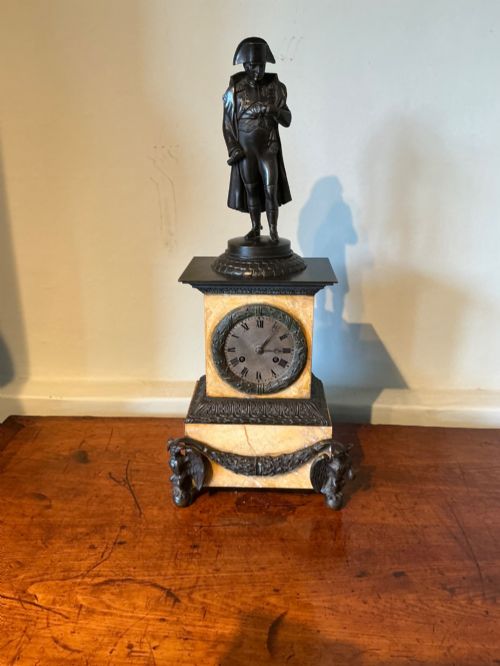


Yellow Marble Mantel Clock
These yellow marble mantel clocks combine rich sienna stone with bronze and ormolu, bringing warmth and weight to a room.
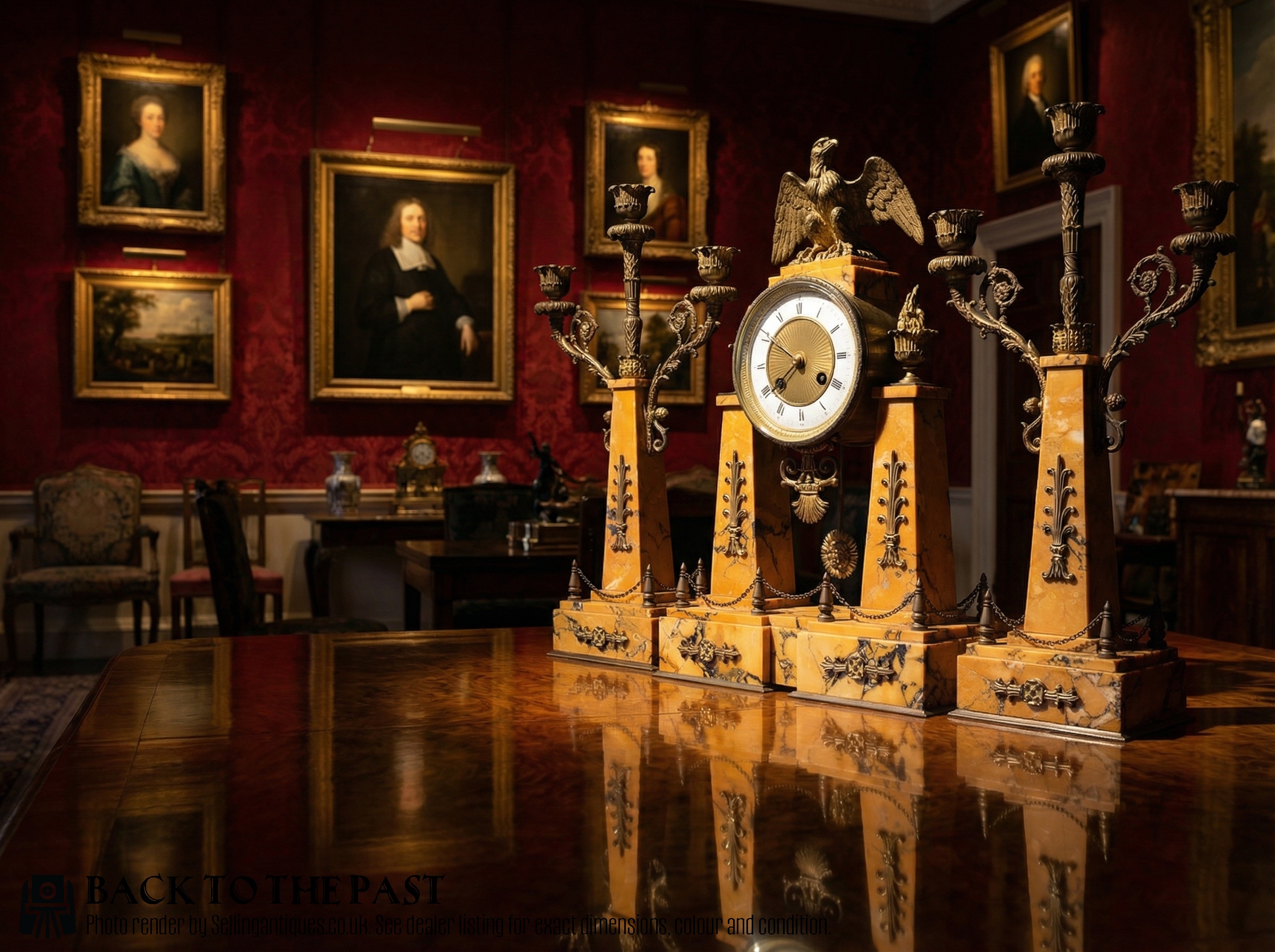
Yellow Marble Mantel Clock
A yellow marble mantel clock is a striking timekeeper primarily formed from sienna marble, often paired with patinated bronze, gilt ormolu, or brass details. These pieces originate from periods spanning the eighteenth, nineteenth, and Victorian eras, reflecting classical European design.
You are most likely to meet nineteenth-century examples and Victorian interpretations on this page, alongside French Empire and Napoleon III styles. Some pieces arrive as part of a clock garniture, accompanied by matching side ornaments.
The architectural shapes range from simple geometric blocks housing enamel dials to elaborate figural compositions featuring military figures, horses, or cherubs. Each object serves both a functional timekeeping role and a decorative purpose on a fireplace mantel.
Materials and construction
The primary body is carved from sienna marble, prized for its deep golden-yellow tones and dark veining, then polished to a smooth finish. This stone is regularly combined with cast bronze and gilt ormolu mounts, showing detailed chasing and patination.
Interior mechanical components typically utilise brass and steel movements, sometimes featuring fusee mechanisms, protected behind glass faces and white enamel dials. Artisans assembled these weighty structures by bolting stone sections together and mounting cast metal ornamentation securely to the exterior.
Napoleon Bonaparte sometimes makes an appearance standing steadfastly atop the marble, overseeing the ticking hours.
Judging quality
Quality rests upon the crispness of the bronze or ormolu casting and the depth of colour within the sienna marble. Finer examples display sharp chasing on figural elements like horses, cherubs, or classical figures, whereas lesser pieces show softer, shallower detailing in the metalwork.
The integration between the stone body and the metal mounts indicates the standard of workshop production. Well-made clocks feature precisely fitted brass bezels, clean enamel dials, and substantial marble slabs free of crude repairs.
Henry Berkeley Square London·Gillion
The Yellow Marble Mantel Clock Glossary
- Sienna marble
- A richly coloured ornamental limestone featuring golden-yellow ground and dark branching veins. It originates primarily from quarries in Italy and forms the main body of these clocks.
- Ormolu
- Finely chopped gold leaf amalgamated with mercury and applied to a bronze base through heat. This technique creates a durable, golden surface finish seen on many period mounts.
- Garniture
- A set consisting of a central clock flanked by matching decorative objects such as urns or vases. These matching sets were designed to display together on a mantelpiece.
- Fusee
- A conical pulley connected to the mainspring by a cord or chain, designed to equalise the driving force as the spring unwinds. This mechanism improves timekeeping accuracy in better quality clocks.
- Enamel dial
- A metal face coated with fused glass powder and fired in a kiln to produce a smooth, white surface. Numerals are typically painted onto this vitrified layer.
Yellow Marble Mantel Clock: Frequently Asked Questions
Where should I place a yellow marble mantel clock?
These heavy stone clocks suit sturdy mantelpieces, large sideboards, or deep console tables where their weight and presence anchor the room.
Ensure the surface is level and capable of supporting the combined weight of marble and metal components.
How do I wind a period mantel clock?
Most mechanical movements require a key inserted into winding holes on the enamel dial to tension the spring inside. Turn the key gently until you feel resistance, avoiding overwinding.
Consult the specific movement type, as fusee and spring-driven clocks have different power reserves.
What is a clock garniture set?
A garniture comprises a central mantel clock accompanied by matching side ornaments, such as decorative vases or candelabra. These matched pieces create a balanced decorative display across a mantel.
They share the same materials, such as sienna marble and ormolu, tying the decorative scheme together.
How do I distinguish French Empire style from Victorian?
French Empire and Napoleon III pieces often lean heavily into classical motifs, military figures, and rich gilt bronze mounts applied to sienna marble. Victorian iterations frequently adapt these classical European designs for British domestic interiors.
Examining the dial signatures, casting techniques, and overall proportion helps clarify the origin and period.