
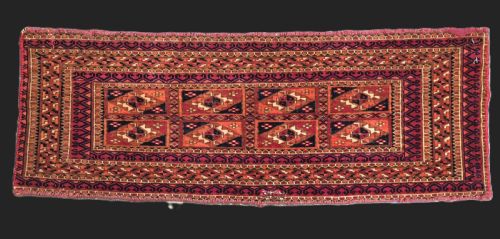
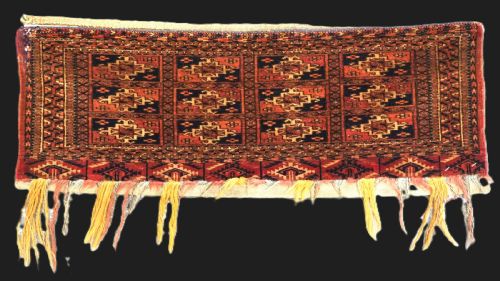


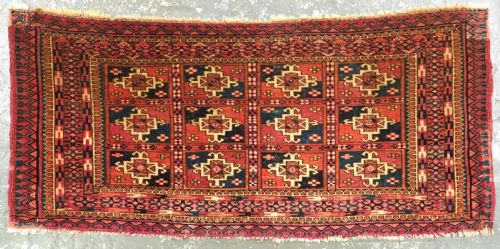

Woven Wool Mafrash
These woven wool mafrash are traditional tribal storage bags brought down from nineteenth and early twentieth century tents.
Woven Wool Mafrash
A woven wool mafrash is a heavy utilitarian container made by nomadic and tribal groups across the Caucasus, Turkmenistan, and Central Asia for domestic storage inside tents.
Buyers will encounter complete storage bags alongside flat panels, complete faces, and torbas created by Tekke, Yomut, Ersari, and Shahsavan makers.
The surviving pieces date from the nineteenth century into the early twentieth century, showing banded flatweave designs, soumak weave, and tree motifs.
How they were made
The makers utilised hand-spun wool, cotton, and linen, building structure with flatweave, soumak, and pile techniques.
Natural and vegetable dyes provided the deep colour palettes seen across Caucasian and Turkmen tribal weaving.
Object types include textile art, kilim rugs, storage bags, and individual panels originating from Caucasian and Turkmen tribal groups.
What varies in quality
Quality rests in the crispness of tribal motifs such as the aina gul or bird and dragon patterns, and the survival of complete backs and original panels.
The handle of the hand-spun wool and the saturation of the natural and vegetable dyes dictate the visual weight of each surviving textile.
The Woven Wool Mafrash Glossary
- Mafrash
- A large rectangular storage bag made by nomadic tribes to bedding and household belongings in transit. These containers were constructed with flatweave or soumak techniques.
- Torba
- A smaller storage bag hung on the tent wall rather than loaded onto pack animals. They share design elements and wool construction with larger mafrash panels.
- Soumak
- A brocade-like weaving technique where pattern wefts wrap around the warp threads before passing back. This method creates a textured surface distinct from standard flatweave.
- Flatweave
- A textile produced without pile by interlacing warp and weft threads directly on a ground loom. Banded flatweave designs are common in Yomut examples.
- Aina gul
- A primary Turkmen design motif featuring mirror or cruciform elements repeated across the field. Tekke weavers utilised this motif on torbas and bag faces.
Woven Wool Mafrash: Frequently Asked Questions
What is a mafrash used for?
These rectangular containers served nomadic families as sturdy receptacles for bedding, carpets, and personal belongings inside tents.
Today, collectors use complete bags and panels as decorative wall hangings or flat textiles within modern interiors.
How do I tell Tekke from Shahsavan pieces?
Tekke pieces often display distinct gul motifs like the aina gul on finely knotted or woven wool surfaces.
Shahsavan weaving typically relies on soumak technique and incorporates bold bird and dragon designs or geometric panel layouts.
Are these pieces complete bags?
Some survivals retain their original plain weave backs and structural sides, forming complete storage containers.
Other examples appear as single bag faces or isolated panels separated from the original carcass over time.
What materials make up these textiles?
Nomadic weavers built these bags using hand-spun wool alongside cotton and linen for structural reinforcement.
Natural and vegetable dyes supplied the characteristic colouration across nineteenth century examples.
How do I care for a tribal bag?
Keep textiles away from direct sunlight to protect the natural and vegetable dyes from fading.
Gentle vacuuming through a mesh screen helps remove dust without disturbing the hand-spun wool fibres.