


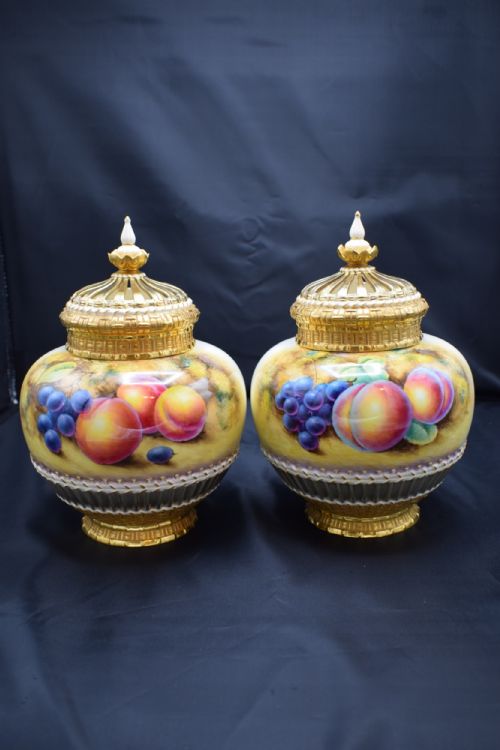


Worcester Painted Fruit Vase
These pieces of worcester painted fruit vase bring together fine porcelain, rich gilding and careful hand painting in traditional English forms.
Worcester Painted Fruit Vase
When searching for a worcester painted fruit vase, buyers encounter porcelain vessels decorated with naturalistic fruit studies, ranging from standard vases to pot pourri jars, ewers and ginger jars. The pieces span periods from the Victorian era through the Edwardian years and into the twentieth century.
The most common forms on this page include covered pot pourri urns, spill vases and two handled vessels bearing the mark of Royal Worcester. These items reflect traditional English porcelain design styles that prioritise botanical detail and heavy gilding over plain surfaces.
How they were made
The construction relies upon fine bone china and standard porcelain bodies moulded into classic vessel shapes such as urns, ginger jars and spill vases. Potters shaped the clay before workers applied an enamel ground suitable for detailed brushwork.
Artisans painted the fruit subjects by hand, adding gold leaf and heavy gilding to borders, handles and covers. Firing fixed the enamels and the gilt details to the porcelain surface.
Some pot pourri jars feature tiny pierced holes on their inner lids that resemble miniature lace patterns.
What varies in quality
Quality depends upon the skill of the painter, with named artists commanding attention through the delicacy and depth of their fruit studies. Pieces signed by known hands display superior brushwork on the porcelain.
The application of gilding and the weight of the porcelain body also distinguish finer examples. Elaborate forms like covered pot pourri jars with crown tops show greater modelling skill than simple spill vases.
Royal Worcester
The Worcester Painted Fruit Vase Glossary
- Porcelain
- A white vitrified ceramic material made from china clay and china stone. It provides a smooth surface for detailed enamel painting.
- Bone China
- A type of porcelain containing animal bone ash for strength and translucency. It forms the base of many fine English vessels.
- Gilding
- The application of gold leaf or gold paint to ceramic surfaces. It highlights handles, rims and covers on traditional vases.
- Pot Pourri
- A vessel with a pierced or perforated cover designed to hold dried scented plant material. These containers often feature painted fruit decoration.
- Enamel
- A glass based decorative coating fused to the porcelain body through firing. Painters use enamel colours to render fruit and foliage.
Worcester Painted Fruit Vase: Frequently Asked Questions
What periods do these pieces date from?
The pieces span from the Victorian era and the Edwardian period through to various decades of the twentieth century, including the nineteen fifties and sixties.
Specific dates on individual pieces reflect the manufacturing eras recorded in the maker marks and signatures.
How were pot pourri vases used?
Pot pourri vases held dried scented herbs and petals inside rooms to freshen the air. The pierced covers allowed the fragrance to diffuse while keeping the contents contained.
Many examples include an inner lid beneath the decorative outer cover to control the scent release.
How do I identify a signed piece?
Artists painted their names directly onto the surface of the porcelain near the base of the fruit study. Common signatures on these vessels include Chivers, Ayrton, Ricketts and Blake.
Finding a signature indicates an individual hand decorated that specific porcelain blank.
How should I display them at home?
These vessels suit placement on mantelpieces, cabinets or side tables where adequate light highlights the gilding and painted fruit details. Keep them away from direct sunlight to protect the enamel colours.
Pair matching spill vases or urns symmetrically to balance traditional interior spaces.