


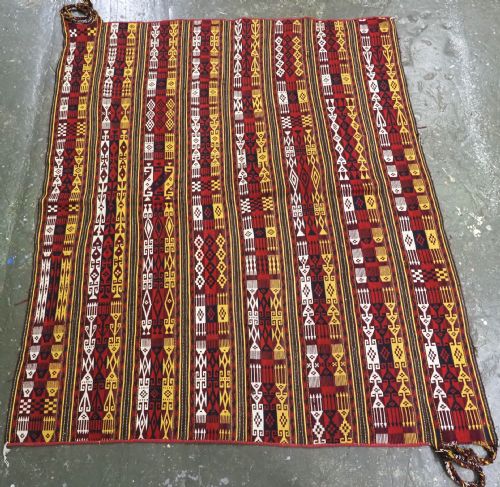


Wool Uzbek Flatweave
These wool uzbek flatweave textiles bring bold Central Asian tribal geometry and rich natural dyes directly into modern interiors.
Wool Uzbek Flatweave
A wool uzbek flatweave represents the woven heritage of nomadic and village communities across Central Asia, encompassing kilim rugs, runner rugs, and textile panels. These pieces include specific regional varieties such as Gajeri, Kungrad, and Tartari pieces, often structured as single panels or multiple strips joined together. Buyers seek out these items for their graphic layouts, repeat patterns, and historical character.
The selection here centres on pieces originating between the late nineteenth century and the early twentieth century, spanning dates from eighteen ninety to nineteen twenty. Formats range from large kilim rugs and wall hangings down to smaller saddlebag faces and tent bands. Central Asian tribal styles dominate the selection, showing distinct regional weaves and cultural motifs.
What varies in quality
Quality in a wool uzbek flatweave rests upon the precision of the tribal geometry, the complexity of the banded or repeat design, and the visual balance of the natural dyes. Pieces exhibiting particularly bold graphic layouts or unusual compositional structures stand apart from standard geometric repeats.
The structural integrity of the strip assembly also influences the character of the piece, whether it is a small item adapted from a tent band or a multi-strip cover. Furthermore, the clarity of secondary elements, such as embroidered details or camel hair grounds, adds depth to the overall textile.
Several compact pieces began life as utilitarian saddlebag faces and tent bands before finding new life as decorative wall panels.
The Wool Uzbek Flatweave Glossary
- Kilim rug
- A flatwoven textile produced without a pile, common throughout Central Asia and often featuring geometric tribal motifs.
- Gajeri kilim
- A specific regional variety of Uzbek flatweave known for fine banded designs and striking graphic patterns.
- Kungrad region
- An Uzbek district associated with distinct multi-strip kilim panels and covers woven in native workshops.
- Torba ilgich
- A hanging bag or trapping originating from Lakai Uzbek tribes in locations like Shakrisabz.
- Camel hair ground
- A natural, un-dyed background material utilising camel fleece to provide a soft, warm neutral tone beneath the woven design.
Wool Uzbek Flatweave: Frequently Asked Questions
How do I clean an antique flatweave?
Gentle surface cleaning and professional textile care preserve the natural wool fibres and vegetable dyes found in these Central Asian pieces.
Avoid harsh chemical detergents or immersion washing unless handled by a specialist familiar with antique tribal flatweaves.
Can I hang these textiles on a wall?
Many smaller panels, torba ilgich pieces, and narrow kilims function well as wall hangings due to their lighter flatwoven structure.
Using a fabric sleeve or non-damaging mounting method distributes the weight evenly across the upper edge of the textile.
What is a multi-strip kilim?
Weavers often produced wider floor coverings and covers by creating several narrow vertical strips and stitching them firmly together.
This construction method reflects traditional nomadic loom widths and results in distinctive linear patterns across the surface.
How are different regional styles identified?
Makers in areas such as the Kungrad region or specific tribal groups like the Lakai utilised distinct colour palettes, strip counts, and geometric arrangements.
Comparing the border work, weft techniques, and dyestuffs helps reveal the geographic origin of each piece.