
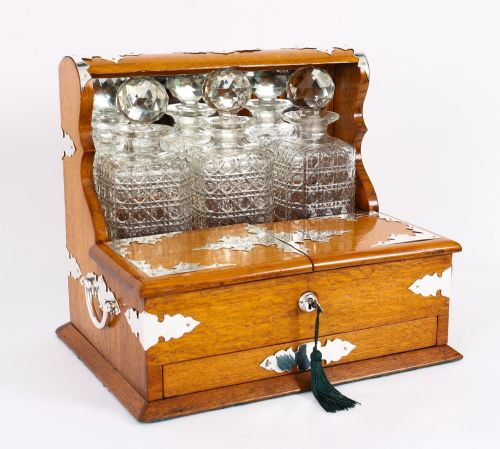
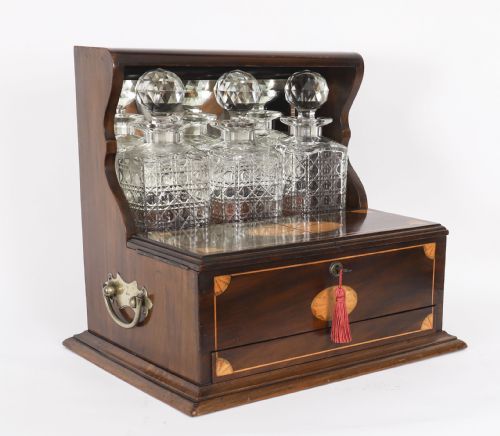
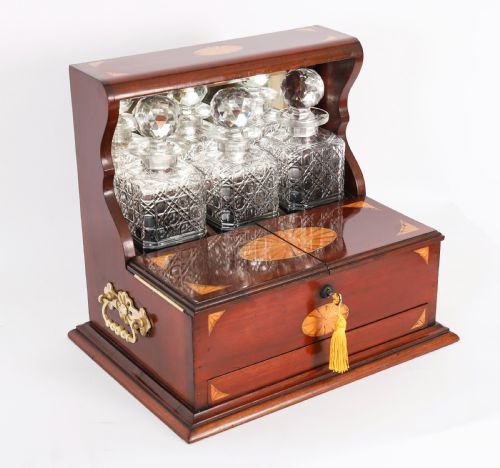


Wooden Tantalus Box
These wooden tantalus box pieces combine secure spirit storage with handsome domestic display, holding decanters firmly under lock and key.
Wooden Tantalus Box
A wooden tantalus box secures decanters of spirits behind a locking mechanism that frustrates thirsty guests while displaying the cut crystal within. These pieces emerge chiefly from the Victorian and Edwardian eras, spanning the late nineteenth and early twentieth centuries alongside earlier Georgian and Regency antecedents.
The dominant forms on this page include combined dry bars, games compendiums, and simple two or three bottle liquor cabinets. Oak and mahogany serve as the primary structural woods, often inlaid or brass-mounted for formal entertaining spaces.
Assessing quality
Quality rests upon the complexity of the internal fittings and the integration of secondary functions like games compendiums or humidors. Pieces featuring multiple compartments, complete sets of cut crystal decanters, and robust brass locking mechanisms stand apart from simpler single-bottle holders.
The choice of timber and precision of inlay work dictate the refinement of the piece. Golden oak, pollard oak, and satinwood veneer demand greater cabinetmaking skill than standard plain hardwoods.
Some nineteenth-century hosts hid their cards right beneath the whisky so guests had to negotiate both vices at once.
The Wooden Tantalus Box Glossary
- Tantalus
- A locking device holding decanters upright without allowing the stoppers to be removed until the mechanism is released with a key. Named after the mythological figure who could see food and water just out of reach.
- Cut Crystal
- Heavy glass decorated by cutting geometric patterns into the surface, which refracts light through the stored liquor. It provides the sparkling contents typically housed within these cabinets.
- Marquetry
- The art of applying decorative veneer pieces to a structure to form intricate patterns or pictures. Craftsmen utilise contrasting timbers like satinwood and mahogany for this detailing.
- Games Compendium
- A fitted box containing equipment for multiple board or card games alongside the main liquor storage. These multifunction units reflect nineteenth-century desires for compact domestic entertainment.
- Liquor Cave
- A French term for a fitted liqueur chest holding glassware and bottles, similar in function to the English tantalus. Examples often display Napoleon III styling and distinct internal framing.
Wooden Tantalus Box: Frequently Asked Questions
How does a wooden tantalus lock work?
A metal bar secures the stoppers of the decanters in place, preventing them from being lifted out of their fitted base. Turning a key in the lock allows the bar to slide or lift clear.
This clever mechanism permitted hosts to control access to expensive spirits while leaving the bottles visible on the sideboard.
What periods do these boxes come from?
Most examples date from the Victorian and Edwardian periods, running from the late nineteenth century into the early twentieth century. Earlier Georgian and Regency decanter boxes also appear.
Craftsmanship shifted from early plain mahogany box designs towards elaborate oak combination bar and games compendiums by the eighteen eighties.
Are keys usually included with them?
Many surviving pieces retain their original working locks and keys, though some rely on replacement keys or remain unlocked. The presence of functional brass locking hardware adds historical completeness.
Collectors often value the retention of the original mechanism even if the key is a later replacement.
Can I use the decanters daily?
The cut crystal and glass decanters are suitable for holding spirits during gatherings, provided they receive careful hand washing. Checking the internal seals and stoppers ensures safe storage for liquids.
Many buyers incorporate these items into modern dining rooms as functional barware rather than static display objects.