


Wooden Rolltop Bureau
A wooden rolltop bureau offers clever slatted containment for your papers, combining a secure writing desk with an elegant cabinet.
Wooden Rolltop Bureau
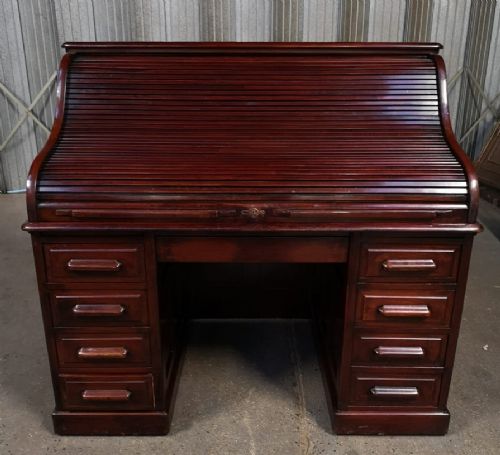
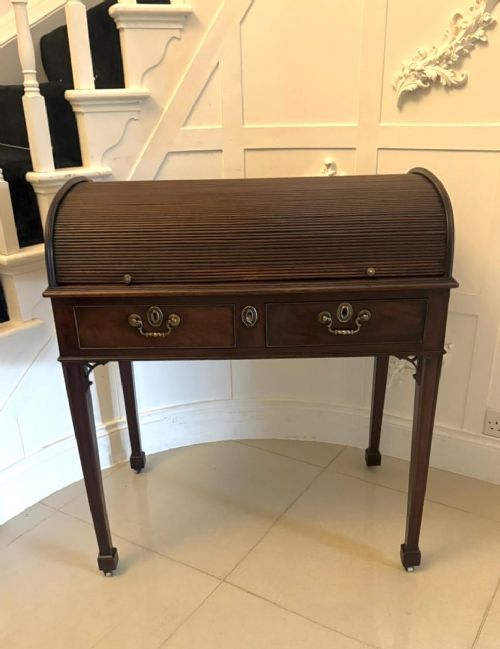
When you search for a wooden rolltop bureau, you are looking at practical writing furniture designed to conceal paperwork beneath a slatted or cylindrical cover. These pieces range from compact Edwardian and late Victorian variations to earlier Georgian forms that feature sophisticated tambour mechanisms.
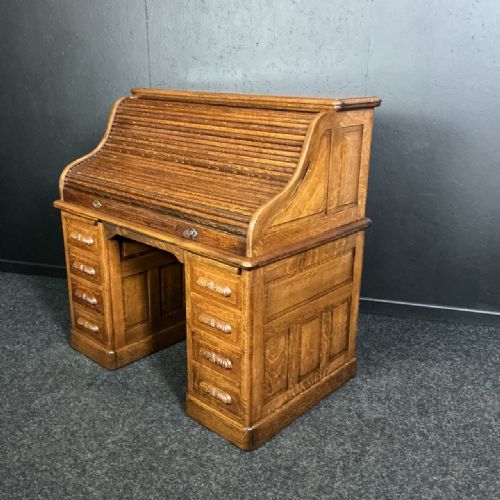
The desks and bureaux on this page span the Georgian, Victorian, and Edwardian eras, alongside pieces dated around 1800, 1860, 1900, and 1910. You will frequently encounter pedestal formats in oak or mahogany, as well as more decorative cylinder desks equipped with pull-out writing slides.
Originating as workspaces for the busy study or office, these items prioritize functional pigeonholes and drawers behind a sliding screen. Whether rendered in solid oak, figured mahogany, or Dutch marquetry, each piece balances utility with traditional cabinetry.
Materials and construction
Cabinetmakers constructed these desks primarily from hardwoods such as mahogany and oak, frequently incorporating satinwood and walnut for contrast and visual depth. Fine examples display delicate boxwood inlay, while brass hardware provides functional pulls and key escutcheons.
The defining mechanical feature involves individual wooden slats glued to a canvas backing, allowing the tambour or rolltop to glide smoothly around a curved track. Pedestal configurations and cylinder fronts demand precise joinery to ensure the writing slides and internal drawers operate without binding.
Listings feature woods such as mahogany, oak, walnut, satinwood, and boxwood inlay across Georgian, Victorian, and Edwardian periods.
Assessing quality and execution
The distinction between standard commercial office furniture and superior domestic cabinetry rests in the selection of timber figures and the precision of the tambour mechanism. Finer pieces employ richly grained mahogany or figured oak, whereas simpler utility desks utilise plain timber.
Internal arrangement further separates grades of execution, with better examples offering fitted pigeonholes, secret compartments, and finely dovetailed drawer construction. The smoothness of the rolling top and the integration of pull-out writing slides indicate the original maker's level of skill.
Wiggers
The Wooden Rolltop Bureau Glossary
- Tambour
- Flexible shutter formed of narrow strips of wood glued to canvas, allowing it to slide around a curved track to conceal the desk interior.
- Cylinder desk
- Writing table featuring a quarter-cylinder or half-cylinder solid wooden lid that rolls back to reveal the writing surface.
- Pedestal desk
- Heavy freestanding desk comprising two supporting banks of drawers with a central opening for the user.
- Marquetry
- Decorative veneer technique arranging pieces of variously coloured wood to form intricate pictorial or geometric patterns.
- Boxwood inlay
- Contrasting pale wood inserted into recesses of a darker ground timber to create sharp linear borders.
Wooden Rolltop Bureau: Frequently Asked Questions
What is a wooden rolltop bureau?
A wooden rolltop bureau is a traditional writing desk enclosed by a slatted or cylindrical sliding cover that conceals the work surface and pigeonholes.
These pieces were designed to keep ongoing paperwork private and secure without the need to lock away every individual drawer.
How do I date a rolltop desk?
Dating relies on timber choices, construction methods, and stylistic cues ranging from Georgian proportions to Edwardian mass production.
Earlier examples from the Georgian period often use lighter tambour mechanisms and refined mahogany, while Edwardian desks frequently present heavier solid oak construction.
Are cylinder desks the same as rolltops?
Cylinder desks utilise a solid curved wooden lid that rotates on a pivot, whereas rolltop desks use multiple small wooden slats on a fabric backing.
Both serve the same purpose of concealing the desk interior, but the cylinder top represents a more solid, unified piece of cabinetwork.
How should I care for the tambour top?
The slatted tambour mechanism relies on clean running tracks and conditioned wood to slide smoothly without catching on the canvas backing.
Applying a gentle furniture wax and maintaining stable room humidity prevents the wooden slats from warping or binding within their grooves.