
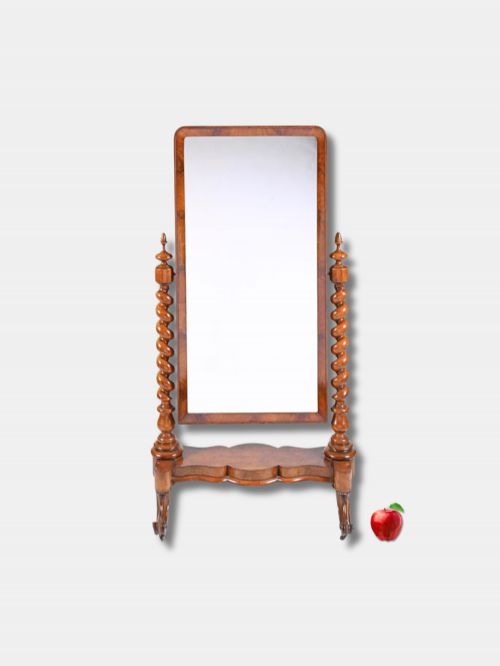
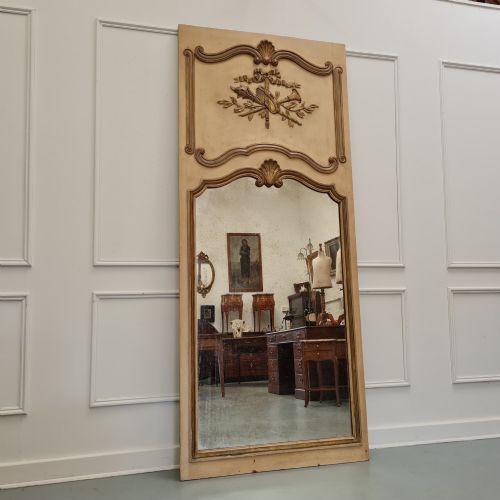


Wooden Floor Standing Mirror
A wooden floor standing mirror offers the practicality of full-length reflection packaged in timber frames that anchor a room.
Wooden Floor Standing Mirror
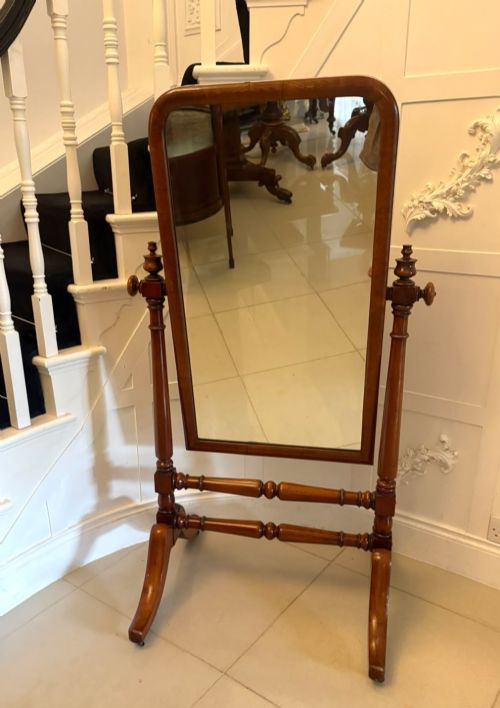
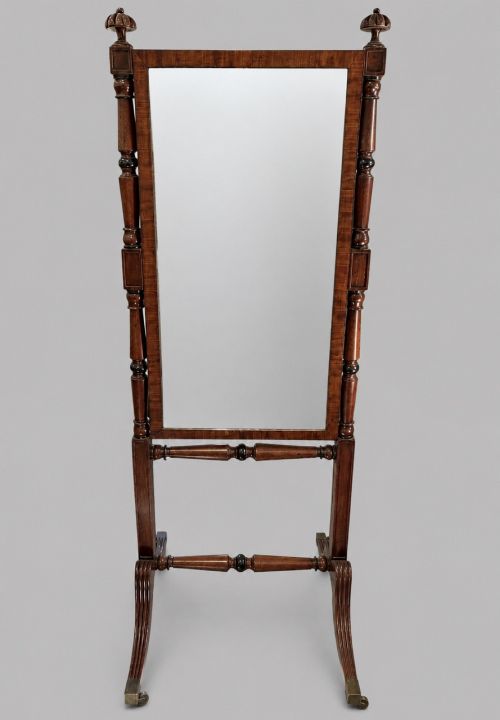
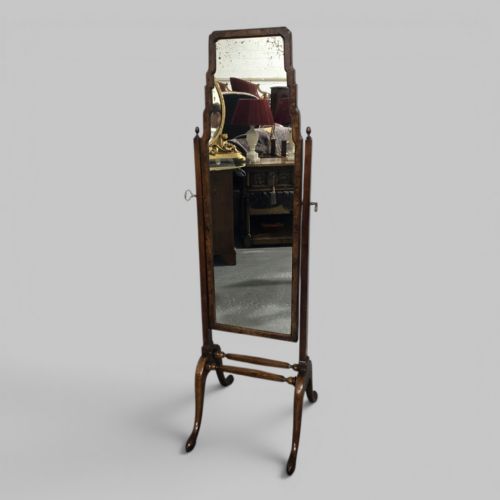
When you search for a wooden floor standing mirror, you encounter tall pivoting frames designed for dressing and grooming. The most common forms on this page are cheval mirrors and floor mirrors dating from the Victorian and Georgian periods up to the twentieth century.
These pieces typically stand on four legs or sturdy trestle supports, allowing the glass to tilt at various angles. Alongside traditional cheval mirrors, the selection includes shaving stands with adjustable glasses and specialised floor-standing dressing mirrors.
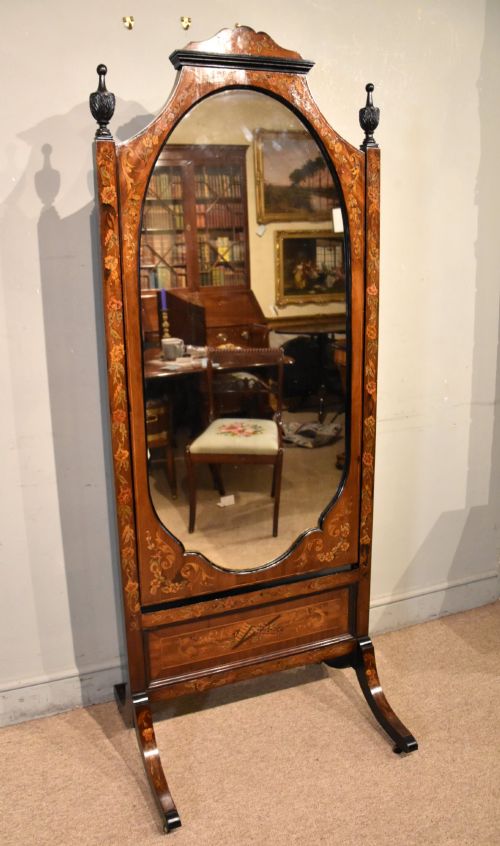
Origins range from English workshops utilising native timbers to continental revival styles influenced by French designs. Mahogany and walnut dominate the selection, often enriched with marquetry inlay or carved details.
How they were made
Cabinetmakers constructed these frames using dense hardwoods like mahogany and walnut, frequently selecting figured veneers for visual depth. Structural stability relied on precise joinery within the upright supports and the trestle bases.
The mirror glass itself was set into pivoting frames using brass pivots or pins that permitted smooth tilting. Decorative flourishes included gesso ornamentation, marquetry inlay, and hand-carved motifs reflecting prevailing styles from Regency to Art Deco.
One listed dressing glass originates directly from a gents outfitters, having spent its earlier career helping gentlemen select their daily attire.
What varies in quality
The distinction between ordinary and exceptional examples lies in the timber selection and the crispness of the carving. Superior pieces employ heavily figured burr walnut or dense mahogany with meticulous grain matching across the frame.
Engineering of the pivot mechanism also separates grades, with finer mirrors utilising substantial brass hardware that securely holds the glass at any angle without slipping. Secondary woods and the neatness of the backboards further indicate the maker's attention to detail.
The Wooden Floor Standing Mirror Glossary
- Cheval mirror
- A freestanding full-length mirror suspended on vertical pivots within a frame. This design allows the glass to swing freely to adjust the viewing angle.
- Barley twist
- A turning technique where the timber is shaped into a spiral resembling a twisted rope. This decorative feature appears frequently on Victorian supports.
- Marquetry inlay
- A technique of embedding thin slices of wood veneer into a solid timber background to form geometric or pictorial patterns. It adds surface decoration to the frame.
- Trumeau mirror
- A tall wall mirror designed to fit a specific architectural space, often incorporating a painted panel or carved artwork above the glass.
- Gesso
- A plaster-based mixture applied to wood surfaces as a smooth base for gilding or painting. It allows intricate relief ornamentation on the frame.
Wooden Floor Standing Mirror: Frequently Asked Questions
What is a cheval mirror?
A cheval mirror is a tall plate of glass set within a frame that pivots vertically on floor-standing supports.
This design allows the user to tilt the glass to check an entire outfit from head to toe.
How do I place one in a room?
These mirrors function best against a sturdy wall or near a window where natural light reflects into the space.
Because they occupy floor space and pivot forward, ensure adequate clearance around the base for safe movement.
How do I date a wooden mirror?
Dating relies on timber choices, construction methods, and stylistic cues such as turned supports or carved crestings.
Victorian pieces often feature heavy mahogany with barley twist columns, while Georgian examples display refined proportions and simpler framing.
Can the mirror glass be replaced?
Original mirror glass often shows foxing and silver loss, which many collectors prize as a sign of age.
If replacement is necessary, traditional mirror glass can be fitted into the existing rebate without altering the structural timber.