












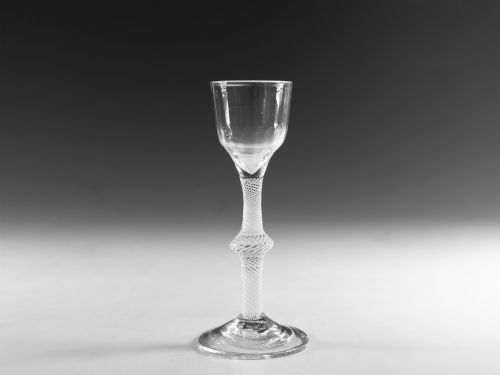
White Twist Stem
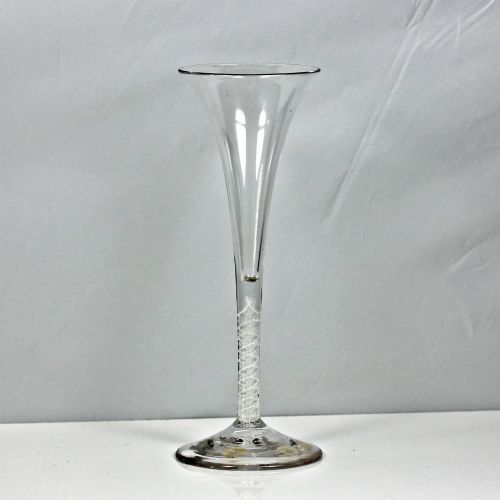
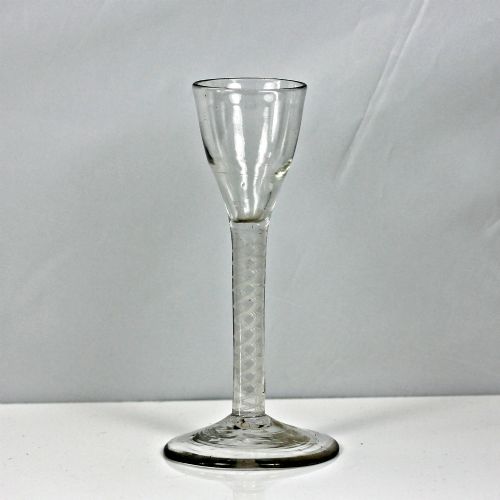
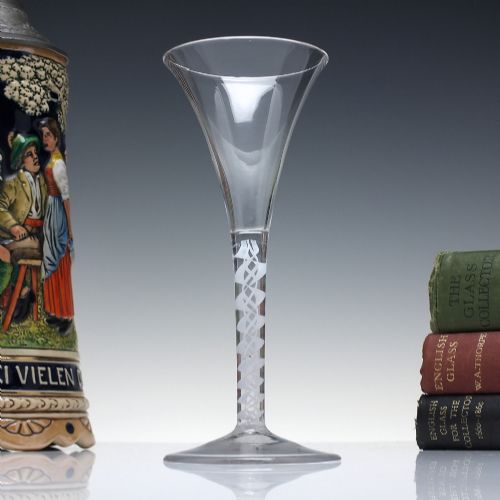
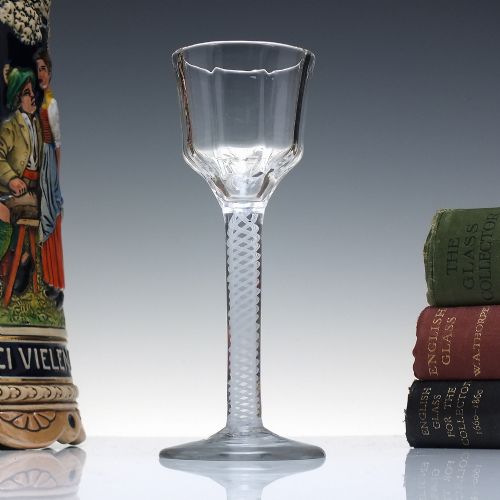
White twist stem pieces are largely Georgian drinking glasses holding bright white enamel threads inside clear lead glass.
White Twist Stem
When you examine a white twist stem, you are looking at drinking vessels predominantly from the 18th Century and the Georgian period. The form appears primarily as wine glasses, ale glasses, and cordial glasses featuring distinct optical threads through the stem.
The version you are most likely to meet on this page is the Georgian wine glass with an ogee, trumpet, or rounded funnel bowl. These pieces span single series and double series opaque twist configurations alongside occasional table lamps from later decades.
How they were made
The manufacture relies on lead glass, lead crystal, and flint glass combined with white enamel to form the internal threads. Makers manipulated opaque enamel canes within molten metal, drawing and twisting the glass to create single or multi-spiral patterns inside the stem.
Bowls were often blown separately and joined to the stem before finishing with a conical foot. Some examples incorporate flute-moulded ogee bowls or engraved surface decoration alongside the twisted interior.
White Twist Stem Retail Price Guide 2026
Typical asking prices for white twist stem among the pieces listed under this phrase on Sellingantiques today, from the lower quarter to the upper quarter. They describe what is for sale here now, not the wider market.
Early glassmakers occasionally hid secret political toasts inside engraved ale glasses to outwit suspicious authorities during Georgian times.
What varies in quality
Quality rests in the crispness and complexity of the internal glass threads and the symmetry of the stem twist. Single series spirals contrast with intricate double series and triple twist formations that demand greater skill from the glassmaker.
The proportion of the bowl to the stem and foot dictates the visual balance of the piece. Superior examples also show refined engraving on the bowl, such as hop and barley motifs or historical emblems, executed with clean incisions.
The White Twist Stem Glossary
- Opaque twist
- A white enamel thread or ribbon enclosed within the transparent glass stem. This technique replaced earlier air twist stems in the mid-18th Century.
- Double series
- A stem containing two distinct sets of opaque white twists, often combining an outer gauze with an inner core of threads.
- Ogee bowl
- A bell-shaped drinking vessel with an 'S' curve profile, curving out at the rim and in towards the base. This form is common among Georgian wine glasses.
- Ale glass
- A taller, narrower drinking vessel designed for malt beverages, frequently featuring engraved hop and barley motifs. They share the characteristic white twist stem.
- Knop
- A bulging, decorative swelling on the stem of a glass. Pieces may feature single, triple, or four knops along the white twist.
White Twist Stem: Frequently Asked Questions
Are white twist stem glasses safe for everyday use?
These 18th Century drinking vessels are delicate collector items rather than robust daily tableware. Hand washing in warm water preserves the antique lead glass and internal enamel.
Sudden temperature changes can crack the material, so hot liquids must be avoided entirely.
How do I date a white twist stem glass?
Dating relies on the bowl form, foot shape, and the manufacturing characteristics of the lead glass. Most opaque twist examples date from the Georgian era between 1750 and 1780.
Later lighting pieces using twist designs belong to the 1920 and 1930 periods rather than the 18th Century.
What is the difference between single and double series?
A single series twist contains one set of opaque white enamel threads rotating down the stem. A double series incorporates an additional internal element, such as a pair of spiral threads alongside an outer gauze.
Double series stems generally require more complex glassblowing skill.