
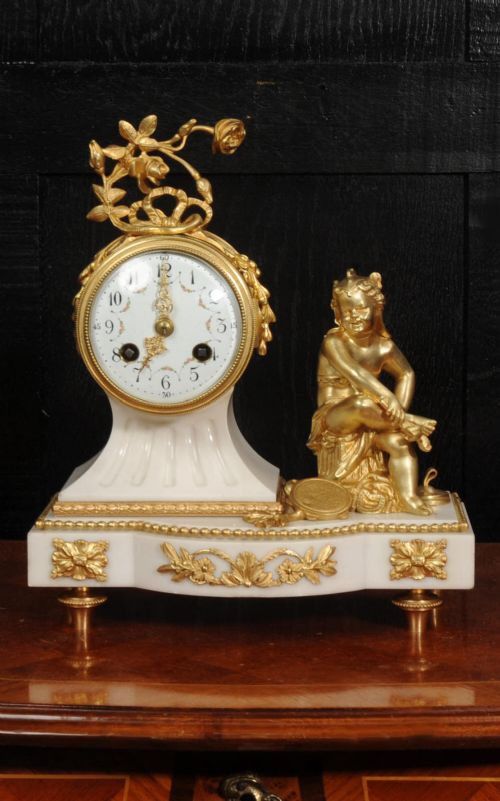


White Marble Desk Clock
White marble desk clock pieces combine solid stone architecture with precise mechanical movement, offering both functional timekeeping and classical presence for a mantel or bureau.
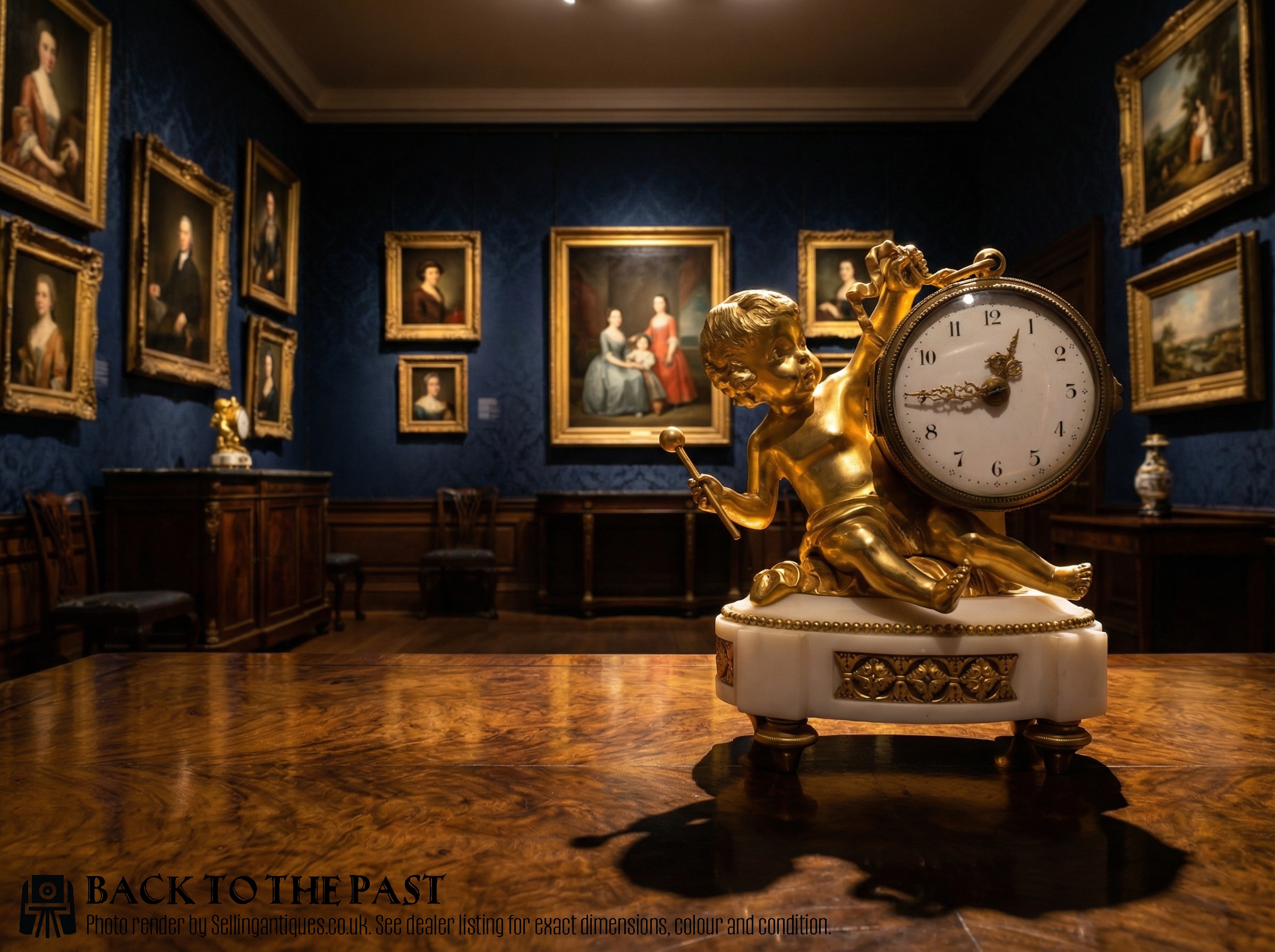
White Marble Desk Clock
A white marble desk clock typically presents a heavy stone body enriched with metallic mounts, appearing frequently across nineteenth-century Victorian and French production. These objects range from compact portico forms to large garnitures flanked by candelabras, integrating dense mineral substance with delicate metalwork.
Makers often drew upon Louis XVI or Empire styles, incorporating columned porticos, urn shapes, and figural globes into the design. The standard survivor on this page is a French mantel clock or desk clock combining white marble with gilt bronze or ormolu mounts.
Materials and construction methods
Craftsmen shaped dense white marble and alabaster into architectural blocks, urns, and porticos using stone-cutting tools before polishing the surfaces to a smooth finish. Enamel dials were hand-painted with roman or arabic numerals, then fitted behind protective glass bezels.
Foundries cast bronze and brass components into ornamental bezels, feet, and figural mounts, subsequently gilding them or finishing them with ormolu. Clockmakers housed eight-day movements and fusee mechanisms within these stone and metal housings to drive the hands.
Listings feature white marble alongside gilt bronze, ormolu, and alabaster, spanning the eighteenth through the early twentieth centuries.
Distinctions in craftsmanship and preservation
Quality rests heavily on the crispness of the cast bronze or ormolu mounts and the purity of the white marble block. Sharp, deeply chased gilt mounts demonstrate superior workshop standards compared to softer, more repetitive cast details.
The integrity of the dial enamel and the original balance between the stone body and metal fixtures determine the overall harmony of the piece. Clean integration of the movement within the marble chassis marks the upper tier of production.
Japy Freres·Louis Goret·Deniere and Cailleaux·Ferdinand Berthoud·F Marti·E White Of Manchester
The White Marble Desk Clock Glossary
- Ormolu
- Finely chopped gold applied to a bronze base through a mercury amalgamation process. This technique produces a rich golden lustre characteristic of better French clocks.
- Portico clock
- A timepiece suspended or housed within a architectural frame supported by four columns. This neoclassical form makes prominent use of marble and alabaster.
- Garniture
- A set comprising a central clock accompanied by matching decorative pieces such as candelabras or urns. These sets were designed to sit symmetrically on a mantelpiece.
- Fusee
- A conical pulley used in clock movements to maintain even force on the gear train as the mainspring unwinds. It represents a mark of mechanical refinement.
- Enamel dial
- A metal face fused with powdered glass melted at high temperatures to create a glossy white surface. Numerals are painted onto this durable ground.
White Marble Desk Clock: Frequently Asked Questions
How do I wind a white marble desk clock?
Most models utilise an eight-day mechanical movement requiring a key inserted into the dial holes to tension the mainspring.
Take care not to overwind the mechanism, stopping as soon as resistance is felt.
Where should I place a heavy marble clock?
Position the clock on a stable, level surface such as a heavy mantelpiece, desk, or sideboard capable of supporting substantial stone weight.
Ensure the surface is flat so the pendulum beats evenly and the clock keeps accurate time.
How do I tell a French clock from an English one?
French examples from this selection frequently combine white marble with gilt bronze or ormolu in Louis XVI or Empire styles, often made by documented Parisian firms.
English pieces in the listings tend to feature skeleton movements or distinct regional attribution, such as London or Manchester makers.
What is a clock garniture set?
A garniture consists of a central timepiece flanked by matching ornamental objects like a pair of candelabras or urns.
These sets were created to provide a balanced decorative display across a mantel or large piece of furniture.