


White Marble Clock Garniture
These white marble clock garniture sets bring neoclassical symmetry and gilded bronze detail to a mantelpiece.
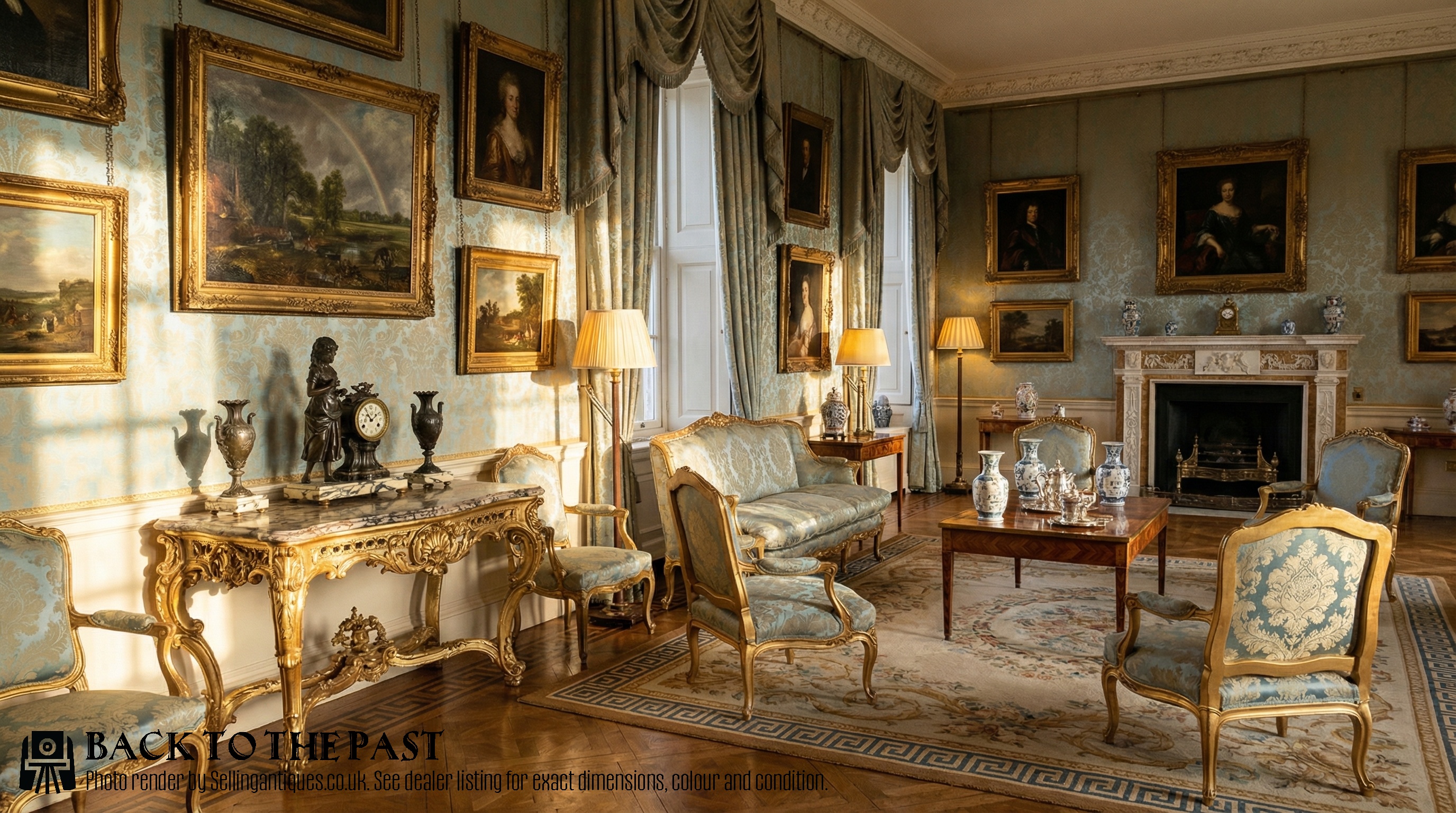
White Marble Clock Garniture
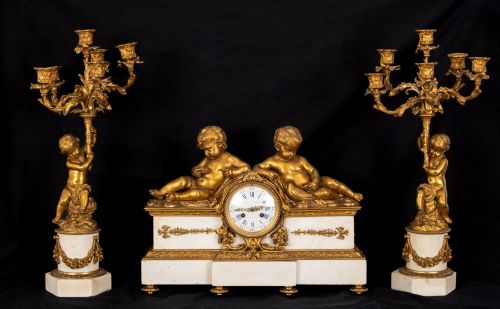
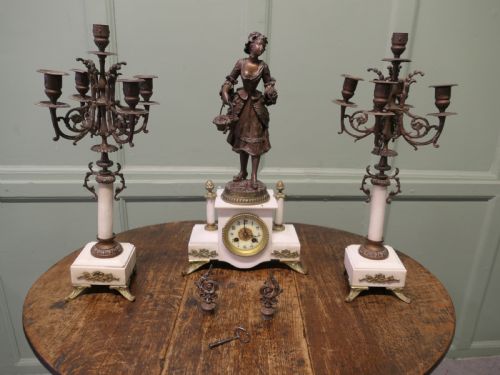
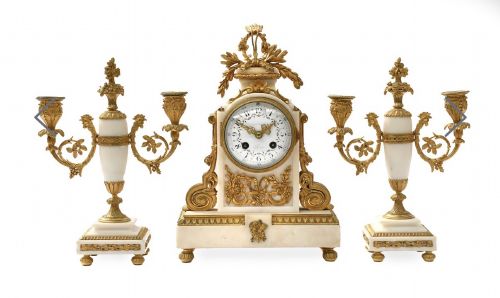
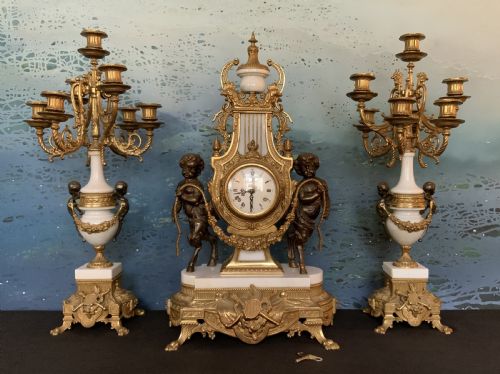
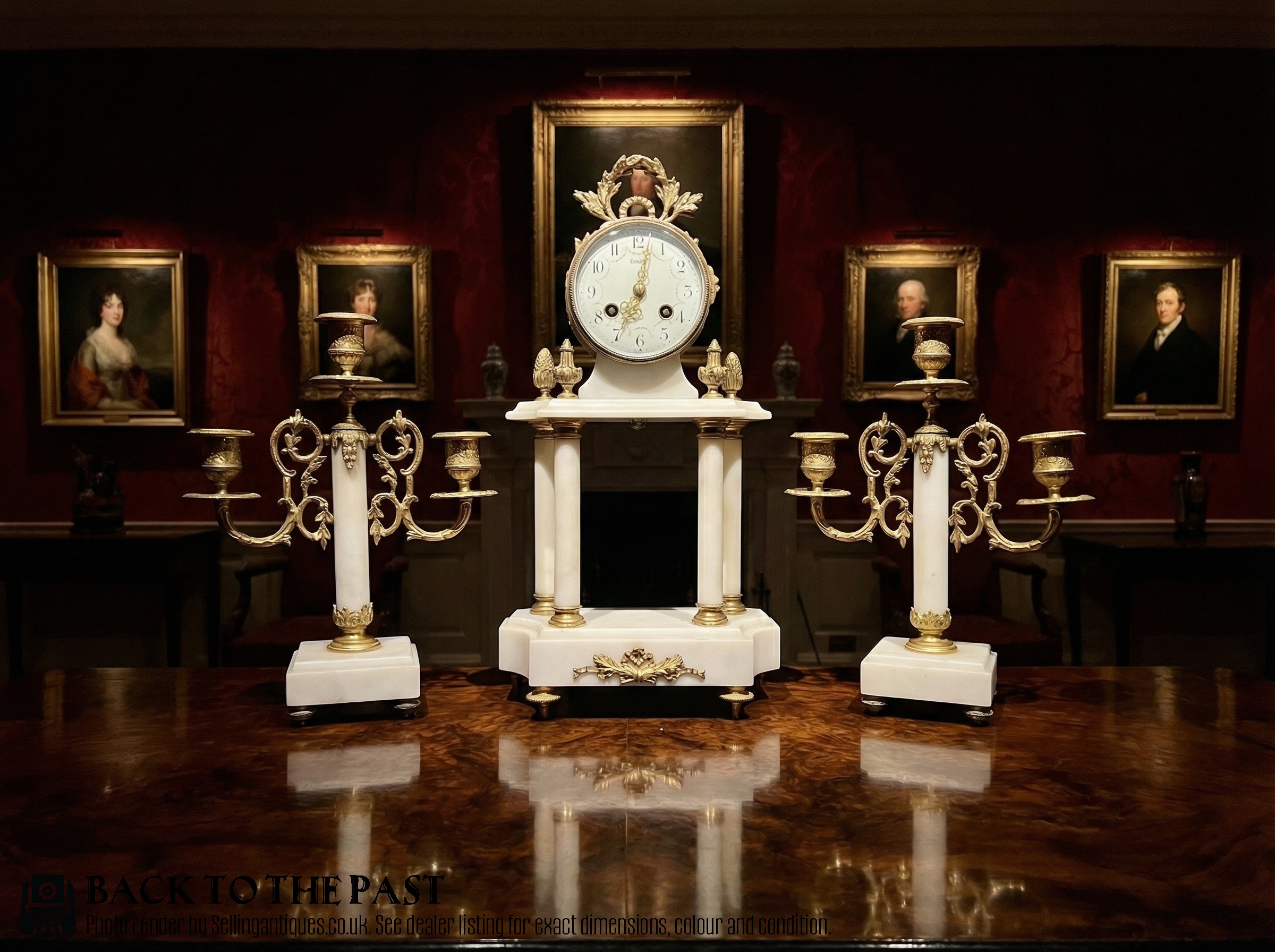
A white marble clock garniture consists of a central mantel clock accompanied by matching side pieces such as candelabras or urns, forming a balanced three-piece display. These sets date predominantly from the nineteenth century, reflecting nineteenth-century French and Victorian tastes for classical proportion and ornamental harmony.
The most common survival on this page is the French Louis XVI style or Louis XVI revival set, pairing white marble bodies with gilt bronze mounts and figural details like cherubs. Enamel dials and visible pendulums frequently feature in these domestic timepieces, which were designed to dominate a formal room.
Makers such as H Luppens Paris and AD Mougin Paris appear on these pieces, alongside works attributed to Ferdinand Berthoud. The forms range from grand architectural mantel clocks paired with tall candelabras down to petite proportions suited for smaller spaces.
Markers of quality
Quality rests in the crispness of the bronze chasing and the harmony between the white marble and the gilt metal mounts. Finer examples show deeply sculpted figural work, such as cherubs, and heavier, more substantial marble bases rather than sparse ornamentation.
Signed movements by known makers elevate a set, as does the completeness and matching patination of the accompanying candelabras or urns. The weight of the bronze and the precision of the enamel dial further separate standard production items from exceptional works.
Listings feature white marble and white veined marble bodies paired with gilt bronze, ormolu, and enamel dials across nineteenth-century styles.
H Luppens Paris·AD Mougin Paris·Ferdinand Berthoud
The White Marble Clock Garniture Glossary
- Garniture
- A set of matching ornamental objects designed to be displayed together on a mantelpiece or sideboard. Typically comprises a central clock flanked by two matching candelabras or urns.
- Ormolu
- Gilded bronze, where a gold amalgam is applied to a bronze base through a mercury-gilding process or electroplating. It provides a bright golden surface that highlights chased details.
- Louis XVI Style
- A neoclassical design aesthetic popular in France and later revived in the nineteenth century, characterised by straight lines, classical symmetry, and antique motifs.
- Candelabra
- A branched candlestick holder designed to hold multiple tapers, frequently included as the matching side pieces in a clock set.
- Visible Pendulum
- A clock design where the swinging pendulum can be seen through a glass panel on the dial or door, often featuring decorative brass bobs.
White Marble Clock Garniture: Frequently Asked Questions
What is a clock garniture?
A clock garniture is a matching three-piece set designed for a mantelpiece, consisting of a central clock and two matching side ornaments such as candelabras or urns.
These sets were created to provide visual symmetry and decorative balance in nineteenth-century formal interiors.
How do I style a garniture?
Place the central clock in the exact centre of a mantelpiece or console table, with the matching candelabras or urns arranged symmetrically on either side.
Ensure the surrounding surface is sturdy enough to support the combined weight of the marble and bronze components.
Are these clocks mechanical?
Yes, these are mechanical timepieces driven by springs and weights, featuring eight-day striking movements that require manual winding with a key.
Many examples include visible pendulums and enamel dials with Roman or Arabic numerals.
How do I identify Louis XVI style?
Louis XVI style is marked by classical restraint, straight architectural lines, and symmetrical motifs derived from ancient Greece and Rome.
In these pieces, the aesthetic appears through ormolu mounts, urn shapes, and balanced bronze ornamentation on white marble.